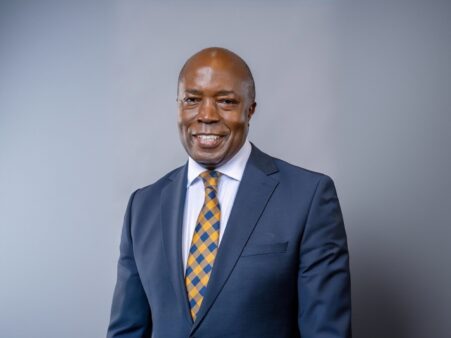
In the world of corporate governance, commercial law, and professional ethics, few Ugandan or regional figures carry the authority and global resonance that Winnie commands. A distinguished lawyer, academic, and board leader, she occupies that rare intersection where rigorous scholarship meets the lived realities of organisational leadership. She currently serves as Board Chairperson of dfcu Bank, Independent Non-Executive Director at MTN Uganda, and Director at Jubilee Allianz Uganda—positions that place her at the heart of some of East Africa’s most consequential institutions. Globally, she is part of the new vanguard shaping international governance and insolvency reforms through appointments to the International Insolvency Institute, INSOL International, the Singapore Global Restructuring Board, and India’s Insolvency Law Academy. Her earlier service on the International Ethics Standards Board for Accountants (IESBA) helped guide global conversations on ethics at a time when the world was wrestling with technological acceleration, regulatory complexity, and shifting societal expectations.
Yet it is in academia that Winnie’s intellectual imprint is perhaps most enduring. As an Associate Professor of Law at Makerere University, she has shaped generations of lawyers, advancing scholarship in corporate law, finance, regulation, and governance. A proud alumna of Mt. St. Mary’s College, Namagunga and Gayaza High School, she went on to earn an LL.B from Makerere University, an LL.M from the University of Cambridge, and a JSM and Doctor of Science of Law (JSD) from Stanford Law School—credentials that speak not only to her excellence, but to a disciplined, curiosity-driven academic trajectory. Her journey has also been shaped by prestigious fellowships, including the Fulbright Program, the Commonwealth Scholarship, and the Robert S. McNamara Fellowship of the World Bank, as well as visiting appointments at Cambridge, Oxford, and Strathmore Law School. Together, these experiences sharpened her global worldview and reinforced her conviction that Africa must not only participate in, but meaningfully shape global legal discourse.
It is against this rich tapestry of accomplishment that the conversation unfolds. What emerges is not merely a chronicle of her professional journey, but a profound meditation on the forces that define leadership today: the evolution of governance, the ethics of power, the architecture of effective boards, the future of the legal profession, the role and impact of women in leadership, and the complex interplay between African realities and global governance norms.
Across the interview, Winnie reflects with remarkable clarity on the moments that shaped her—from early mentorship at the Capital Markets Authority to the intellectual frameworks forged at Stanford. She demystifies the mechanics of effective boards, explains how values guide leaders through ethical dilemmas, and offers a grounded view of why governance must rest on fairness, responsibility, accountability, and transparency. She speaks with conviction about women’s leadership and its multiplier effect, the future of corporate and insolvency law in a digitising economy, the global debates around AI, data privacy, ESG, and capital rules, and how African institutions can assert their values while engaging international standards.
The result is a rare and expansive conversation—one that traverses law, governance, power, gender, ethics, institutional reform, and personal philosophy. It is in Winnie’s reflections- curated into 26 powerful lessons- leaders will find both wisdom and provocation; young professionals will find a roadmap; and institutions will find a challenge to rethink how they govern, grow, and steward their legacy.
#1: Know Who You Are Before You Lead Anything
Authentic leadership begins with the self—not with titles, achievements, or status. For Winnie, identity is the foundation upon which all leadership rests. Before being known as a lawyer, academic, board chair, or governance expert, Winnie prefers to be known as “Winnie- this is who I’ve always been before I took on any of these roles, and that’s who I am”. But more profoundly, a mother. “About 16 years ago, I became a mother, and so apart from Winnie, there are three extremely energetic young people who call me mummy, and to them I am just mummy. What a blessing to have three hearts that walk outside my body,” grounding leadership in humanity rather than hierarchy.
This lesson calls leaders to locate their worth beyond the roles they occupy. When leaders remember who they are outside the boardroom, they gain perspective, humility, and resilience—essential attributes for navigating complexity.
#2: Purpose Often Reveals Itself Through the Journey, Not at the Start
Many imagine career paths as straight lines defined by early clarity, but Winnie’s story challenges this myth. “Probably accidental, but maybe that is the path the Lord ordained for me,” she reflects about her journey into law and governance. Her life demonstrates that purpose often unfolds gradually, shaped by curiosity, opportunity, and willingness to step into unfamiliar spaces. She did not set out to be a governance authority; the discipline found her through exposure and growth.
“I was a lawyer first, before I got into the governance space. My interest was always in commercial law. Of course, commercial law is broad; over the years, I have narrowed it to corporate law, finance and banking. Governance is critical to these. It is critical to understand how organisations operate and how they are financed. I was introduced to corporate governance when I was a young lawyer working at the Capital Markets Authority,” she narrates.
This lesson teaches that leaders must stay open to evolving callings. Purpose is not discovered once—it emerges through decisions, challenges, and seasons. Aligning competence with opportunity often reveals the true path.
#3: Early Mentorship Shapes the Leader You Become
The early years of one’s career can be catalytic—or limiting—depending on the mentorship, environment, and exposure available. Winnie’s pivotal season was at the Capital Markets Authority, where she worked straight out of law school. “It was not just a job… I was trained, mentored and given opportunities that laid the foundation for what I do today,” she recalls, adding: “I’ve always had an interest in commercial law, and before that, in secondary school, I liked commerce and economics, so it is not surprising that at University, I was more inclined towards the corporate law and finance courses, and as I have mentioned, governance is core. I keep intellectually engaged by reading. I read a lot and enjoy reading, not just the law, but widely.”

That early immersion introduced her to governance, finance, organisational structures, and the ethical dimensions of regulation. This lesson underscores the value of intentional early-career environments and the profound impact of leaders who invest in young professionals. Mentors shape perspectives, cultivate confidence, and plant seeds that bear fruit decades later.
#4. Lifelong Learning Is the Engine of Intellectual Power
Great leaders are great learners. For Winnie, the law is not static, and neither is leadership. Intellectual longevity comes from continuous reading, curiosity, and engagement across disciplines. “I read a lot and enjoy reading, not just the law, but widely,” she explains. This commitment cultivates breadth—essential for navigating complex governance issues—and depth, the hallmark of rigorous legal practice. Today’s leaders cannot rely on yesterday’s knowledge; they must remain students of society, economics, technology, and human behaviour. Learning expands perspective, fuels innovation, and keeps leaders relevant. In a world that is constantly reinventing itself, the mind must remain open and hungry.
#5. Seek Environments That Stretch You and Raise Your Standards
From Makerere to Cambridge, then Stanford, Oxford, and Strathmore, Winnie’s academic journey reflects intentional choices to immerse herself in spaces that stretch her intellectual and professional capacity. “It is important to place yourself in an environment that challenges you and raises the bar for you,” she emphasises.
Growth requires friction—the kind that forces a leader to adapt, refine, and elevate. When we only stay in comfortable environments, our thinking stagnates. Exposure to high-performing ecosystems fosters discipline, excellence, and ambition. For African professionals, it also brings a global perspective and the confidence to participate in international discourse. Excellence is contagious—grow by proximity.
#6. Africa Must Tell Its Own Story—Or Others Will Misrepresent It
Winnie’s time abroad revealed gaps in global understanding of Africa—gaps shaped not by hostility but by limited exposure and inherited assumptions. As Winnie discovered when she became the first visiting academic from Africa at Oxford’s Centre for Commercial Law, global institutions often engage the continent with curiosity but insufficient context. Reflecting on these encounters, she observes, “I have learned that they are keen to engage, but sometimes their knowledge and views about Africa may be limited, and it is our job to tell our story and bring Africa to the table.”
This insight transforms representation from aspiration into responsibility. If African professionals do not speak for the continent, others—operating with partial information—will shape narratives that may be incomplete or inaccurate. For Winnie, this makes storytelling an act of intellectual sovereignty. African legal scholars, governance experts, and institutional leaders must publish, lecture, reform, and lead in ways that insert African perspectives into global debates on law, economics, and institutional evolution.
Telling Africa’s story is not about defending identity—it is about expanding the world’s understanding of the continent’s intellectual depth, institutional maturity, and transformative potential. It allows Africa to influence global standards, challenge outdated assumptions, and assert its rightful place not as a passive participant in global governance, but as a co-author of the frameworks that will define the future.
#7. Humility Is a Quiet but Transformative Force in Leadership
In reflecting on her mentor Japheth Katto, who she says has left the most profound impression on her philosophy of leadership, she describes him as “graced with the quiet strength of humility.”
“He was invested in our professional and leadership growth,” she recalls.
Leadership, she suggests, is not loud or performative; it is anchored in character, consistency, and genuine concern for others’ growth. Humility is not weakness—it is strength under disciplined control. It builds trust, diffuses conflict, and fosters collaborative environments. In boardrooms, humility enables leaders to listen deeply, integrate diverse perspectives, and steer organisations with clarity rather than ego. Her experience reinforces that the most enduring leaders are those who uplift others, give credit freely, and remain students even at the height of their influence.
#8. Governance Must Be Anchored in Universal Principles
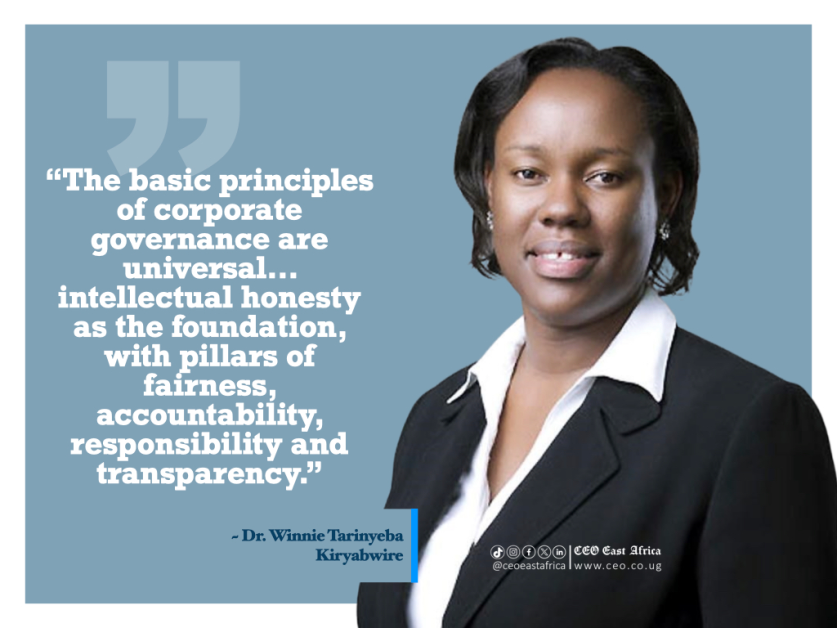
With decades of governance experience, Winnie insists that contexts change but governance principles remain constant. She echoes Prof. Mervyn King: “The basic principles of corporate governance are universal… intellectual honesty, fairness, accountability, responsibility and transparency.” These are not aspirational clichés—they are operational imperatives. Organisations collapse when these principles are compromised, diluted, or selectively applied. For her, intellectual honesty is the foundation: the courage to tell the truth, confront issues, and act with integrity even when inconvenient. Governance is not paperwork or procedure; it is a behavioural discipline at the highest level. This is a timeless, borderless lesson.
#9. Ethics Is the Heartbeat of Sustainable Organisations
Winnie, a former global ethics standard-setter at the International Ethics Standards Board for Accountants, warns that the rise of artificial intelligence magnifies—not replaces—the ethical responsibility of leaders. “Ethics is at the heart of everything we do. I hope you realise that, as AI becomes a reality, the key issue of concern is not AI legal frameworks, but ethics,” she cautions. For her, ethics is not a compliance requirement; it is the cultural backbone of an organisation, shaping behaviour long before policies are invoked.
She reinforces this with a stark reminder: “As Einstein rightly put it, without an ethical culture, there is no hope for humanity.” Technology, in her view, merely amplifies human intentions—for better or worse. Without strong ethical foundations, even the best-regulated organisations will ultimately falter because ethics is the unseen force guiding decisions, influencing conduct, and shaping long-term outcomes.
It is for this reason that she describes ethics as her non-negotiable when it comes to board conduct and culture. Ethical leadership is not optional; it is the condition upon which governance credibility rests.
This lesson invites leaders to invest in ethical infrastructure with the same seriousness, intentionality, and resourcing they give to financial systems or technological innovation—for in the end, it is values, not algorithms, that safeguard the soul of an institution.
#10. Values Guide Leaders Through Dilemmas Where Law and Policy Fail
When law, policy, and values seem to collide, leadership is tested. Yet Winnie insists the conflict is often superficial: Law and policy are always evolving. That is why we review policies, and we have reform programs to revise and modernise laws. Values are the cornerstone or pillars of how we do what we do. If you hold on to your values, you will weather the storm of bad policies and laws and emerge on the other side stronger and more resilient.
Values offer a compass when external frameworks shift or contradict. A leader anchored in values does not waver with political winds or institutional pressures. Integrity becomes both shield and guide. This lesson challenges leaders to articulate their values clearly—and live them consistently—because a leader without values is easily manipulated, easily confused, and ultimately ineffective in moments that demand courage.
#11. Women in Leadership Create a Multiplier Effect Across Society
Her reflections on women and leadership are among the most compelling in the interview. Organisational data, post-crisis studies, and lived experience converge to a single truth: when women lead, societies flourish. “Think about the impact of women in leadership… on families, peers, the younger generation of women, on governance and growth. Limitless possibilities,” she says. This is not sentimental rhetoric—it is evidence-based. After the global financial crisis, institutions with balanced governance were less prone to excessive risk-taking. Women bring perspective, prudence, empathy, and holistic thinking. The multiplier effect extends beyond institutions to entire communities. Empowering women is not symbolic—it is strategic.
#12. Influence Requires Groundedness, Listening, and Empathy
Asked what advice she would give young women leaders, her response is striking in its simplicity:
“Stay grounded, listen, be open-minded, and be empathetic.”
These qualities are not “soft”—they are strategic. Groundedness builds credibility. Listening builds wisdom. Openness builds adaptability. Empathy builds loyalty and influence. Leadership is not the performance of strength; it is the practice of understanding. This lesson reminds leaders that power without humanity alienates, while influence rooted in emotional intelligence transforms. In a world increasingly defined by complexity and fragmentation, empathy becomes a leadership advantage—not a vulnerability.
#13. Great Boards Are Built on Clarity, Transparency, and Mutual Respect
Healthy board–CEO relationships require clear boundaries and aligned expectations. “Clarity of roles, transparency and mutual respect,” she says, are essential. Problems arise when roles blur—when boards attempt to manage or when CEOs attempt to govern. She cautions CEOs not to exploit board fractures:
“The CEO should focus on the job and positioning the company for the future, and not seek refuge in the cracks of a divided board,” she advises.
Strong governance is built on disciplined partnership, not competition. This lesson calls for professional maturity and structural clarity as prerequisites for organisational stability and high performance.
#14. Boardroom Politics Is a Distraction—Focus on Purpose
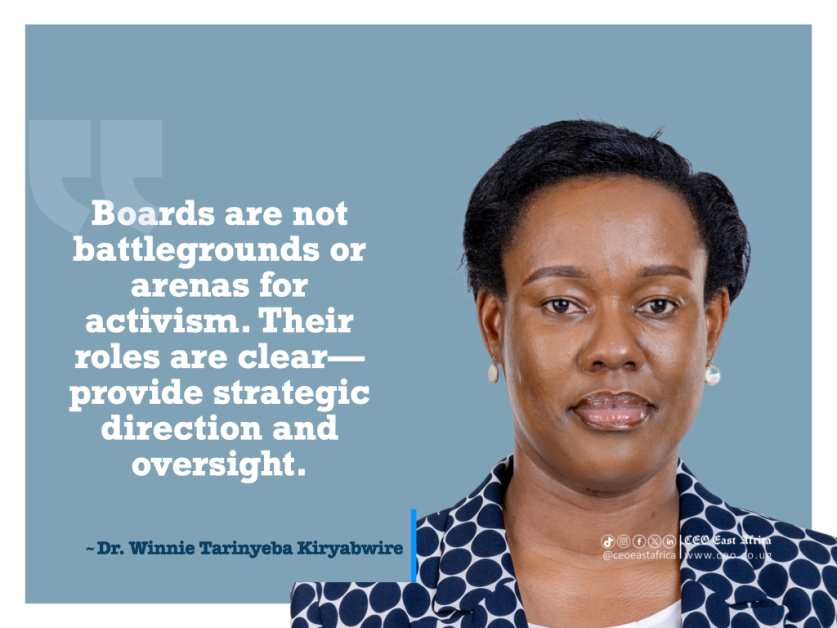
Politics is inevitable but optional. “You can feed it or focus on the right things,” she observes. Every boardroom has unspoken alliances, egos, and competing priorities, but great leaders refuse to be consumed by them. Instead, they return to purpose—oversight, strategic guidance, stewardship. She warns that too many leaders give politics more credit than it deserves. Boards are not battle grounds or arenas for activism. The roles of boards are clear- provide strategic direction and oversight,” she reminds us. The call here is to discipline: the discipline to prioritise organisational mission over personal positioning. Political savvy may help you enter a room, but purpose-driven leadership determines what you accomplish once inside it.
 Tax Appeals Tribunal Halts URA’s Objection to Non-Payment of 30% of Disputed UGX 169.9b by MTN Over Due Process Failures
#15. Board Service Is a Responsibility—Not a Status Symbol
Board appointments are often glamorised, but Winnie dismantles the illusion. “If you accept a board role, you should be prepared to commit time… Status has no place in these conversations.” Boards demand preparation, technical understanding, and consistent engagement. Directors who join to “tick a box” harm the institution.
“It is one way of killing organisations”, she doesn’t mince her words.
Real governance requires diligence: reading board packs, asking intelligent questions, and showing up prepared. Her lesson is a call for seriousness in a space too often treated as ceremonial. Board service is stewardship, not stardom. Institutions thrive when directors treat their roles as operational responsibilities, not social badges.
#16. The Journey to the Boardroom Is Earned Through Mastery, Discipline, and Integrity
Few of Winnie’s insights are as sharply delivered as her guidance on how one earns a seat at the board table. “Many people think board roles are positions of privilege. That is so wrong! It is a journey,” she emphasises—cutting through the illusion that board appointments are rewards, honours, or entitlements. For her, the boardroom is the culmination of years of disciplined mastery, not a shortcut for the ambitious.
Boards seek depth: technical competence, professional maturity, ethical steadiness, and the ability to navigate pressure without ego. That journey begins with excellence in one’s core field. “Aim to have deep knowledge and expertise in your area as a professional,” she advises. Only after establishing mastery should professionals intentionally add leadership exposure, governance training, and committee-level experience.
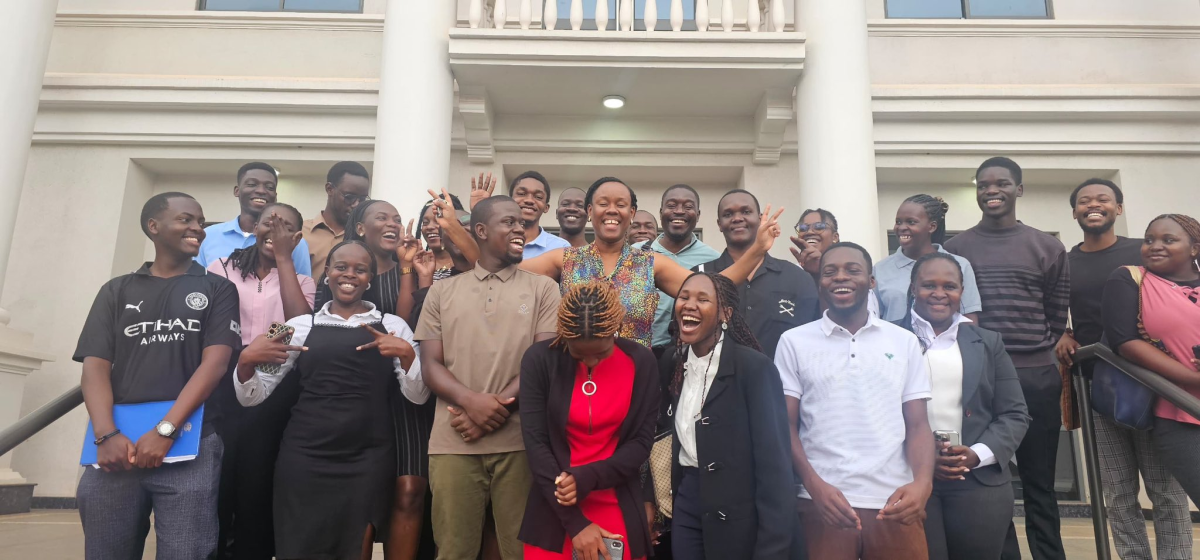
She encourages aspiring directors to immerse themselves in environments where they regularly interface with boards and board committees. “This is where you learn communication skills, preparation for meetings, and most importantly, where you learn to be challenged and not take it personally,” she explains. The boardroom does not reward fragility; it rewards resilience, maturity, and the intellectual discipline to handle scrutiny.
To understand this journey more deeply, Winnie directs young professionals to literature that reveals the lived reality of leadership. She recommends Martin Oduor Otieno’s biography, Beyond the Shadows of My Dream, describing it as a roadmap to transformational leadership across sectors. “When you read the book, you understand the importance of hard work, integrity, professional competence, and deep and broad experience,” she notes. The boardroom is not for those seeking prestige—it is for those who have paid the price of preparation.
Networks such as League of East African Directors (LEAD), Institute of Corporate Governance of Uganda (ICGU), and the Uganda Institute of Directors (IoDIoD also play a role, offering structured learning and access to governance ecosystems. But even these do not replace the core truth: board service is earned through years of disciplined practice, cultivated judgment, and values lived consistently.
In Winnie’s framing, influence is neither inherited nor conferred by title; it is built. The boardroom is not a destination—it is the natural next step for those whose mastery, integrity, and leadership have made them impossible to ignore.
#17. Influence in the Boardroom Comes From Depth, Not Volume
While every director must contribute, influence is not distributed equally—and that is by design. “Some may influence decisions because of their depth of experience or subject matter knowledge,” she explains. Influence arises from substance, not noise. Those who speak from mastery command attention. This lesson encourages professionals to build expertise that becomes indispensable. The boardroom does not reward flamboyance; it rewards insight. Sustainable influence is earned through credibility, preparedness, and intellectual restraint—knowing when to speak, and when silence demonstrates wisdom. Influence anchored in knowledge shapes decisions; influence anchored in ego destabilises them.
#18. Effective Boards Rely on Structure, Competence, and Strategic Composition
Great boards do not happen accidentally—they are engineered. According to Winnie, three pillars define them:
- Balanced composition
- Strong committee structures
- Competent executives
- She warns: “Boards and organisations pay a high price for not recruiting the right people.” Governance fails not only because boards are weak, but because executive leadership is misaligned with the organisation’s needs. Structure without competence is chaos; competence without structure is underutilised potential. This lesson highlights the strategic nature of board architecture: institutions must select people who understand governance, respect process, and bring the skillsets necessary to solve real-world challenges.
#19. Laws Must Be Grounded in Local Realities—Africa Needs Homegrown Governance Solutions, Not Blind Importation
Winnie challenges Uganda’s tendency to adopt foreign legislative models without adapting them to local economic DNA. She argues that while international frameworks offer useful reference points, they often fail when transplanted wholesale into African contexts. Reflecting on Uganda’s adoption of UK-inspired corporate and insolvency laws, she notes, “We introduced ideas… because the UK had introduced them… but I think we were wrong. Over 90% of our businesses are informal… We need to critically understand our ownership and financing structures and enact laws that are fit for purpose.”
For her, this is not a rejection of global best practice but a call for contextual intelligence. Effective governance must reflect the lived realities of African enterprises—family-owned firms, informal market networks, hybrid financing models, unique accountability mechanisms, and culturally shaped business behaviours. Laws that ignore this complexity risk looking modern on paper yet failing in implementation.
This lesson is a challenge to policymakers, regulators, and reform advocates to build legal and governance systems through African lenses. Good laws must be empirically grounded, economically relevant, and structurally aligned to the environments they govern. Only frameworks rooted in local realities can support institutional resilience, drive sustainable growth, and position African economies to thrive in a globalised world.
#20. Africa Needs Homegrown Governance Solutions, Not Blind Importation
For Winnie, one of the most pressing governance challenges on the continent is the uncritical adoption of foreign legal and regulatory models. While global standards offer valuable guidance, they are not automatically compatible with Africa’s economic and institutional realities. Reflecting on Uganda’s adoption of UK-style corporate and insolvency frameworks, she observes, “We introduced ideas… because the UK had introduced them… but I think we were wrong. Over 90% of our businesses are informal… We need to critically understand our ownership and financing structures and enact laws that are fit for purpose.”
This is a call for intellectual honesty and contextual responsiveness. Effective governance must flow from the lived realities of African enterprises—family-owned businesses, informal networks, hybrid financing structures, entrepreneurial cultures, and diverse accountability norms. Importing laws without adaptation risks creating frameworks that look modern on paper but fail in practice.
Winnie’s lesson is clear: Africa must design governance solutions through African lenses. Only laws and systems rooted in local realities can support sustainable growth, strengthen institutions, and deliver the accountability and resilience required for the continent’s next phase of development.
#21. Legacy Is the Shade You Leave Behind—Not the Applause You Receive
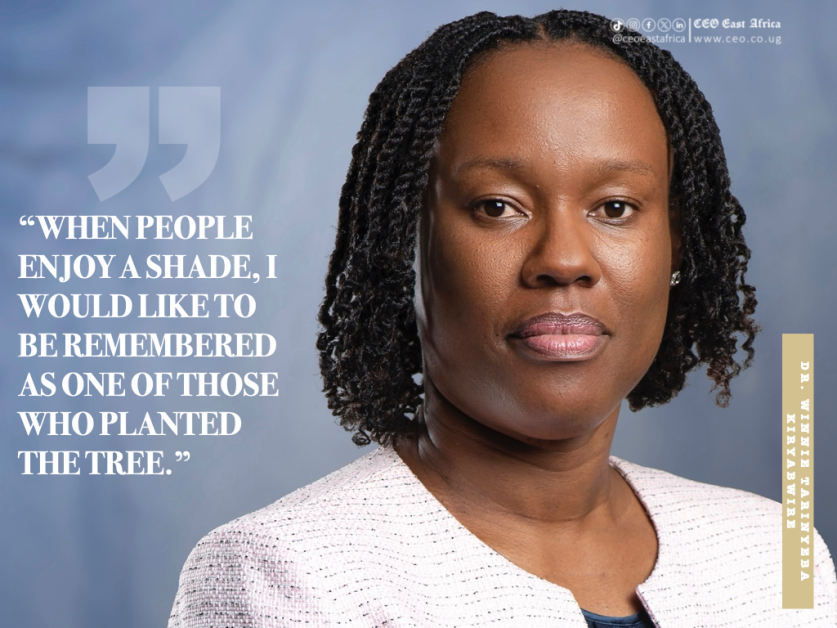
Her final lesson is deeply personal and profoundly universal. When asked how she wishes to be remembered, she answers with poetic simplicity:
“When people enjoy a shade, I would like to be remembered as one of those who planted the tree.”
Legacy is not fame. It is the long-term impact of decisions, mentorship, integrity, and service. It is the growth we inspire in others, the organisations we strengthen, and the future we prepare for generations we will never meet. Leadership, she teaches, is not about being celebrated—it is about being useful. The shade outlives the planter.
#22. The Future of Law Belongs to the Negotiator, Not the Litigator
As the world becomes more interconnected, complex, and technologically accelerated, the nature of legal practice is shifting fundamentally. Winnie highlights this when she references Justice Geoffrey Kiryabwire’s recent observation that “the future of the legal profession belongs to the negotiator and not the litigator.” This is not a dismissal of litigation but a recognition of global economic realities. Modern business requires speed, problem-solving, cross-border collaboration, and the ability to resolve disputes without destroying relationships. Negotiation, mediation, and structured dialogue increasingly anchor corporate survival and continuity. In this new landscape, the lawyer who can convene, persuade, mediate, and craft win–win solutions will define the next era of legal leadership. The future rewards those who build bridges, not those who burn them—and negotiation is the language of progress.
#23. Institutions Need Leaders Who Understand Both Public and Private Sector Dynamics
Effective leadership demands an ability to read and respond to context. As Winnie observes, “A company in Uganda, Europe and America has the same features. However, the cultural context is very different.” Governance principles may be universal, but how institutions function—how decisions are made, how accountability is enforced, how stakeholders engage—varies dramatically across environments. Leaders who have operated in both public and private spheres develop a richer understanding of regulatory ecosystems, institutional incentives, cultural expectations, and political realities. This cross-sector fluency enables them to anticipate risks, adapt governance models, and build institutions that are both globally credible and locally resonant.
#24. Leadership Is Stewardship, Not a Career Strategy — and Teaching Is How She Lives That Stewardship
For Winnie, leadership is not a ladder to climb but a legacy to build. Her philosophy is captured in her evocative reflection: “When people enjoy a shade, I would like to be remembered as one of those who planted the tree.” This belief in planting seeds for others defines not only how she leads but also why she teaches. In the classroom—at Makerere, Cambridge, Oxford, Strathmore, and Stanford—she sees an opportunity to shape future thinkers, lawyers, and leaders who will carry forward the values and rigour she embodies. Teaching, for her, is stewardship in its purest form: the deliberate transfer of knowledge, discipline, and ethical grounding to those who will inherit the institutions she now serves.
She teaches because strong institutions need strong people—and strong people are built early. She teaches because ideas outlive positions. And she teaches because the most enduring legacy a leader leaves is not their own achievements, but the generations they prepare to lead with clarity, courage, and conscience.
In her worldview, the classroom and the boardroom are not separate arenas; they are extensions of the same calling—to plant trees whose shade she may never sit under, but which others will benefit from for decades to come.
#25. The Legal Profession Must Evolve Beyond Traditional Practice
For Winnie, the future of legal practice will belong to professionals who understand that law no longer operates in a silo. Technology, digitisation, sustainability, data governance, insolvency reform, and cross-border finance are redefining the terrain. As she observes, “Technology is disrupting [banking], but banks are not sleeping either… the game of the day is collaboration and partnerships, and this is going to force us to think differently about legal frameworks.”
This disruption requires lawyers to become architects of systems, not just interpreters of statutes. Regulatory and governance standards must keep pace with innovation, which is why she cautions that “as we digitise… it is important that we align with the highest standards.”
The lawyers who thrive in this new era will be those who blend doctrinal mastery with technological fluency, global awareness, policy insight, and the ability to design frameworks for emerging business models. The profession must evolve—or risk becoming irrelevant to the world it seeks to regulate.
#26. Emotional Resilience Is a Leadership Competency
For Winnie, one of the most underestimated attributes of effective leadership—especially in governance—is emotional resilience. Boardrooms are spaces of scrutiny, debate, and competing perspectives. They test not only intellect but temperament. Reflecting on the value of early exposure to board–committee interactions, she notes, “This is where you learn… to be challenged and not take it personally.”
This insight captures a critical truth: leaders who internalise critique or personalise professional disagreements cannot make sound decisions under pressure. Emotional resilience allows leaders to separate issues from ego, listen without defensiveness, adapt when confronted with new information, and remain steady when tensions rise.
In governance roles, where decisions carry institutional weight, emotional maturity becomes a strategic advantage. It enables leaders to preserve relationships while navigating conflict, hold firm when principles are tested, and maintain clarity amid complexity. For Winnie, resilience is not merely a soft skill—it is a core competency of leadership.
A Call to Stewardship: Leading with Mind, Values, and Courage
Through these 26 expansive lessons, Dr Winnie Tarinyeba-Kiryabwire offers more than professional guidance—she articulates a philosophy of leadership anchored in intellectual discipline, ethical clarity, contextual intelligence, and human purpose. Her reflections challenge leaders across East Africa and beyond to rethink what it truly means to lead: not as an exercise in status or ambition, but as an enduring responsibility to institutions, people, and future generations.
Across law, governance, board leadership, ethics, gender, and education, one theme remains constant: leadership must be earned, values must be lived, and institutions must be built to outlast individuals. She calls on leaders to pursue competence before visibility, humility before authority, integrity before convenience, and stewardship before self-interest. In doing so, she reminds us that the most consequential leaders are not those who dominate their moment, but those who quietly strengthen systems, mentor successors, and plant trees whose shade they may never sit under.
These are not merely lessons drawn from an accomplished career. They are an invitation—indeed, a challenge—to a higher standard of leadership: one that is rigorous yet humane, globally engaged yet locally grounded, and ambitious not for applause, but for impact that endures.