“Uganda Wildlife Authority is saddened to announce the death of six lions in Queen Elizabeth National Park. The carcasses of the lions were found last evening at Ishasha sector with most of their body parts missing. Eight dead vultures were also found at the scene which points to possible poisoning of the lions by unknown people,” read a statement from UWA, the Government of Uganda’s agency responsible for the management and protection of Wildlife in and outside protected areas.
UWA further said that a team of investigators was on the ground and collaborating with police the nearby Kanungu district to establish the cause of death and possibly identify the suspects.
“Given that some of the body parts of the lions are missing, we cannot rule out illegal wildlife trafficking. UWA strongly condemns the illegal killing of wildlife because it does not only impact negatively on our tourism as a country, but also revenue generation which supports conservation and community work in our protected areas,” UWA further said.
The death is a disaster to Queen Elizabeth National Park (QENP) and the tourism industry in general. The last time there was a recorded killing of lions by locals was in March 2018, when 11 lions were killed in Queen Elizabeth National Park in March 2018.
The State of Wildlife Resources in Uganda, a 2018 report authored by Aggrey Rwetsiba, Fred Kisame and Fredrick Wanyama of the Uganda Wildlife Authority (UWA) estimated that there was a population of 493 lions in Uganda. Murchison Falls National Park, Kidepo Valley National Park and QENP harbour the most, if not the only number of lions in the country.
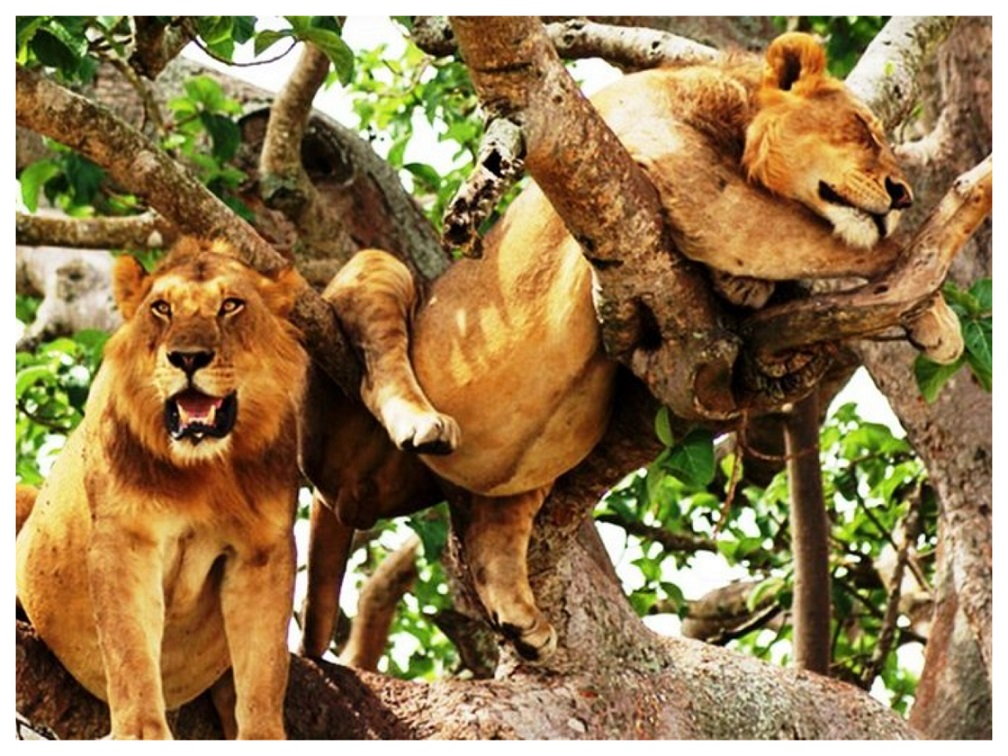
The tree climbing lions of Ishasha, are a unique attraction and a highlight especially for visitors transiting between QENP and Bwindi Impenetrable National Park to see the mountain gorillas, another Ugandan gem.

In general, the lion population of Uganda is under threat by indiscriminate killing by the local communities especially pastoralists, road accidents, habitat loss and diseases.
UWA, said in a statement that, to reduce on the impact of human-wildlife conflict, the agency gives back 20% of gate entry fees to the communities neighbouring through a revenue sharing scheme.
“In the last five years, a total of UGX 4,457,283,992= was shared with communities neighbouring Queen Elizabeth National Park to enhance their livelihoods. The revenue sharing scheme is meant to strengthen partnerships between local communities, local governments and management of wildlife areas leading to sustainable management of wildlife resources in protected areas,” UWA said.
The adency also added that it “shall continue to strengthen the protection of lions and other wildlife in Uganda and will pursue this matter to its logical conclusion.”
“Our national parks remain safe and attractive to visitors and we still have lions in Queen Elizabeth and other parks,” the agency said.
 Inside the Balance Sheet: CFO Doreen Kyomugisha on Building Capital Strength and Financial Discipline at SanlamAllianz General Uganda
Lions, leopards, rhinoceros, elephants, and Cape buffalos, altogether known as the Big Five game are the most sought-after animals in the wild by tourists. Uganda has all the five, in addition to chimpanzee, mountain gorilla, zebra, hippopotamus, crocodile, and several hundreds of bird species.
Leveraging this vast resource richness, Uganda has for the past years positioned itself as the most value-for-money destination where tourists can see the most variety of animals per square kilometre in the region.
For example, although Uganda is 4 times small than Tanzania, 2.4 times smaller than Kenya, and 9.7 times smaller than DRC, it is endowed with 7% of the Global Mammal Diversity or 39% of Africa’s Mammal Richness, including, 19 species of primates that among others, comprise of 53.9% of the world’s remaining population of mountain gorillas. Uganda also boasts of 11% of the world’s recorded species of birds- roughly 50% of Africa’s bird species and 19% of Africa’s amphibian species richness.
Over and above diseases, an increase in cases of human-wildlife conflicts mainly emanating from crop destruction, livestock predation and human attacks by elephants, crocodiles, lions, leopards, chimpanzees, gorillas, baboons among others continue to threaten protected animal populations. Human-wildlife conflicts also emerge when individuals or communities invade wildlife conservation for poaching, illegal logging, cultivation, grazing and other related illegal resource access practices.
Queen Elizabeth, a Medley of Wonders
Described as a Medley of Wonders and measuring 1,978km² Queen Elizabeth National Park is Uganda’s second most-visited National Park, attracting 86,875 visitors in 2018 after Murchison Falls National Park, which attracted 102,305 visitors. The park’s diverse ecosystems, which include sprawling savanna, shady, humid forests, sparkling lakes and fertile wetlands, make it the ideal habitat for classic big game, ten primate species including chimpanzees and birds.
In total, the park is home to over 95 mammal species and over 600 bird species.
The Katwe explosion craters mark the park’s highest point at 1,350m above sea level, while the lowest point is at 910m, at Lake Edward.
Set against the backdrop of the jagged Rwenzori Mountains, the park’s magnificent views include dozens of enormous craters carved dramatically into rolling green hills, panoramic views of the Kazinga Channel with its banks lined with hippos, buffalo and elephants.
This is a breaking story and shall be updated as more facts become available.