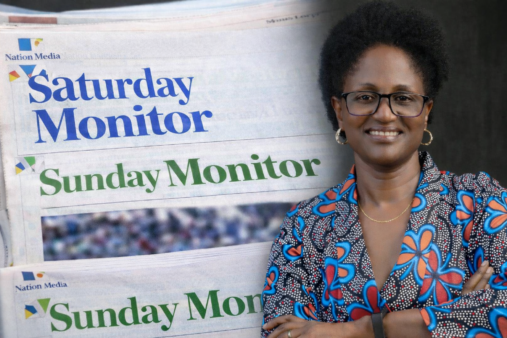
When Susan Nsibirwa took over as managing director of Nation Media Group (NMG) Uganda, she arrived with the promise of a reset.
At her first staff address at Hotel Africana, staff jokingly nicknamed her “the chic” after she had referred to herself that way during her maiden address.
To many, she represented a new beginning after years of internal power struggles under her predecessor, Tony Glencross.
But within less than two years, more than five senior managers have either resigned, retired early, or been pushed out.
What began as optimism has evolved into a silent and turbulent period that has placed Nsibirwa at the centre of intense internal politics.
Behind the departures lies a complex story, one that mixes long-standing internal rivalries with a deeper crisis facing the media business itself.
Inheriting a fragmented power structure
Nsibirwa inherited an organisation already shaped by years of structural tension.
For much of its recent history, NMG Uganda operated through two largely separate corporate entities that functioned almost like parallel businesses.
One arm, Monitor Publications Limited, ran the group’s print and radio assets, including Daily Monitor, KFM, Dembe FM, Nation Courier, and the largely Kenyan-controlled East African.
The other arm, Africa Broadcasting Uganda Limited, controlled the television business, managing NTV Uganda and Spark TV.
Although both companies belonged to the same parent group, NMG, with headquarters in Kenya, they were historically run with different management structures, budgets, and operational cultures.
Editorial teams, commercial departments, and operational systems evolved separately, creating distinct centres of influence inside the organisation.
Around 2016, NMG attempted to bring the two operations together under a broader convergence strategy aimed at integrating newsrooms, commercial structures, and management oversight.
But insiders say the convergence was never fully completed.
Instead, the process left behind overlapping authority lines and competing power centres, a structure that would later complicate leadership transitions.
Former managing director Tony Glencross had struggled to maintain control across these competing structures.
Over time, sources say, after some of his decisions had been overridden by people structurally junior to him, he gradually stepped back from active operational control.
In fact, some staff sources say he semi-retired into the job and was happy to only pick his salary as he waited in the wings for when he would be pushed out.
Much of the management oversight increasingly shifted to John Wanjohi, a hardline finance manager brought in from Kenya.
Wanjohi’s influence within the organisation was widely understood to be strengthened by his relationship with former Nation Media Group chief executive Stephen Gitagama.
Before becoming Group Managing Director, Gitagama had served as Group Finance Director, a period during which the company began internal reviews into financial irregularities across some of its operations.
Sources inside the organisation say Wanjohi was viewed within senior leadership in Nairobi as a trusted financial administrator tasked with tightening financial controls and addressing suspected fraud risks.
Even as staff in Uganda openly accused him of overreach and heavy-handed management, insiders say, Gitagama continued to back him.
At several internal meetings, sources say, employees questioned Wanjohi’s authority and decision-making style, arguing that he was centralising power and interfering in operational areas beyond finance.
But despite the complaints, some of which bordered on threats on his life, he remained firmly in position, a situation many staff interpreted as evidence of strong backing from Nairobi.
One example of these tensions involved his relationship with Glencross, which sources say remained cold for much of the eight years, partly stemming from Wanjohi’s refusal to approve what he described as questionable marketing budgets.
In fact, during one editorial meeting, Glencross reportedly remarked that the internal politics within NMG Uganda were more complex than those in the government bureaucracy.
The tensions occasionally spilled into the open. In one heated meeting at the former NMG Airtel House commercial offices on Wampewo Road, staff openly accused Wanjohi of overstepping his authority, making unilateral decisions, and failing to understand the complex workings of a multidimensional media house.
Despite such confrontations, Wanjohi remained in position and would only leave after Glencross was retired and the arrival of Nsibirwa.
Thus, by the time Nsibirwa arrived, what had begun as an attempt at convergence had hardened into entrenched power blocs and competing loyalties within the organisation.
The exit wave
The first major departure came from the marketing department.
Elizabeth Namaganda, who had worked well with the Glencross administration, soon found herself under mounting pressure amid what colleagues described as unrealistic targets placed on an already under-resourced team.
But what made it even worse, there seemed to be someone waiting in the wings – Hajara Batuuka – to replace her.
Rather than engage in the internal struggles, she resigned and later joined Pride Bank as marketing manager.
She was indeed replaced by Batuuka, who had earlier been shopped on a consultancy engagement.
Next came the quiet exit of IT manager Adrian Mbabazi, widely respected for building a digital performance monitoring system that had significantly modernised internal processes.
He was reportedly escorted off the Namuwongo premises by security following allegations that he had sabotaged an editorial operating system – Naviga – that sources say had cost the company more than UGX 300 million.
At the Serena-based Africa Broadcasting Uganda Limited office, Johnson Omolo was quietly fighting to keep his job.
His structural tensions with Monitor Publications Limited and the Namuwongo headquarters had, in fact, begun much earlier, during the tenure of former managing director Tony Glencross, only that Glencross had allowed him to operate with some autonomy.
As General Manager of Africa Broadcasting Uganda Limited, the entity that runs NTV Uganda and Spark TV, Omolo presided over a broadcasting division that many insiders say operated almost like a semi-autonomous empire, at times openly competing with and occasionally defying the leadership at the top.
But under Nsibirwa, that autonomy was capped, worsened by an alleged fight over certain programmes that management suspected were being undercut for the benefit of some managers.
Unable to sustain the fight, Omolo eventually exited in December 2024.
Although publicly framed as a resignation, insiders say the departure may have been a face-saving exit following growing disagreements over leadership direction and the balance of power within the organization with Nsibirwa.
The turbulence soon spread to the commercial division.
While the tensions had existed for long, they were flared up by an internal email from business manager Harunah Kisirinyi that accused senior managers of favouritism, unrealistic targets and growing frustration among both staff and clients.
The fallout led to the suspension and eventual resignation of Commercial Manager–Print Kenneth Mugabe, while General Manager Sam Barata opted for early retirement.
Kisirinyi, though junior in the managers’ structure, has also since left the company for a job at NRG Radio.
The Daniel Kalinaki moment
The most symbolic departure seems to be the early retirement of Daniel Kalinaki, one of Uganda’s most prominent editors.
Early this week, in an email to staff, Nsibirwa wrote that she had accepted Kalinaki’s early retirement, due for April 2026.
Of course, the email was cloaked in retirement, but insiders say Kalinaki was pushed out after a long period of infighting.
Initially, Nsibirwa and Kalinaki appeared to enjoy a cordial relationship.
But over time, tensions reportedly emerged. Kalinaki eventually stopped attending heads-of-department meetings, and complaints surfaced within the newsroom that he had become increasingly absent, communicating official decisions largely through WhatsApp messages and informal emails.
The tensions would be made worse by bloggers, who in December last year linked him to the operations of a private media venture, one which would be in direct competition with some of the NMG products.
These claims were, sources say, just the icing on the cake, as it is claimed that reports had already been compiled on him, some of which were shared with the boards in Kampala and in Nairobi.
Thus, it was imminent that soon or later, Nsibirwa would announce Kalinaki’s exit.
 Canal+ shuts down loss-making Showmax Streaming Platform
Reform meets resistance
Several senior managers who have left the organization had also been contenders for the managing director position, including Omolo, Barata and Kalinaki.
Sources say some of them were confident of their chances of leading NMG Uganda.
The appointment of an outsider, therefore, introduced a new centre of authority into an already competitive leadership environment.
At the same time, the company faced economic pressures that demanded difficult decisions, tighter revenue targets, commercial restructuring, and operational changes.
That combination proved combustible.
A battle for control and survival
Taken individually, the departures might appear to be personal conflicts or routine executive reshuffles.
But taken together, they reflect a deeper organizational transition unfolding inside Nation Media Group Uganda.
The company is attempting to reposition itself in an era where print circulation is shrinking, advertising revenue is migrating to digital platforms and newsroom structures are being forced to evolve.
Glencross, in a December 2023 exit interview with the CEO East Africa Magazine, acknowledged the scale of that challenge shortly before leaving office, noting that the company had begun laying the groundwork for what he described as the “business of the future”, a strategy aimed at transforming NMG from an analogue media operation into a digitally driven enterprise.
Under that plan, the traditional products, television, radio and the printed newspaper, would continue generating revenue in the short term while the company gradually builds a sustainable digital business capable of eventually contributing a significant share of total income.
But transitions of that scale rarely happen smoothly.
Leadership changes often expose underlying tensions within organizations, particularly when long-standing structures, power centres and business models are being dismantled at the same time.
Many of the managers who have exited in recent months were influential figures under the previous administration and had built considerable autonomy within their departments.
The reorganization under Nsibirwa has inevitably disrupted those arrangements.
For now, however, Nsibirwa appears to be consolidating authority, bringing in people who, sources say, she thinks will work well with her to implement her and other pre-existing plans.
At least, all senior figures who once competed for the top job are no longer inside the organization.
This leaves Nsibirwa with greater room to reshape the leadership structure and pursue the next phase of the company’s transformation.
What began as an internal struggle for authority is gradually evolving into a broader corporate reset.
Yet the deeper challenge remains unresolved.
The structural crisis behind the turmoil
While internal politics continues to simmer, a deeper structural problem has for years unfolded quietly: the steady erosion of newspaper circulation.
Audit Bureau of Circulation (ABC) data shows that the Monitor brand has experienced a sustained decline in both weekday and weekend circulation over more than a decade, reflecting a broader structural shift in Uganda’s print media industry.
Figures compiled from ABC reports show that Daily Monitor circulation fell from 25,700 copies in 2007 to about 18,787 by the end of 2017, a decline of roughly 27% over 10 years.
The downward trend continued beyond 2017. By the first quarter of 2019, Daily Monitor circulation had fallen further to about 16,638 copies, meaning the paper had lost more than a third of its circulation over the 12 years.
Not unique
The pattern was, however, not unique to the Monitor. Across the industry, Uganda’s English-language newspapers were losing readers as audiences increasingly migrated to digital platforms.
While the combined circulation of Uganda’s three largest dailies, New Vision, Daily Monitor and Bukedde, appeared relatively stable for much of the period, that stability was largely driven by the rapid expansion of Bukedde, the Luganda-language daily.
Once Bukedde’s growth is excluded, the picture looks far more troubling. Circulation for the two main English-language newspapers, Daily Monitor and New Vision, declined significantly over the same period.
But the sharpest decline occurred in the weekend segment, historically the most commercially valuable part of the newspaper business.
ABC data shows that Sunday Monitor circulation fell from 25,531 copies in 2007 to about 12,187 copies by 2017, a drop of more than 52%.
By early 2019, the slide had continued, with circulation falling further to around 10,816 copies, meaning the paper had lost nearly 60% of its readership over 12 years.
Across the industry, the pattern was similar. Combined circulation of weekend newspapers dropped from nearly 60,000 copies in 2007 to just over 26,000 copies by 2019, effectively cutting the market in half.
For decades, weekend editions had been the most commercially valuable products in the newspaper business. They carried the largest advertising volumes and generated the revenues that financed large newsrooms and investigative reporting.
The decline reflected bigger changes in media consumption habits. As mobile internet access expanded and smartphones became widespread, readers increasingly turned to digital platforms and social media for real-time news.
Industry research shows the scale of the shift. The proportion of Ugandans who reported reading a newspaper within seven days fell from 29% in 2010 to just 8% by 2018, highlighting the speed at which audiences were abandoning print.
Accelerated decline
By the time Covid-19 struck in 2020, Uganda’s newspaper industry was already structurally fragile. The pandemic merely accelerated trends that had been building for more than a decade.
Shortly before the pandemic, Monitor Publications Limited stopped submitting its circulation figures to the Audit Bureau of Circulations (ABC), making it difficult to independently verify how the paper’s numbers evolved after 2019.
What is clear, however, is that the pandemic intensified the pressures facing print media. Distribution networks were disrupted, street vendors disappeared during lockdowns, advertising budgets tightened sharply and readers moved even faster toward digital platforms.
The result was a harsh commercial reality: the print products that had historically financed large newsrooms were becoming increasingly difficult to sustain.
By late 2024, internal circulation figures reportedly suggested that weekend editions had fallen below 10,000 copies, a sharp contrast to the more than 25,000 copies sold barely a decade earlier, a collapse that underscores the scale of the structural transformation confronting Uganda’s traditional newspaper industry.
Merged weekend editions
Given that narrative, it was prudent that Monitor takes some hard decisions, including merging the weekend mastheads, Saturday Monitor and Sunday Monitor, into one single edition, Weekend Monitor.
The move followed a similar shift within the broader Nation Media Group. In Tanzania, Mwananchi Communications Limited had already discontinued print versions of its weekend editions and moved them into digital-only formats.
In Uganda, the merger has been officially framed as a move to deliver deeper journalism and a stronger weekend product.
But internally, it is widely understood as part of a broader reformation driven by hard economics.
NMG has aggressively pushed a digital-first agenda, but the revenues generated online have yet to meaningfully replace what has been lost through falling print circulation and a weakening advertising market.
The same is happening for the broadcast division. Audiences have shifted to viewing on the go channels.
Thus, the struggle for restructuring the broadcasting division of NTV and Spark is also demanding.
Attempts have been made on monitising the NTV-Spark content, but how to do it remains a serious challenge and will remain one of Nsibirwa’s biggest headaches.
For Daily Monitor, the website has been monetized through ad spend and prime content, but the returns remain low compared to targets.
The real battle, therefore, is not merely about leadership.
It is about whether a traditional media organization built around the economics of print circulation can successfully reinvent itself for a digital era, in which audiences consume news on phones, advertising has fragmented across multiple platforms, and the old revenue model is steadily eroding.
That question, more than the internal politics, will ultimately determine whether Nsibirwa’s tenure is remembered as a successful turnaround or simply another chapter in the slow, uncertain transformation of Uganda’s media industry.