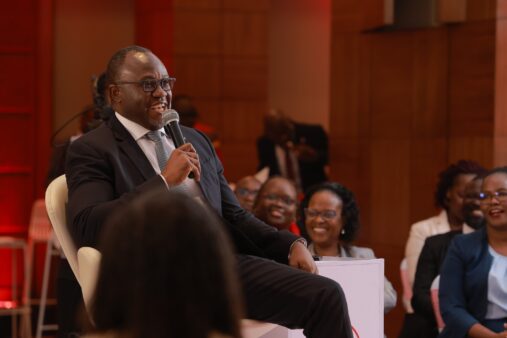
Stanbic Bank Uganda has launched a powerful new brand campaign—Keep Growing—positioned as both a celebration of Uganda’s resilience and a reaffirmation of the bank’s role in powering the nation’s long-term progress. Running for 18 months, the campaign arrives at a critical moment: when many commercial banks are scaling back lending, tightening risk controls, and slowing balance sheet growth in response to economic pressures.
For Uganda’s largest bank, largest lender, largest holder of customer deposits, and one of the most consistently profitable financial institutions in the country, the message is unmistakable. Stanbic is recommitting itself to the sectors that form the backbone of Uganda’s recovery: women, youth, farmers, SMEs, industries, and households.
And perhaps more importantly, the campaign signals that the bank intends to do the opposite of what many lenders are doing—lean in when others lean back.
A Legacy of Partnership: 118 Years in the Making
Stanbic Bank’s message draws credibility from its weighty historical arc. The bank’s origins date back to 1906, when the National Bank of India set up operations in East Africa—evolving over decades into Grindlays Bank, one of the region’s early commercial anchors.
In 1991, Standard Bank Group entered the Ugandan market through the acquisition of Grindlays’ regional assets, adopting a purpose that continues to define its brand:
“Uganda is our home. We drive her growth.”
The pivotal transformation came in 2002 when the government privatised the Uganda Commercial Bank (UCB). With Standard Bank acquiring a 90% stake, Stanbic became—almost overnight—the country’s largest bank, inheriting a nationwide presence and a mandate to deepen financial inclusion.
Today, as part of Africa’s largest banking group by assets, Stanbic remains tightly intertwined with Uganda’s economic trajectory.
Why Keep Growing Matters Now
The new campaign positions Stanbic as a stabilising force at a time when Uganda’s credit uptake is softening. Rising loan impairment pressures, cautious lending policies across the banking sector, and a generally conservative economic outlook have slowed credit extension.
Yet in the midst of this, Stanbic is choosing a narrative of expansion and empowerment—particularly for the most economically active and vulnerable groups: women, youth, and smallholder farmers.
These three constituencies account for the largest share of Uganda’s labour force, yet historically face the greatest barriers to credit and financial inclusion. By placing them at the centre of its campaign, Stanbic is signalling a strategic shift from banking growth to banking inclusion that drives growth.
Aligning Purpose With Action
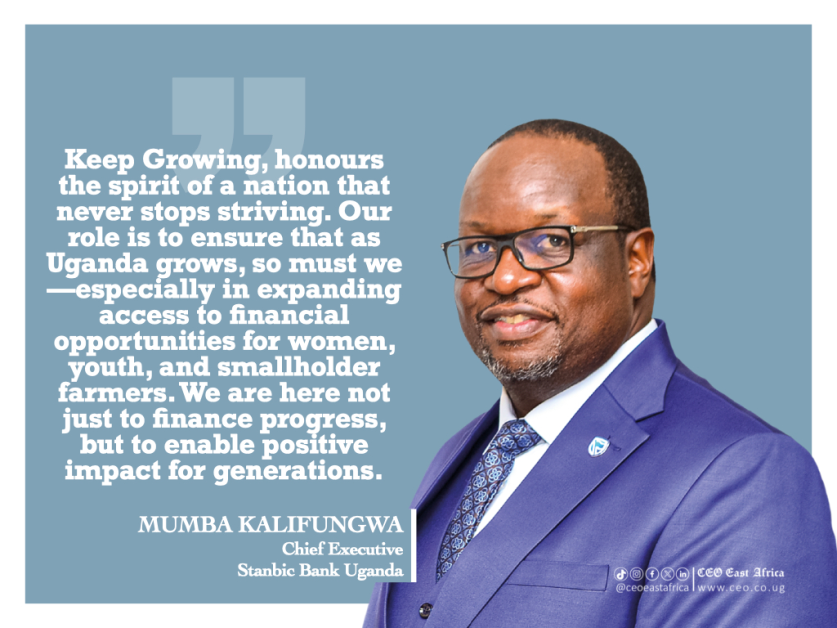
Flagging off the campaign, Mumba Kenneth Kalifungwa, Chief Executive, stressed that the message reflects both national resilience and institutional responsibility:
“Keep Growing honours the spirit of a nation that never stops striving. Our role is to ensure that as Uganda grows, so must we—especially in expanding access to financial opportunities for women, youth, and smallholder farmers. We are here not just to finance progress, but to enable positive impact for generations.”
His message strikes at a time when the banking sector is increasingly criticised for not lending enough to the real economy. Stanbic’s response—through a public campaign—suggests a willingness to go against the sector’s tightening trend.
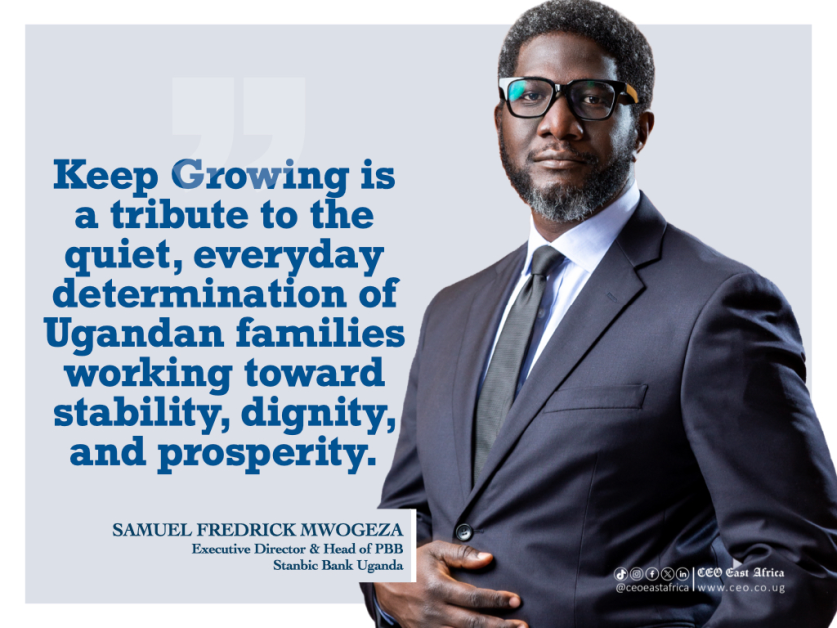
Samuel Fredrick Mwogeza, Executive Director & Head of Personal & Private Banking, framed the campaign as a tribute to the resilience of Uganda’s everyday economic actors: “Keep Growing is a tribute to the quiet, everyday determination of Ugandan families working toward stability, dignity, and prosperity. We will continue innovating solutions that move households closer to their goals.”
This comes at a time when household credit uptake has been slowing, especially among lower-and middle-income borrowers squeezed by inflation and lower disposable income. A renewed focus here could signal new retail banking innovations.
From a macroeconomic lens, Stanbic’s commitment aligns with Uganda’s infrastructure, trade, and export ambitions.
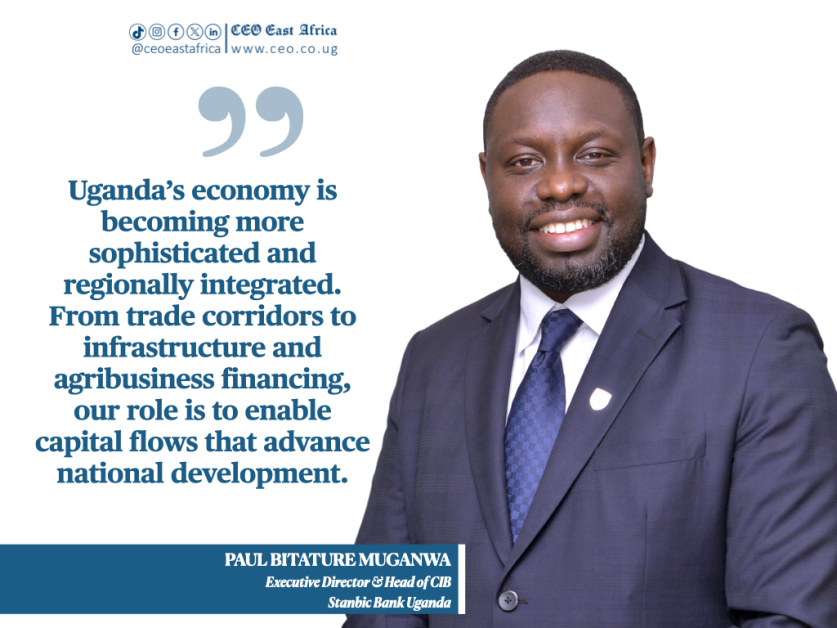
Paul Bitature Muganwa, Executive Director & Head of Corporate & Investment Banking, notes: “Uganda’s economy is becoming more sophisticated and regionally integrated. From trade corridors to infrastructure and agribusiness financing, our role is to enable capital flows that advance national development.”
This reflects Stanbic’s long-standing role in financing energy, roads, agribusiness value chains, and corporate expansion—sectors that require long-term capital even when market liquidity tightens.
Tunde Thorpe, Head of Business and Commercial Banking, underscored the central role of entrepreneurship: “Commercial enterprise is the heartbeat of Uganda’s transformation. Keep Growing is our commitment to provide capital, digital tools and market access so businesses can scale and create jobs.”
SMEs remain the biggest casualty of tightened credit conditions. A renewed push from Uganda’s largest commercial lender could be catalytic.
 After Success, Then What? Francis Kamulegeya on His Aptly Titled New Book and Life Beyond Big Titles and Offices
Investing for Wealth, Protecting Prosperity
The campaign also stretches beyond lending to wealth creation and financial security.
Grace Semakula, CFA, Chief Executive, SBG Securities Uganda, highlights a shift in Uganda’s savings culture:
“Ugandans are increasingly looking to build intergenerational wealth through capital markets. Keep Growing reinforces our role in guiding investors towards diversified and secure portfolios.”
Meanwhile, Catherine A. Poran, Chief Executive, Stanbic Business Incubator, emphasises enterprise capacity-building: “When entrepreneurs grow, communities grow. By equipping SMEs with investment-ready skills, we unlock long-term value for Uganda’s economy.”
And Tichaona Makonese, Head of Insurance & Asset Management, frames growth as something that must be both created and safeguarded:
“Growth must be protected. Our solutions ensure that livelihoods, businesses, health, and property are safeguarded so success is sustained across generations.”
Together, these perspectives broaden the campaign beyond banking—it becomes a message about holistic prosperity.
One distinctive element of the campaign is its storytelling approach—an invitation to Ugandans to share their personal and business journeys.
Diana Kahunde, Acting Head of Brand & Marketing, explains:
“Keep Growing is a story about all of us. It says: no matter your starting point, there is always a next chapter—and we will walk that journey with you.”
ANALYSIS: Why Keep Growing Matters Now — Uganda’s Lending Climate in 2025
Uganda’s lending climate in 2025 provides a powerful backdrop to Stanbic Bank’s Keep Growing campaign, revealing just how timely—and necessary—this renewed commitment truly is. According to the Bank of Uganda’s Bank Lending Survey for the quarter ending September 2025, Uganda’s credit market is entering a phase of heightened complexity: demand for credit is rising sharply, yet banks are simultaneously preparing for more risk, tighter conditions, and elevated default pressures.
During the quarter, credit standards for enterprises remained broadly unchanged, but with a subtle shift toward caution. The survey shows that while 81.2% of banks kept enterprise lending standards unchanged, only 18.8% eased them, and 0% tightened, resulting in a net easing of –18.8%—a marginal but fragile easing trend. Looking ahead to December 2025, banks expect this balance to reverse, projecting a modest net tightening of +1.7%. Long-term loans, in particular, face stronger tightening pressures, with expectations shifting from –3.6% in June–September to +9.9% by December. These movements signal that even small increases in perceived risk are enough for banks to begin recalibrating their long-dated credit exposure.
Sectoral behaviour reinforces this cautious posture. The data shows that most sectors experienced some net easing in September 2025—Personal & household loans at +14.2%, Community & social services at +10.6%, Manufacturing at +7.3%, Trade at +6.1%, Agriculture at +5.4%, and Business services at +4.2%. However, two critical sectors saw pronounced tightening: Building, mortgage, construction & real estate, which saw a sharp net tightening of –25%, and Transport & communication, which tightened by –5.3%. These sectors, heavily exposed to government payments, contractor delays, and market slowdowns, are historically among the first to feel stress during periods of political and economic uncertainty.
Meanwhile, household credit standards eased much more aggressively than enterprise lending. Banks reported a substantial 39.0% net easing in household lending standards for the quarter—up significantly from 8.6% in the previous survey—largely driven by innovations in digital lending and automated loan approvals. Yet, paradoxically, this easing is accompanied by a projected rise in household default rates, with banks expecting a net increase of 4.2% in the quarter ahead. The anticipated rise is tied directly to three forces: the increased cost of funds following reduced USAID and NGO inflows (traditionally a source of cheap deposits), the difficulty of assessing risk on mobile borrowers, and the seasonal tendency for consumers to divert funds during the festive period.
Perhaps the most striking trend is the surge in credit demand. Banks project a 57.3% net increase in overall demand for credit by December 2025—up from 39.2% during the previous quarter. Demand for SME loans is expected to jump from 26.6% to 45.5%, while demand from large enterprises is projected to rise from 29.8% to 41.9%. Short-term loan demand is forecast to increase by 54.1%, driven by working capital needs, school-term expenses, and post-festive season stock replenishment. Even long-term loan demand is expected to grow by 27.2%, buoyed by infrastructure activity around oil and gas, including pipeline development.
Yet this rising demand coincides with rising expected defaults. The survey shows that 61.6% of banks expect enterprise default rates to remain unchanged, but the net expectation still points to a 10.1% increase—a reversal from the 11.8% decrease projected in the previous survey. Political uncertainty tied to the electoral cycle accounts for a dominant 63% of this concern, followed by 22% linked to ongoing disruptions in USAID and NGO funding, and 13% tied to the thin credit histories of mobile borrowers. These are not minor fluctuations; they illustrate a banking system bracing for the possibility that credit quality may erode over the next six months, even as demand surges.
Interest rate expectations further reflect this caution. A significant 96.8% of banks expect lending rates to remain unchanged through December 2025, citing a stable macroeconomic environment with low inflation and a steady Central Bank Rate (CBR). Yet the 3.2% who expect increases tie their concerns directly to the rising cost of funds and heightened uncertainty, implying that the room for further easing or rate cuts is limited.
Taken together, these figures—tightening long-term lending, rising expected defaults, sector-specific strain, and a surge in credit demand met with risk aversion—paint a picture of a financial system preparing to become more conservative, not more expansive, as Uganda heads toward the end of 2025.
It is against this backdrop that Stanbic Bank’s Keep Growing campaign becomes a statement of real consequence. At a moment when the lending ecosystem is bracing for tighter conditions, Stanbic—Uganda’s largest bank, largest lender, and largest custodian of customer deposits—is signalling its intent to stay open, stay present, and continue powering the very segments the survey identifies as most vulnerable: women, youth, smallholder farmers, SMEs, and households. While other lenders may step back, Stanbic is stepping forward, positioning itself not only as a financial institution but as a stabilising national partner. In an environment of rising demand and rising risk, Keep Growing is more than a slogan. It is a deliberate countercyclical promise—an assurance that Uganda’s growth story will not be slowed by fear, uncertainty, or tightening credit conditions, and that Stanbic Bank intends to help carry the country through whatever comes next.