As Jumia Africa unveiled its 2025 second quarter results, a familiar tension came into focus: the company is growing, but still losing money.
On the surface, the numbers look promising. Orders are up. Active customers are rising. Revenue continues to grow.
In many ways, the African e-commerce pioneer appears to be regaining momentum after years of restructuring.
But its growth is running up against a hard barrier.
The high cost of deliveries across a continent where logistics are not only underdeveloped but often unpredictable is a key challenge.
This is the real battlefield – not the mobile app, not the digital storefront, not the payments backend.
While investors often focus on metrics like Gross Merchandise Value or customer acquisition, Jumia’s quarter two numbers show it’s expensive to effectively operate in Africa.
Roads are poor, addresses are unreliable, cities are congested, warehousing is limited, and fuel and labour costs always fluctuate.
The company is not just running an online store — it’s running a vast logistics network in countries where such infrastructure barely exists.
This is what makes Jumia different from its Western or Asian peers.
Amazon, for example, operates in countries with extensive public and private logistics infrastructure.
Delivery times are measured in hours, and last mile is tightly optimised.
Yet Jumia must build many of those systems itself just to deliver a $15 order to a customer on the outskirts of Lagos or Kampala.
So, while the top-line momentum in quarter two is real, with double-digit growth in orders and user base, the losses are also real.
They reflect the cost of moving boxes in difficult terrain.
Growing demand, yet persistent losses
Jumia’s quarter two 2025 revenue rose 25% year-over-year to $45.6 million — a strong showing.
It reflects the company’s successful push to grow both its customer base and transaction volumes.
This growth was fuelled in large part by an 18% increase in physical goods orders.
It reaffirms Jumia’s pivot back to its core e-commerce business after years of experimentation with services like food delivery and payments.
Quarterly active customers also grew by 13% compared to the same period in 2024.
This shows renewed consumer engagement across major markets such as Nigeria, Kenya, and Egypt.
Gross Merchandise Value, a key measure of total sales, rose 9%.
It was modest but meaningful progress, where inflation, currency devaluations, and economic uncertainty pose persistent challenges.
Together, these numbers paint a picture of a business regaining its commercial footing.
Consumers are shopping more frequently. The average order size is stabilizing.
And the product categories driving growth — particularly fast-moving consumer goods, fashion, and household essentials — align closely with everyday needs, rather than discretionary luxury.
Yet despite this commercial momentum, profitability remains elusive.
Jumia posted a net loss before income tax of $16.3 million — an improvement over the $22.5 million loss recorded in 2024.
But still, this is a sizable deficit.
On an adjusted earnings before interest, taxes, depreciation, and amortisation (EBITDA) basis, the company lost $13.6 million.
This means Jumia continues to spend significantly on operations than it brings in from revenue.
This picture illustrates a broader truth about e-commerce in Africa.
Even when demand is growing, margins remain razor-thin, while costs are stubbornly high.
Every dollar of growth still comes with a heavy operational price tag.
Logistics, warehousing, customer service, platform development, and marketing — all of these remain expensive inputs.
Jumia has made strides in narrowing its losses.
But its unit economics are dragging it down.
This needs correction — either through better logistics efficiency, increased order value, or reduced cost of customer acquisition.
The logistics bottleneck
A closer inspection of Jumia’s cost structure reveals the core friction point in its business model: fulfillment.
In quarter two of 2025, fulfillment expenses rose by 16% year-over-year, reaching $10.8 million.
This line item — which includes warehousing, inventory handling, last-mile delivery, and returns management — is not just a cost center.
It is a financial battleground where Jumia’s ambitions collide with Africa’s logistical realities.
Unlike in developed markets, where logistics can be streamlined, African e-commerce faces a vastly different terrain.
Many of Jumia’s customers live in areas with limited formal addressing systems, poor road access, or patchy transportation options.
These conditions make last-mile delivery not just expensive, but also operationally complex and prone to delays.
Even in major cities like Lagos, Nairobi, or Cairo, urban congestion, informal street layouts, and high variability in customer availability complicate fulfillment.
In rural regions, the cost-per-delivery often rises dramatically.
Individual orders require disproportionately long trips — a far cry from the high-density drop-offs that make e-commerce scalable elsewhere.
Jumia’s own logistics arm, which was once seen as a strategic advantage, now presents a double-edged sword.
While it offers control and reliability, it also means the company bears the full cost burden of delivery operations.
Efforts to rein in spending are underway.
Sales and advertising costs declined modestly as Jumia moved away from blanket promotions to targeted, data-driven campaigns.
General administrative expenses also fell, reflecting tighter cost discipline and streamlined headcount in markets where operations have folded.
But these gains, while commendable, remain too small to offset the structural drag of fulfillment.
And therein lies the conundrum.
 Ruparelia Group Wins Key Entebbe Land Case, Clearing Path for the New Mega Speke Resort and Convention Centre, Entebbe
Jumia can grow revenue, cut overhead, and even optimize marketing – but until it cracks the logistics code, every step forward remains expensive.
Some experts believe it needs to fix the infrastructure, third-party delivery ecosystems, or improve its regional logistics networks.
These are major limiting factors in its push toward sustainable profitability.

Africa’s unique infrastructure challenge
Unlike in Western markets, where logistics networks benefit from decades of investment, standardization, and economies of scale, Africa presents a vastly different landscape.
It is fragmented, underdeveloped, and unevenly regulated.
In many regions, road infrastructure is either poor or non-existent.
Outside a handful of dense urban centers, population dispersion makes route planning inefficient and expensive.
Add to this a patchwork of customs procedures, fuel price volatility, and informal settlement patterns.
The result is a “last mile” that is not just logistically difficult — it’s economically punishing.
This structural gap is not merely a technical challenge; it’s a strategic constraint.
In African e-commerce, fulfillment isn’t a margin reducer – it’s a margin killer.
And it’s not easily solved by conventional cost-cutting or tech upgrades alone.
The lack of basic infrastructure means even small delivery innovations can require disproportionately high investments, with slow returns.
For Jumia, this creates a profound identity challenge.
It cannot operate solely as a lean digital marketplace matching buyers and sellers.
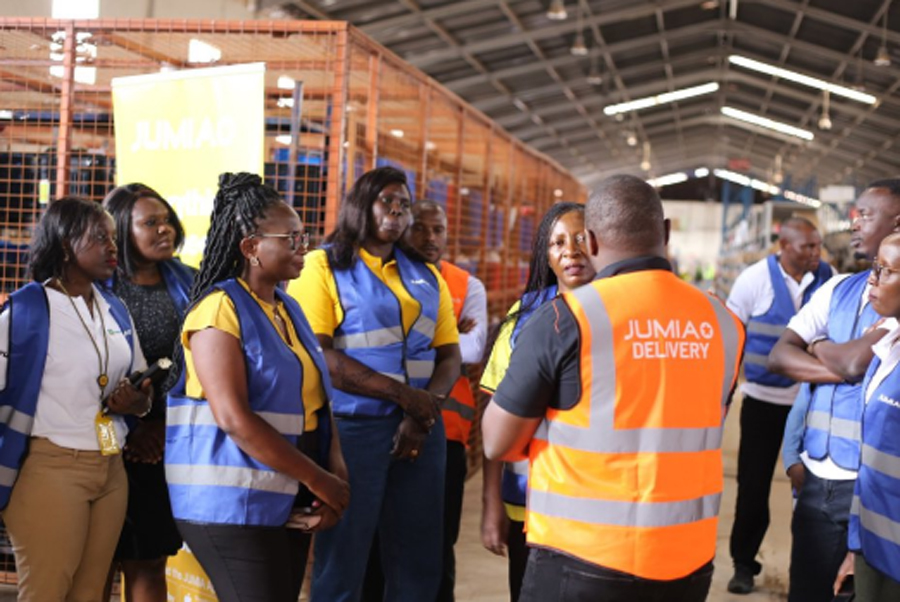
It must also be a logistics company – building, managing, and financing a physical delivery backbone in an environment that resists efficiency.
This hybrid role stretches the business across two very different fronts.
There must be agile tech development on one side, and capital-heavy operational execution on the other.
In effect, Jumia is competing not just with other online retailers, but also with the reality of physical terrain.
This means that every step of its value chain – from warehousing to last-mile drop-offs – must be actively built.
Or it must be tightly coordinated in a region where logistical outsourcing options are limited or unreliable.
And while the company has made strides through Jumia Logistics and select third-party partnerships, the broader cost-to-serve remains steep.
Logistics as the profitability gatekeeper
Jumia’s revised full-year 2025 guidance strikes a delicate balance between ambition and realism.
The company now expects physical goods orders to grow between 25% and 30%.
Additionally, it expects Gross Merchandise Value to expand by 15% to 20%, and losses to narrow to between $45 million and $50 million.
This is a marked improvement from earlier forecasts.
These targets reflect the company’s ongoing operational discipline and growing confidence that it can scale more efficiently.
But they also signal caution: growth must now be paired with tighter execution, not just top-line momentum.
Critically, Jumia has outlined a roadmap to break even on a loss-before-tax basis by the fourth quarter of 2026.
It has set full-year profitability for 2027, which is the clearest signal yet of a long-term path to sustainability, but it’s far from guaranteed.
Achieving these milestones is something that requires more than continued customer growth or marketplace expansion.
One of the decisive factors is expected to be whether Jumia can innovate fast enough and invest smartly enough in logistics infrastructure.
This will meaningfully bend the cost curve, which means reimagining fulfillment not as a burden, but as a core strategic asset.
In here includes expanding localized distribution hubs to reduce delivery times and cutting inter-city transport costs.
One other thing the company is considering is route optimization technologies – including AI-driven logistics planning – deployed at scale.
Many logistics experts think strategic partnerships with local transport networks, boda-boda riders, and third-party logistics startups could unlock last-mile flexibility.
They could also enhance digital innovations, such as real-time order tracking, dynamic dispatching, and automated returns handling.
This can improve efficiency without degrading the customer experience and is not just a question of cost savings.
For Jumia, fulfillment is increasingly the battleground for customer trust and retention.
African consumers are becoming more demanding – not just on price, but on reliability, speed, and service quality.
If Jumia can cut logistical costs while improving the buyer experience, it won’t just survive Africa’s brutal e-commerce environment.
It could emerge as the first true, sustainable e-commerce champion of the continent.
But if these bets fall short, or growth in core markets stalls under macroeconomic pressure, the company risks being caught in a profitless plateau.
A sustainable African e-commerce ecosystem
Jumia’s trajectory underscores a deeper truth about the digital economy in Africa.
While growth metrics – rising orders, active users, expanding gross merchandise value – are important signals, they are no longer sufficient.
This means that for companies to move from promise to profitability, they must contend with invisible but critical physical constraints.
The central challenge is not simply building a platform or acquiring users.
It’s bridging the vast and fragmented space between online demand and physical delivery.
This is done across markets where paved roads are scarce and transport infrastructure is underdeveloped.
This friction in the “real world” is what makes Africa’s e-commerce story different from the Western or Asian models.
Thus, Jumia’s future will not be written in downloads, orders, or revenue alone.
It will be written on the roads, delivery routes, and warehouses where Africa’s e-commerce future will either rise or stall.