Every year, almost like clockwork, a quiet but consequential shift begins to take shape across the banking sector.
It is neither announced nor formally recognized, yet it is deeply understood by those within the industry.
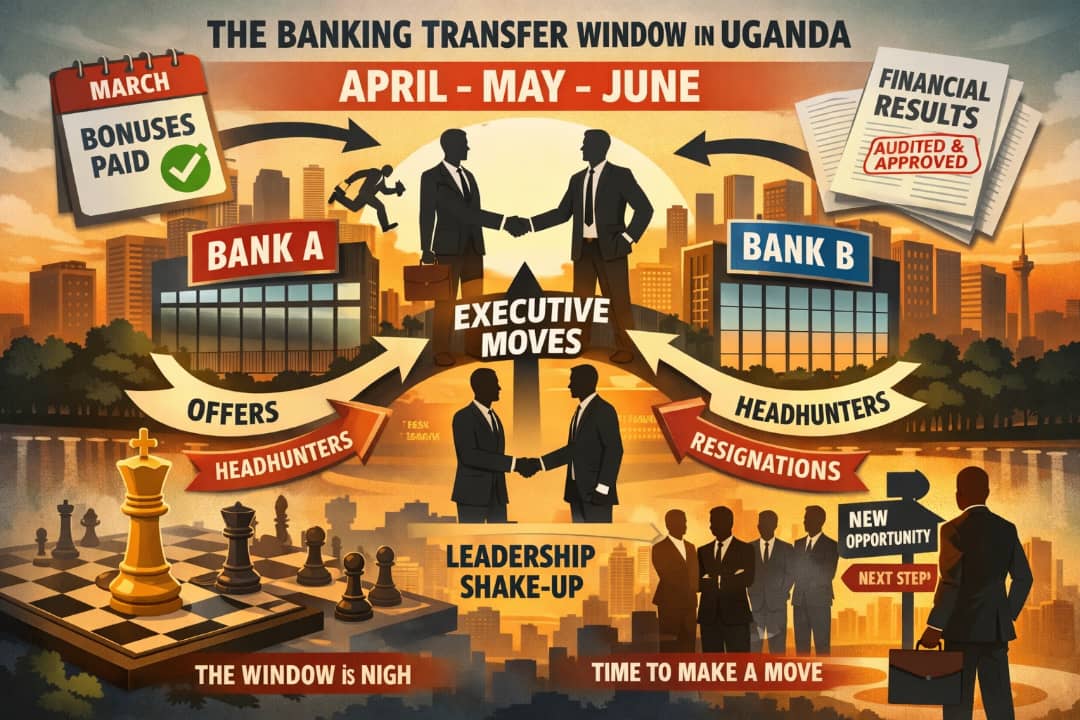
By the time April approaches and May looms, the sector enters what can best be described as its unofficial transfer window, a period when senior executives begin crossing from one bank to another, subtly but decisively reshaping leadership teams, institutional strategies, and the competitive balance of power. And once again, the signals are aligning. The window is nigh.
The rhythm beneath the surface
To the casual observer, executive exits and appointments may appear isolated; individual career decisions made in response to opportunity or dissatisfaction.
But within the banking sector, these movements are anything but random. They follow a disciplined rhythm dictated not by impulse, but by structure.
At the center of this structure lies a simple but powerful truth: no serious banking executive moves before their money is secured.
Senior leaders in the banking industry are not compensated through salary alone. Their earnings are anchored in annual performance bonuses, deferred incentives, and long-term retention rewards, all of which are tied to institutional performance and individual contribution.
These payouts are not immediate. They are calculated after year-end performance assessments, validated through external audits, approved at board level, and in many cases subject to regulatory oversight.
This entire process unfolds over several months, typically stretching from February through March and sometimes into April.
To leave before this cycle concludes is to forfeit a significant portion of earned income. For many executives, this is not a trivial sacrifice. It can amount to hundreds of millions of shillings in bonuses and deferred compensation.
As a result, even those who have secured opportunities elsewhere often choose to wait. They remain in place, biding their time, ensuring that what has been earned is fully realized before any transition is made.
Closure and release
Uganda’s financial reporting calendar reinforces this discipline and provides a natural inflection point. Listed companies, including banks, are required to publish their financial results by the end of March, while non-listed banks typically follow by the end of April.
These deadlines are more than regulatory obligations; they represent the formal closure of the financial year.
By the time results are published, audits have been completed, performance has been publicly recorded, and the internal processes that determine bonus payouts have largely been finalized.
For executives, this moment carries both financial and psychological significance. It marks the end of one performance cycle and the beginning of another.
More importantly, it marks the point at which they are no longer financially tethered to the past year.
Once bonuses are paid and incentives crystallized, the constraints that previously limited mobility begin to fall away.
Executives who were previously locked in by financial considerations are suddenly free to explore new opportunities without penalty.
It is at this precise moment, quietly and without fanfare, that the industry transitions from stability to motion.
When movement becomes action
With the financial year closes and compensation secured, the conversations that have been taking place behind the scenes begin to materialize.
What were once tentative discussions evolve into concrete negotiations. Phone calls turn into meetings, meetings into offers, and offers into resignations.
April and May thus emerge as the months when movement becomes visible. CEOs begin to consider their next chapters. Heads of departments reassess their trajectories.
Boards, armed with fresh performance data, accelerate their succession planning and recruitment efforts. The entire ecosystem becomes more fluid, more dynamic, and more responsive.
This pattern is not incidental; it is borne out by recent appointments across the industry. In March 2025, Stanbic Bank appointed Kenneth Mumba Kalifungwa as chief executive, right at the start of the post-results window.
In April 2023, Charles M. Mudiwa took over as managing director of dfcu Bank, while earlier, on April 1, 2020, Kenneth Mumba Kalifungwa had assumed leadership at Absa Bank Uganda in a similar timeframe.
The cycle consistently extends into May and June: David Wandera was appointed managing director of Absa Bank Uganda on May 5, 2025, and Sanjay Rughani took over as chief executive of Standard Chartered Bank Uganda in June 2022.
Taken together, these appointments underscore a clear industry rhythm; once results are published and bonuses paid, leadership transitions accelerate.
This is the period when the talent chessboard is reset. Banks are no longer constrained by timing or compensation cycles; they are free to act.
And they do so with intent. Unlike in global markets, where executive transitions are often accompanied by large and publicly disclosed buyout packages, Uganda’s approach is more understated.
Here, timing itself serves as the mechanism that enables movement. Executives are not compensated for what they leave behind because, by design, they leave nothing behind. They wait, they earn, and then they move.
The silent war for talent
 6 Ugandans Arrested in Connection to USD 3.4 Mn Equity Bank Rwanda Digital Heist
Beneath the surface of these movements lies a deeper dynamic; a quiet but intense competition for talent. Banks are not merely filling vacancies; they are strategically targeting individuals who can strengthen their institutions and weaken their rivals.
A well-placed hire can have far-reaching implications, influencing everything from deposit mobilization and lending strategies to digital transformation and risk management.
In an industry where products are often similar and differentiation is increasingly difficult, leadership becomes a critical source of competitive advantage.
The right executive can unlock new growth, drive cultural change, and reposition an institution in the market. Conversely, the loss of a key leader can create vulnerabilities that competitors are quick to exploit.
This is why the April–May window is so significant. It is not simply a period of movement; it is a moment of recalibration.
It is when banks reassess their strengths and weaknesses, identify gaps, and act decisively to address them. It is, in essence, a silent war for talent, fought not through public declarations but through strategic hires and carefully timed departures.
Boards in reflection mode
For boards of directors, the period immediately following the release of financial results is one of introspection. The numbers tell a story, and that story often raises difficult questions.
Where performance has fallen short, boards must consider whether the issue lies in strategy, execution, or leadership. Where results have exceeded expectations, they must determine how to sustain momentum.
This process of reflection naturally leads to evaluation. Do we have the right leadership team for the next phase of growth? Are we sufficiently competitive in key segments such as corporate banking, SMEs, or digital services? Are we positioned to respond to emerging risks and opportunities?
Where the answers are unsatisfactory, change becomes inevitable. And because the broader market is simultaneously entering its period of mobility, boards have access to a wider pool of talent.
This convergence of internal need and external availability creates a powerful catalyst for executive movement.
The executive decision point
For executives, the post-results period is equally significant. Having seen their institution’s performance and received their compensation, they are confronted with a set of fundamental questions.
Are they valued within their current organization? Is there a clear path for growth and advancement? Does the bank’s strategy align with their own ambitions? And perhaps most importantly, are there better opportunities elsewhere?
The clarity that comes with financial closure often sharpens these considerations. For some, the answer is to stay, to build on existing momentum and pursue the next phase of growth within their current institution. For others, it is to move, to seek new challenges, new environments, and new opportunities for impact.
It is this collective process of evaluation, taking place simultaneously across multiple institutions, that gives rise to the broader pattern of movement observed during the April–May window.
A distinctly Ugandan model
While the concept of an executive transfer window is not unique to Uganda, the mechanisms that underpin it are distinctly local.
In more developed markets, executive mobility is often facilitated by large buyout packages designed to compensate individuals for forfeited bonuses and incentives. These arrangements are typically disclosed and can reach substantial sums.
In Uganda, such practices are far less common. Compensation structures are less transparent, and large, explicit buyouts are rare.
Instead, the system relies on timing. Executives simply wait until their financial obligations are fulfilled and their incentives secured before making a move. It is a quieter, more organic approach, but one that achieves the same outcome.
There are, however, exceptions to the pattern. In January 2023, Mathias Katamba was appointed chief executive officer of dfcu Bank, while Gift Shoko took over as managing director of Equity Bank Uganda in January 2024, both appointments occurring well before the traditional window.
More recently, Claver Serumaga was appointed executive director at Equity Bank in July 2025, slightly outside the typical April–June cycle.
Such cases are relatively rare and often driven by urgency, strategic shifts, or unique institutional circumstances. They do not overturn the pattern, but rather highlight how strong it is.
The window is nigh
As the current financial year draws to a close and banks move toward publishing their results, the familiar conditions are once again falling into place. Audits are being finalized, boards are reviewing performance, and compensation structures are being completed. Behind the scenes, conversations are already underway, and decisions are being made.
Some executives have chosen their next destinations. Others are still weighing their options. Boards are preparing for transitions, and headhunters are actively engaging with potential candidates. The pieces are moving, even if the full picture has yet to emerge.
What follows will not be unexpected. Announcements will come, some sudden, others anticipated. Movements will occur, some high-profile, others less visible. And across the sector, the ripple effects will begin to take shape.
Because in Uganda’s banking industry, this is not an anomaly. It is a cycle. A predictable, structured, and deeply embedded phase in the annual rhythm of the sector.
And as April approaches, one thing is clear. The window is not just approaching. The window is nigh.