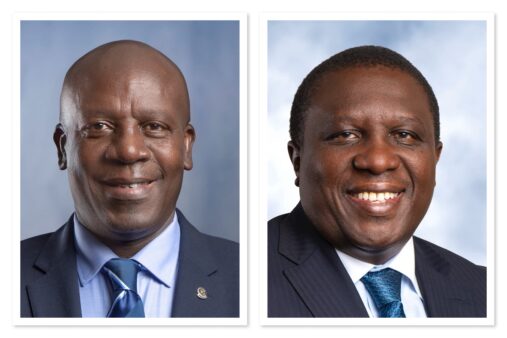
African Export-Import Bank (Afreximbank) shareholders have appointed Dr George Elombi as the next president and chairman.
The appointment marks a pivotal leadership transition as the continent’s premier trade finance bank seeks to become a $250 billion financial powerhouse over the next decade.
Dr Elombi, a Cameroonian and long-serving executive within the bank, will officially take over in September 2025, succeeding Professor Benedict Oramah, whose tenure since 2015 saw Afreximbank expand its balance sheet, influence, and mandate.
Elombi becomes the fourth president of the bank since its founding in 1993.
The announcement, made during the bank’s 32nd Annual General Meeting, comes at a critical moment when Africa is grappling with rising financing needs for industrialization, energy access, trade facilitation, and climate-aligned infrastructure.
The choice of an insider with deep institutional memory signals a preference for continuity amid this ambition.
A challenge of execution
Dr Elombi joined Afreximbank in 1996 as a legal officer and rose through the ranks, most recently serving as Vice President for Governance, Legal and Corporate Services.
His institutional roots make him a natural successor—one steeped in the bank’s evolution from a niche trade finance entity to a continental development catalyst.
His previous roles included Chair of the Emergency Response Committee—where he led the mobilization of over $2 billion for Covid-19 vaccine acquisition across Africa and the Caribbean—and head of equity mobilization and investor relations, helping lift ordinary equity to $3.6 billion by April 2025.
In his acceptance speech, Dr Elombi reaffirmed the bank’s vision to industrialize Africa and “regain the dignity of Africans wherever they are.”
His immediate challenge will be navigating Afreximbank through a tougher financial climate marked by a downgrade by global rating agency Fitch, which in 2025 revised the bank’s rating from BBB to BBB- with a negative outlook.
Fitch cited rising non-performing loans – 7.1 percent against the bank’s stated 2.44 percent – largely tied to sovereign exposures in Ghana, Zambia, and South Sudan, alongside concerns over risk management and reporting transparency.
The downgrade could raise Afreximbank’s cost of funds, increasing borrowing costs for its clients, many of whom are small and medium-sized African enterprises.
The $250 billion question
Afreximbank’s total assets stood at $40.1 billion at the end of 2024, with $7.2 billion in shareholder funds.
Achieving the $250 billion target will require not just asset growth but also disciplined capital allocation, improved risk controls, and greater confidence from capital markets.
The bank holds investment-grade ratings from six agencies, including Moody’s (Baa1), GCR (A), JCR (A-), and CCXI (AAA).
Yet sustaining these ratings while scaling up aggressively will require navigating the very governance and credit concerns now flagged by Fitch.
 Shashi Dhar Drives Bank of Baroda Uganda Profit to UGX 156.8 Billion After Three Years of Strong Growth
The incoming president is looked at as one that must balance ambition with prudence, growth with credibility.
His success will rest not just on legacy continuation but on reforming internal systems to withstand greater scale, regulatory scrutiny, and global financial volatility.
Energy, trade, and institutional leverage
The African Energy Chamber (AEC) has already endorsed Dr Elombi’s appointment, citing the bank’s expanding role in energy financing – from upstream oil and gas to downstream infrastructure, renewables, and energy access.
Afreximbank is also behind the new African Energy Bank, a $5 billion initiative set to provide targeted funding for Africa’s energy needs, complementing broader trade and industrial financing under the African Continental Free Trade Area (AfCFTA).
Under Oramah, Afreximbank helped birth the Pan-African Payments and Settlement System (PAPSS), a cornerstone of the AfCFTA, and increased intra-African trade financing with a goal of doubling it from $20 billion in 2021 to $40 billion by 2026. In 2024 alone, the bank disbursed $20 billion in trade finance.
The question now is whether Dr Elombi can not only preserve this momentum but expand it. Afreximbank’s mandate is increasingly intersectional, cutting across trade, finance, development, and climate.
Its role as a development financier is being tested in an era where concessional capital is scarce, and geopolitical alignment increasingly matters.
Leadership change as strategic signal
While his predecessor, Professor Oramah, is credited with institutional innovations and expanding the bank’s reach across multiple sectors, Dr Elombi inherits a more complex operating environment.
External pressures—from global interest rates to geopolitical uncertainty—combine with internal demands for transparency, efficiency, and measurable impact.
Still, Dr Elombi’s insider status gives him a crucial advantage: the ability to hit the ground running without a disruptive learning curve.
The rigorous selection process initiated in January 2025 underscores the bank’s strategic intent to manage succession with minimal turbulence.
Educated in Cameroon and the UK—with a law degree from the University of Yaoundé, a master’s from the London School of Economics, and a doctorate in commercial arbitration—Dr Elombi brings legal, academic, and institutional depth to the role.
But what will matter most now is executive agility.
Afreximbank’s decision to promote from within reflects a bet on institutional continuity during a period of strategic stretch.
As it aims to quintuple its size in a decade, deepen its impact, and respond to a more volatile global landscape, leadership alone won’t be enough.
It is something that would require recalibrated risk models, tighter governance, and closer alignment with African states’ priorities.