For decades, Uganda’s trade story has been defined by its deepening integration into regional markets, rising dependence on Asia, and enduring ties with Europe.
But when you look past the big numbers and focus on balance of trade, who buys more from Uganda than Uganda buys from them, the picture of Uganda’s “real” trading partners changes dramatically.
Uganda’s external trade has expanded significantly in the past five years.
Exports more than doubled from $5.3 billion in the 2020/21 financial year to $10.6 billion in the 2024/25 financial year.
Imports also rose, from $8.3 billion to $13.2 billion over the same period.
Despite strong export growth, Uganda consistently runs a trade deficit, spending more on imports than it earns from exports.
But the balance varies sharply depending on the country and region. Some partners are overwhelmingly net buyers of Ugandan products, while others flood the country with goods and buy little in return.
The data in this analysis is drawn from the Bank of Uganda’s Direction of Trade statistics.
UAE towers above all
No partner illustrates Uganda’s shifting trade fortunes more clearly than the United Arab Emirates.
In the 2024/25 financial year, Uganda exported $3.56 billion worth of goods to the UAE, while importing just $958 million.
That surplus of more than $2.6 billion makes the UAE Uganda’s single most important “real” trading partner.
The bulk of these exports are dominated by re-exports and high-value commodities such as gold, which transit through Dubai.
Other Middle Eastern countries like Saudi Arabia and Israel trade with Uganda, but on a much smaller scale, and often at a deficit.
Neighbours matter most
Closer to home, Uganda’s trading heartbeat lies in the region, particularly within COMESA and the East African Community.
South Sudan is a vital surplus market. Uganda exported $496 million to Juba in 2024/25, while importing only $36 million, a trade surplus of about $460 million.
DR Congo has emerged as another export giant, with $543 million in exports against $43 million in imports, a surplus of $500 million.
Rwanda, too, has turned into a strong buyer, taking in $292 million against just $31 million in imports.
Burundi consistently absorbs Ugandan goods, with a modest but positive balance.
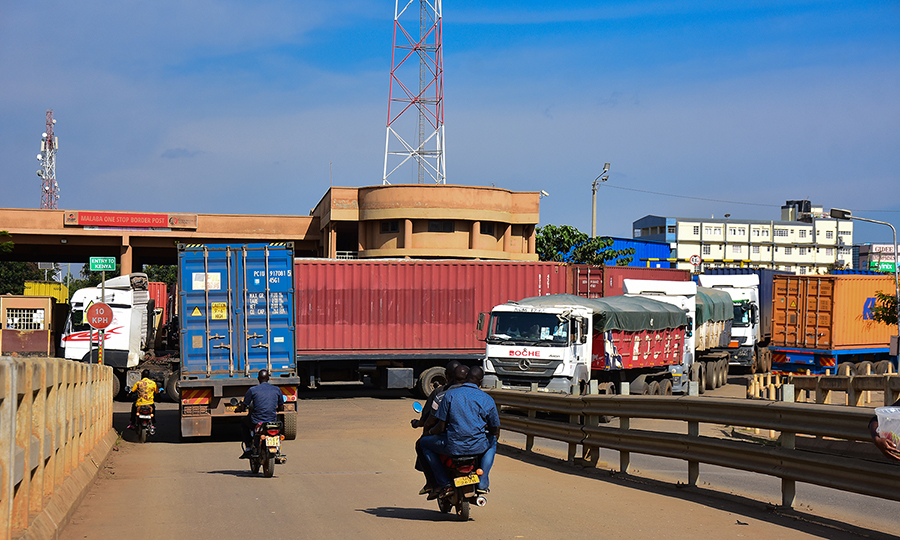
On the other hand, Uganda bleeds trade value to some neighbours. Kenya remains a key partner, but it is a deficit market.
Uganda imports $1.2 billion worth of goods from Kenya, but exports only $566 million.
Tanzania has, in recent years, emerged as a deep deficit partner, especially as Uganda sources petroleum and manufactured goods from Dar es Salaam, with $2.21 billion in imports versus $192 million in exports in the 2024/25 financial year.
Egypt is another consistent deficit partner, with imports outstripping exports nearly fivefold.
Europe: A market for Uganda’s coffee and commodities
 Ruparelia Foundation to Hold Free Eye Camp in Bukedea in Honour of Rajiv Ruparelia
Uganda’s historical ties with Europe continue to pay off, with the balance tilting in Kampala’s favour.
Collectively, the European Union imported $1.93 billion worth of Ugandan goods in the 2024/25 financial year, while exporting just $772 million back.
Italy stands out as a star partner, taking in $931 million of Ugandan exports, mainly coffee, while supplying just $107 million, a surplus of more than $824 million.
Germany, the Netherlands, and Belgium are also strong net buyers of Ugandan goods.
This makes the EU bloc Uganda’s second most important “real” partner after the UAE, not only in volumes but also in the favourable balance of trade.
Asia: The deficit giants
Asia is Uganda’s largest import source but also its biggest trade headache. Uganda imported $2.34 billion from China in the 2024/25 financial year but exported only $118 million, a staggering deficit of more than $2.2 billion.
India presents a similar story, with imports hitting $1.22 billion against just $177 million in exports, leaving a deficit of $1.04 billion.
Japan and Malaysia follow the same pattern, with deficits in the hundreds of millions.
The only bright spots are niche markets like Hong Kong, where Uganda exported $768 million against $10 million in imports.
This was largely driven by commodity re-exports.
The Americas: Small but balanced
Uganda’s trade with the Americas is modest but relatively balanced. With the US, Uganda exported $135 million and imported $144 million in the 2024/25 financial year, almost even.
Canada is similarly balanced, with Uganda exporting $28 million and importing $33 million. This contrasts with the structural deficits Uganda faces in Asia.
The Top 10 “real” partners
When measured by balance of trade, Uganda’s top surplus partners in the 2024/25 financial year were the UAE, Italy, Hong Kong, DR Congo, South Sudan, Rwanda, Germany, the Netherlands, Burundi, and Belgium.
By contrast, the top deficit partners were China, Tanzania, India, South Africa, Kenya, Japan, Malaysia, Egypt, Saudi Arabia, and Indonesia.
The numbers tell a story that is often obscured by aggregate figures.
Uganda’s “real” trading partners are not necessarily those with the highest trade volumes.
They are those who contribute positively to the country’s trade balance.
By that measure, the UAE, the EU, especially Italy, Germany, and the Netherlands, and regional neighbours like South Sudan, DR Congo, Rwanda, and Burundi, emerge as the most reliable trading partners.
Thus, as Uganda looks to diversify and strengthen its export base, these imbalances raise tough questions.
Can Uganda turn deficit markets into more balanced relationships?
Or should it double down on surplus partners where its goods are already in demand?