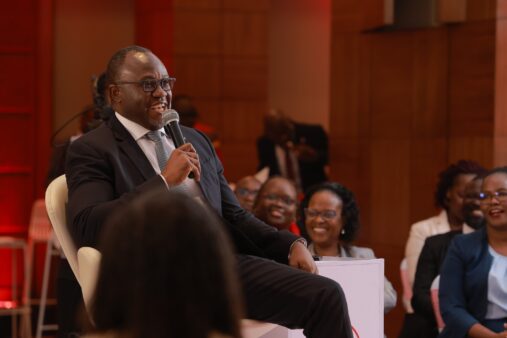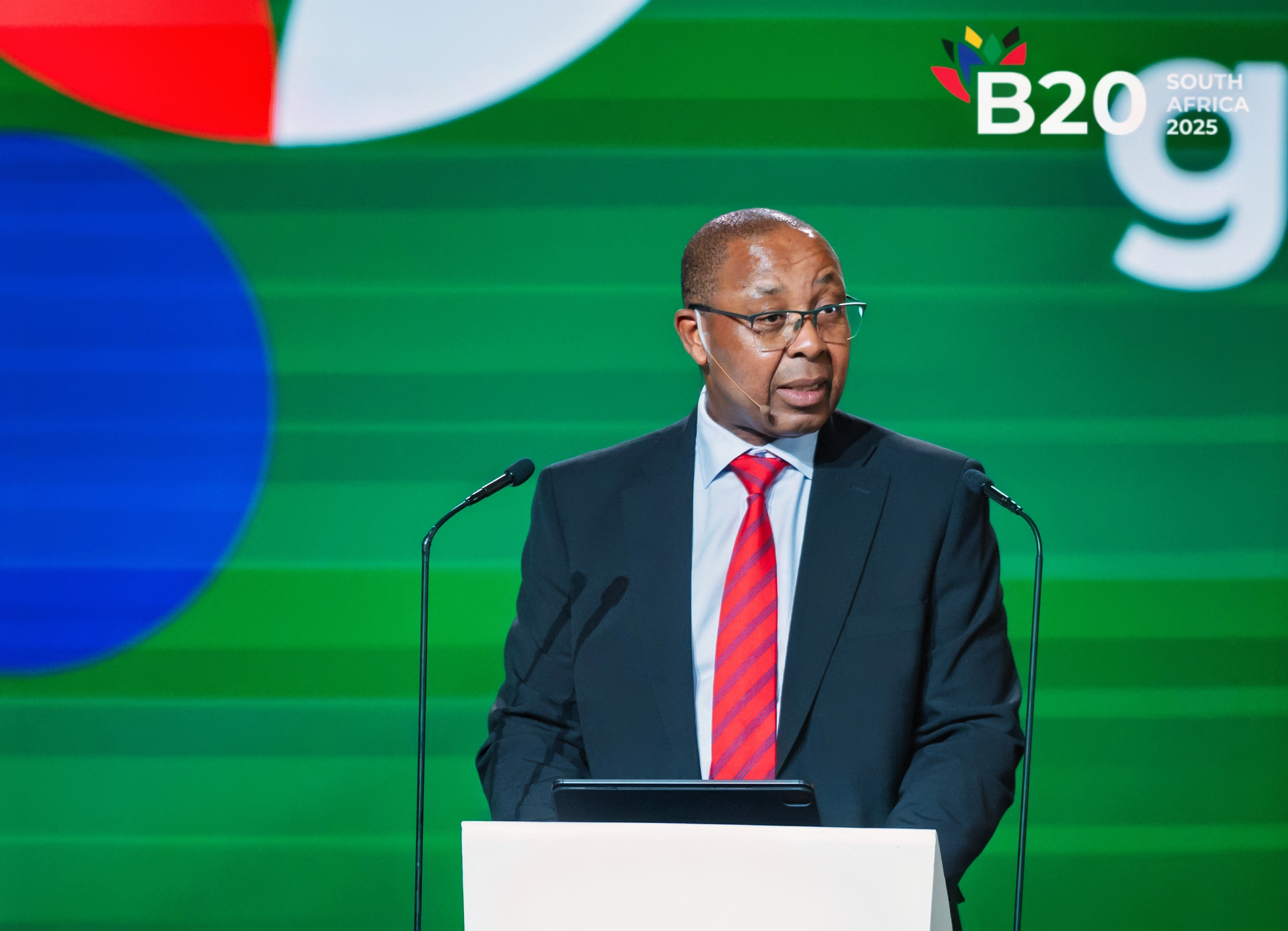
When Kenny Fihla walked onto the stage at the B20 Summit in Johannesburg, there was a sense that the room was bracing for more than a corporate address.
As the Group Chief Executive Officer of Absa Group, one of Africa’s most influential financial institutions, he arrived with a message that felt both urgent and momentous.
Africa, he argued, is standing at a rare inflexion point, one shaped by shifting global dynamics and the continent’s own emerging strengths.
And if the room expected a predictable speech filled with familiar development clichés, they quickly realised they were in for something different.
Fihla began by calling attention to what the world already senses. The global economic landscape is transforming faster than the frameworks intended to interpret it.
Economic headwinds, geopolitical realignments, and waves of technological disruption are redrawing the map of opportunity and risk.
Yet Africa, instead of being overwhelmed by volatility, is entering what he described as a “moment of possibility that is both fragile and extraordinary.”
That possibility hinges, above all, on Africa’s people. With over 60 per cent of Africans under the age of 25, the continent boasts the world’s youngest population.
Citing a January 2024 World Economic Forum report, Fihla reminded delegates that by 2050, one in every four people on earth, and more than a third of the world’s youth aged 15 to 24, will be African.
This is more than a demographic trend. It is a tectonic shift in global labour, consumption, innovation, and leadership.
Africa’s youthfulness, he said, is not just a competitive advantage. It is the continent’s “most valuable untapped asset,” capable of redefining economic possibilities if nurtured with the right infrastructure, digital access, and skills.
But Africa’s promise does not end with its demographics. The continent sits on 65 per cent of the world’s uncultivated arable land, giving it unmatched leverage in global food security.
Its mineral wealth is equally formidable, with a dominant share of strategic minerals such as Platinum Group Metals, cobalt, and manganese, all essential to the global energy transition. Africa’s natural wealth,
Fihla emphasised that the continent is not a marginal resource supplier but a central player in the world’s agricultural and clean energy future.
And yet, the paradox persists. Africa is overflowing with opportunity, but constrained by the mechanisms required to unlock it.
The continent continues to face an 80 billion dollar annual infrastructure financing gap, a figure drawn from a November 2023 African Development Bank report.
Layered on top of this are regulatory inconsistencies, governance weaknesses, and corruption, factors that distort investor sentiment, impede cross-border trade, and inflate the cost of capital.
These are not incidental challenges. There are structural barriers that keep Africa from realising its full potential.
What stood out, however, was Fihla’s refusal to accept these constraints as permanent fixtures.
His tone was steady, solutions-oriented, and even defiant. Financial institutions like Absa, he insisted, must take responsibility for reshaping the landscape.
Absa is already structuring social infrastructure projects using blended finance and risk-sharing mechanisms, approaches designed to attract private investment while easing pressure on governments.
The message was unmistakable. Africa cannot wait for perfect conditions. It must innovate its way through imperfection.
It was when Fihla shifted to digital transformation that his vision became even sharper. In today’s world, he said, digital infrastructure is as critical as physical infrastructure.
And Africa is already demonstrating global leadership. Sub-Saharan Africa accounts for 70 per cent of global mobile money transactions, with Kenya, Ghana, and South Africa at the forefront.
This is not simply about convenience. It is a revolution in financial inclusion.
People previously locked out of formal systems are now transacting, saving, building micro businesses, and participating in the economy in ways unthinkable a decade ago.
He referenced the 2024 African Banking Digital Transformation Report, which found that nearly 60 per cent of African banks have digitally transformed most of their operations, and 76 per cent rank digital transformation among their top three strategic priorities. These shifts reflect more than tech enthusiasm.
They represent a banking sector bracing for a future built on AI-driven platforms, omnichannel strategies, and blockchain-enhanced payments.
 Ruparelia Group Wins Key Entebbe Land Case, Clearing Path for the New Mega Speke Resort and Convention Centre, Entebbe
Stablecoins, he noted almost casually, are already becoming a significant part of transaction volumes in Sub-Saharan Africa, signalling a new frontier for cross-border payments and financial efficiency.
“Banks that embrace these innovations responsibly,” he said, “will lead the next chapter of growth.”
The implication was stark. Those who fail to adapt will be left behind.
One of the most poignant moments came as he turned to the fate of small and medium-sized enterprises, arguably Africa’s most dynamic but most constrained sector.
SMEs represent the vast majority of private businesses worldwide, yet in Africa, access to credit remains one of the largest barriers to scaling.
Too many promising ventures collapse under the weight of financing limitations, insufficient collateral, or risk models that fail to capture Africa’s entrepreneurial reality.
Fihla highlighted emerging SME solutions from development finance institution programmes to public-private partnership funds aimed at reducing investment risk.
Absa is building funding value chains that link banks, development partners, and fintechs to improve working capital access.
He pointed to Absa’s partnership with the SheTrades Commonwealth+ Programme, which aims to equip 10,000 Kenyan women entrepreneurs with skills and trade opportunities, and to tailor enterprise development programmes in South Africa targeting women and youth.
Supporting SMEs, he made clear, is not philanthropy. It is an economic strategy.
Still, no discussion about African growth is complete without confronting the continent’s prohibitively high cost of capital.
According to a United Nations Development Programme study, Africa loses roughly 75 billion dollars annually because of inflated risk premiums and credit ratings that often misrepresent economic fundamentals.
This distortion affects everything. Debt affordability, infrastructure investment, SME credit, and ultimately, growth.
The good news is that momentum is building toward reform.
Fihla referenced the Financing Africa Forward Summit and proposals for a Cost of Capital Commission, both aimed at improving global financial architecture, enhancing data transparency, and shifting global perceptions of Africa from aid-dependent to investment-ready.
To illustrate what is possible when collaboration meets ambition, he offered the example of the Lobito Corridor initiative.
Once completed, it will slash mineral export times from 25 days to just 6 days, unlocking new trade routes for cobalt and copper, minerals crucial to electric vehicles and clean energy supply chains.
And then there is the African Continental Free Trade Area. With its promise to connect 1.3 billion people and integrate a 3.4 trillion dollar GDP, it is the largest free trade area in the world.
If fully implemented, Fihla noted, it could lift tens of millions of people out of extreme poverty and boost incomes across the continent by 10 per cent.
This is the Africa he sees emerging, connected, ambitious, industrialising, and ready to claim its place in the global economic order.
By the time he wrapped up, Fihla had painted a picture that was unsparing in its realism yet deeply optimistic. Africa has gaps, serious ones.
But it also has unparalleled potential, rising regional cooperation, expanding digital infrastructure, and a young population brimming with possibility.
He closed with a call to action, urging financial institutions, policymakers, and business leaders to embrace bold thinking, shared accountability, and an unwavering focus on resilience and inclusion.
“History will only bend in Africa’s favour,” he implied, “if its leaders choose to make it so.”
As I walked out of the summit hall, those words echoed in my mind. Africa is no longer asking whether it is ready for transformation. It is asking whether its leaders and its institutions are ready to rise to the moment.
And according to Kenny Fihla, that moment is now.