
Hardly two weeks after Absa Group CEO Kenny Fihla concluded a high-level working visit to Nairobi, Kenya, the Group this week announced that it had hired Sitoyo Lopokoiyit as its new Head of Personal and Private Banking — a move that reads less like a leadership reshuffle and more like a strategic declaration.
During that Nairobi visit, Fihla was unusually direct about Absa’s intentions in Kenya and the wider East African corridor. In an interview with Business Daily, he confirmed the bank was actively exploring acquisition opportunities in Kenya, signalling a renewed appetite for inorganic growth and a determination to rebuild Absa into a scale player in a retail market it once dominated.
“We are always on the lookout for opportunity, be they organic or inorganic… Fortunately, Kenya and many of the countries in East Africa have a very conducive environment for us to be looking at inorganic growth,” Fihla said.
He added that Absa had not yet landed on a specific deal, but that the search was active and deliberate.
“We have not yet come across anything, but we continue to look, we continue to explore and at the right time we will do what is necessary to ensure that our business grows.”
In the same interview, Fihla laid out the strategic logic behind Absa’s retail push with unusual clarity: scale, deposits, liquidity and relevance.
“Ultimately, we want to be a scale player because banking is about scale,” he said.
And perhaps most tellingly, he framed the retail segment not as a vanity play, but as the foundation of Absa’s balance-sheet strategy:
“The retail market is very attractive to Absa Bank… First, it helps us to gather liabilities or liquidity that is required for us to lend to clients,” Fihla said.
Then came the line that read almost like a manifesto for a bank still rebuilding its post-Barclays identity:
“Secondly, you cannot call yourself an African bank if you are not relevant to the people who live in Africa and make sure that people have access to the financial system.”
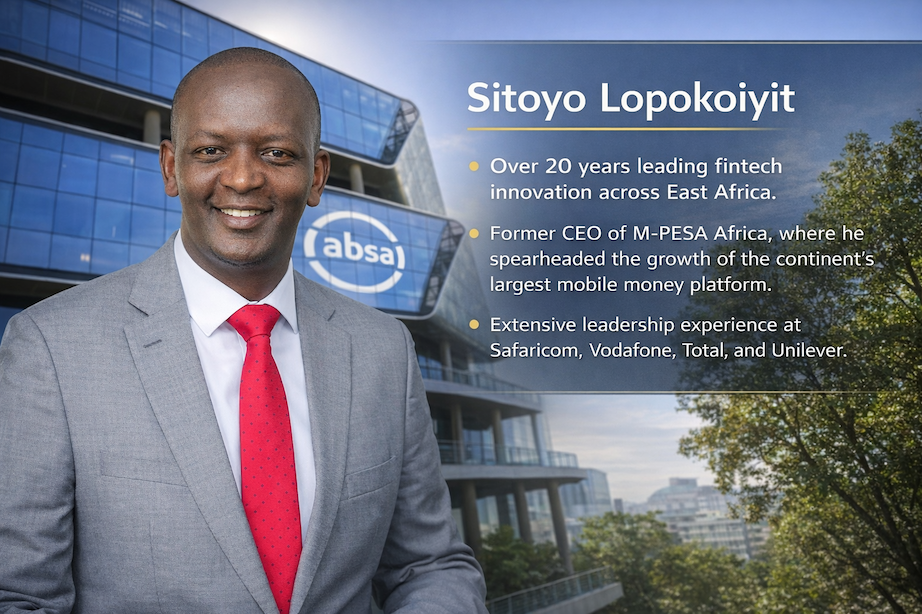
Against that backdrop, the announcement of Sitoyo Lopokoiyit’s appointment begins to look less coincidental and more calculated. If Absa is serious about scale, retail relevance and deposit mobilisation in East Africa, then importing one of the continent’s most accomplished fintech platform builders is not merely a leadership upgrade — it is a structural move designed to align execution with ambition.
Sitoyo is not your everyday hire. He is not a conventional banker shaped by branch networks, credit committees and treasury rotations. Sitoyo is a fintech ecosystem architect — a leader forged in the logic of platforms, merchant aggregation, data-driven product layering and customer-scale distribution across multiple African markets.
Seen through that lens, Kenny Fihla’s decision signals something far more consequential than executive succession. It suggests Absa is aligning its leadership bench with its continental ambition. The bank is not simply refreshing management; it is recalibrating for the next phase of Africa’s financial evolution — one defined by fintech convergence, digital-first behaviour, platform economics and an intensifying contest for deposits, engagement and everyday financial relevance.
A Broader Executive Reset Under Kenny Fihla
Sitoyo Lopokoiyit’s appointment did not occur in isolation. It formed part of a wider cluster of senior leadership changes that underscore how decisively Absa Group CEO Kenny Fihla has been reshaping the bank’s executive bench since assuming office in June 2025.
On 11 February 2026, Absa announced a package of strategic executive appointments designed to strengthen leadership depth, governance capability and institutional resilience across the Group. Alongside Sitoyo’s confirmation as Chief Executive, Personal and Private Banking, the bank confirmed three other key moves effective 1 March 2026.
Prabashni Naidoo transitioned from Group Chief Internal Audit Executive into a newly reconstructed role as Group Chief Governance Officer, consolidating Legal, Compliance and Group Secretariat into one expanded portfolio. In the same announcement, Rushdi Solomons was appointed Group Chief Internal Audit Officer, succeeding Naidoo. Absa also appointed Fatima Newman as Chief Compliance Officer, further strengthening its compliance bench.
These February changes followed an earlier strategic leadership realignment announced in September 2025, in which Absa introduced a new executive architecture explicitly aimed at accelerating its Pan-African strategy. In that reshuffle, former Interim Group CEO Charles Russon assumed the newly created role of Group Executive: Africa Regions, formalising Africa markets as a central performance engine within the Group. Absa also confirmed the appointment of Zaid Moola as Chief Executive: Corporate and Investment Banking, effective January 2026, subject to regulatory approval. In the same announcement, Musa Motloung joined as Group Strategic Risk Officer, reporting to the Group Chief Risk Officer.
Taken together, the appointments point to a Group CEO building not just a leadership team, but a leadership architecture — one designed to deliver faster execution, stronger governance, and sharper customer relevance across Africa. Yet the most strategic signal may lie not in the governance or risk appointments, but in where Absa appears to be placing its growth emphasis.
In recent months, Fihla has increasingly framed East Africa as the next major theatre for Absa’s expansion — a region he has described as a “huge growth opportunity.” And during his February 2026 working visit to Nairobi, as well as his July 2025 engagements in Kampala, Uganda, he went further, openly signalling Absa’s appetite for scale, inorganic growth, and deeper retail penetration across Kenya and the wider East African corridor.
Understanding the Sitoyo Factor
Before Sitoyo Lopokoiyit’s appointment can be fully understood, it must first be read through Kenny Fihla’s own stated worldview about where banking is headed — and what role fintech will play in Absa’s next chapter.
In his July 2025 interview with CEO East Africa Magazine, Fihla was unusually blunt about the competitive reality banks now face. He acknowledged that fintechs have structurally reshaped financial services by building new cost models and customer experiences that traditional banks cannot simply outcompete through legacy scale.
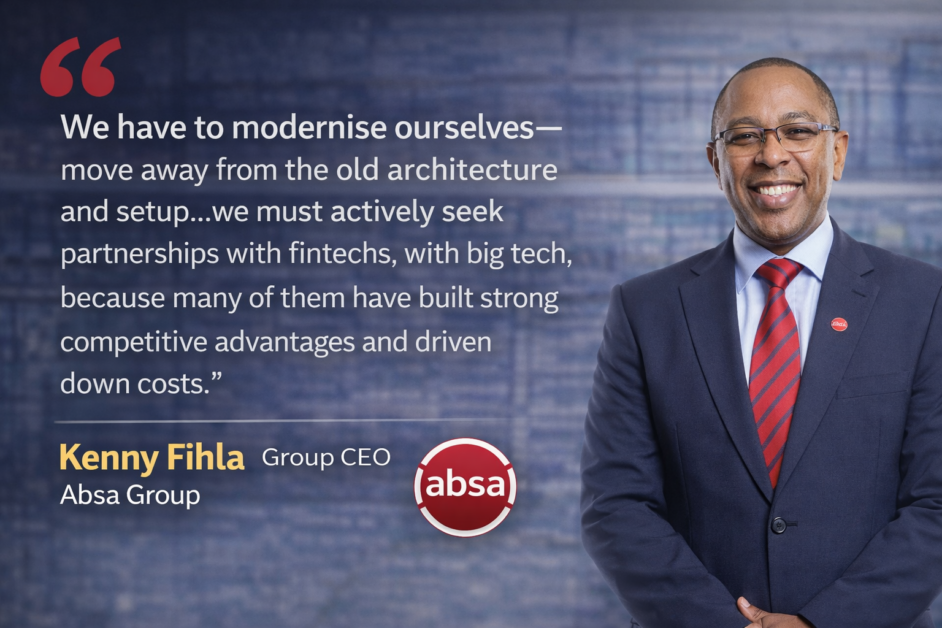
“Second, we must actively seek partnerships with fintechs, with big tech…”, Kenny said.
He went further, conceding that fintechs have created advantages that banks cannot unwind:
“Many of them have built strong competitive advantages and driven down costs.”
“We won’t be able to reverse those cost structures.”
Fihla’s position was clear: the future is not a bank-versus-fintech contest. It is a convergence era in which Absa must modernise, partner and integrate — or risk being outflanked. As he put it: “So, instead of competing head-on, we need to partner and find ways to complement what they offer, bringing our strengths into that equation.”
It is against that strategic backdrop that Sitoyo’s hiring begins to look less like an executive recruitment and more like a blueprint decision — fintech leadership being deliberately inserted into the heart of Absa’s retail engine.
This Is About Retail Reinvention, Not Maintenance
Absa’s Personal and Private Banking division is not a peripheral portfolio. It is the retail core of the Group — overseeing deposits, consumer lending, private banking, wealth, and digital channels.
 Shashi Dhar Drives Bank of Baroda Uganda Profit to UGX 156.8 Billion After Three Years of Strong Growth
Placing a fintech architect at the helm of that franchise signals intent. Absa does not plan to preserve retail banking as it has traditionally been practised. It intends to rebuild it.
Fihla made that philosophical shift explicit in the same July 2025 interview when he said: “Customer experience is the only true differentiator. Most banks offer similar products.”
That line reframes the battlefield. If products are commoditised, then interface, integration and daily relevance become decisive.
Sitoyo’s track record at M-PESA was not built on branch expansion or balance-sheet optimisation. It was built on platform thinking — scaling merchant networks, embedding payments into daily life, layering credit and savings products onto transaction rails, and driving customer adoption through ecosystem design.
In effect, Absa is not simply hiring someone to manage retail performance. It is recruiting someone who understands how to turn a financial institution into a customer platform.
Speed and Platform Architecture
Fihla has been equally clear that modernisation cannot be cosmetic.
He described the legacy banking architecture in plain terms: “If you wanted a credit card, it was processed on one system; a home loan, on another, and so on.”
That fragmentation, he implied, is no longer sustainable.
“First, we have to modernise ourselves—move away from the old architecture and setup.” “So clearly, modernisation is not optional.”
For a bank of Absa’s scale, modernisation is not merely about upgrading apps. It is about unifying customer data, integrating product systems, and enabling seamless cross-product experiences.
M-PESA’s continental evolution required precisely that mindset: integrated rails, interoperable systems, and rapid product iteration across multiple markets.
Sitoyo’s experience is not theoretical digital fluency. It is lived execution across Kenya, Tanzania, Mozambique, Lesotho, Ghana and Ethiopia — markets where scale and integration are existential, not experimental.
If Absa intends to accelerate its retail transformation, importing a leader forged in that environment is a logical move.
A Deposit War in the Digital Era
Retail banking remains, fundamentally, a deposit business. Deposits fund lending. Lending drives earnings. Liquidity underpins growth.
But deposits are no longer passively retained through brand familiarity or branch footprint. Customers increasingly move money fluidly between banks, wallets, fintech apps and embedded platforms.
The deposit war is no longer fought on high streets. It is fought on screens and handheld devices.
Sitoyo understands that behavioural shift intimately. M-PESA’s dominance was built on daily engagement — paying bills, sending money, accessing credit, managing micro-savings — not episodic transactions.
Fihla, meanwhile, recognises the enduring advantage banks retain: “Customers still trust banks, and trust is the foundation of banking.”
That trust is Absa’s structural asset. But trust alone is not enough. The next contest is about relevance — who owns the daily interface.
Hiring Sitoyo suggests Absa intends to combine its trust advantage with fintech-grade engagement design.
Culture Shift: From Process to Outcome
Fihla’s vision extends beyond systems and strategy. It is also cultural.
“So, the second priority is shifting the organisation from being process-driven to outcome-driven.”
Fintech firms are built around outcomes: instant onboarding, frictionless payments, rapid credit approval, seamless interfaces. Banks, by contrast, often default to internal controls and layered approvals that customers experience as friction.
Sitoyo’s career has been built in outcome-driven environments where user adoption determines survival. Embedding that mindset into Absa’s retail core could prove as significant as any systems upgrade.
But make no mistake, none of this suggests Absa is abandoning its institutional DNA. Fihla has been clear about the bank’s regulatory and fiduciary responsibilities: “Banks operate under a much more stringent regulatory environment, and that gives us a responsibility to continuously upgrade our systems.”
The strategy for Absa is not to become a fintech. It is to evolve banking — without surrendering the trust foundation that has always defined it.
Africa’s financial landscape is converging at speed. Telecom operators are deepening their financial services footprint. Fintechs are expanding aggressively into credit and savings. Big tech is embedding payments into platforms that sit between banks and customers. In that environment, inertia is no longer caution — it is strategic risk.
Under Kenny Fihla, Absa is not merely modernising its systems. It is repositioning the institution itself — for speed, for convergence, and for sustained relevance in Africa’s next financial chapter.