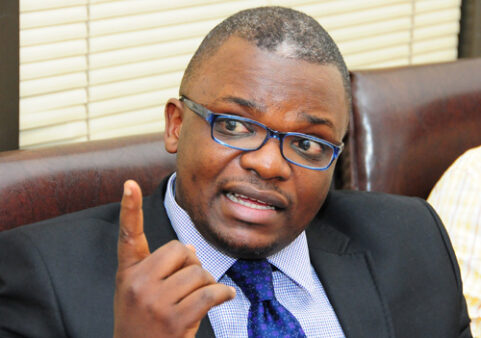
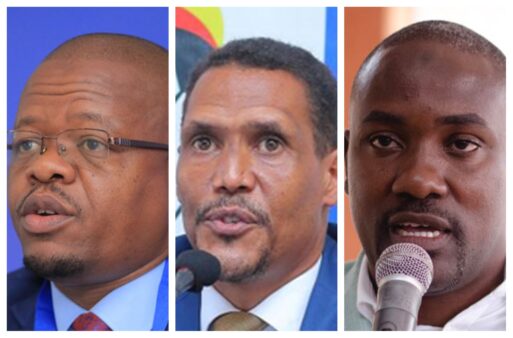
Following the suspension of FUFA President Moses Magogo by FIFA, the acting president of the federation has reacted to the dismissal.
In an exclusive interview with CEO EA Magazine, Justus Mugisha said, “Mr Magogo will return to office on 10th December this year, FUFA is in good hands and it’s statutes are very clear. FUFA will not be taking any punitive action against Magogo.” he revealed. Mugisha will be taking over in acting capacity in accordance with FUFA’s constitution.

His suspension came after allegations that he fraudulently sold 177 Brazil 2014 World Cup tickets which had been allocated to Uganda.
Who is the Embattled Eng. Moses Magogo Hassim?
He is currently the president of FUFA who succeeded Lawrence Mulindwa in August 2013. Magogo is an electrical engineer by profession and has worked for the African Development Bank. Magogo was previously the Federation’s Vice President, in charge of administration.
In 2000, while playing for Kinyara FC, Magogo started to actively participate in sports talk shows on radio. That platform endeared him to the public and by the time he was elected the FUFA delegate for Lubaga, Magogo had created a niche as one of the most knowledgeable persons about football management. FUFA subsequently appointed him to run the Super League.
Magogo is accredited for having transformed the league and football competition systems in Uganda and particularly the FUFA Big League and Regional Leagues. He is also responsible for starting the players contracting regulations and system in Uganda, negotiating and concluding the various sponsorships to football. With an assertive nature he has been a central figure in administration wrangles.
Some of the Sports Pundits That Have Suffered the Same Fate Before
In the past, such Fifa investigations have claimed hardwearing scalps including Sepp Blatter, Jerome Valcke, Jack Warner, Michel Platini and Kalusha Bwalya, who were either banned or suspended for specific period from football because of corruption.
Fifa president Gianni Infantino has been at the forefront in fighting corruption and corrupt tendencies in the football, a situation that has led to the global soccer body’s taking over the management of national and confederation units, including Caf. Recently, the police authorities in France briefly detained Caf president Ahmad Ahmad on allegations of corruption.
Who are they?
Sepp Blatter
Joseph “Sepp” Blatter (born 10 March 1936) is a Swiss football administrator who was the eighth President of the FIFA (French: Fédération Internationale de Football Association) from 1998 to 2015. He is currently serving a six-year ban from participating in FIFA activities.
From a background in business, public relations, and sports administration, Blatter became general secretary of FIFA in 1981 and was then elected president at the 51st FIFA Congress on 8 June 1998, succeeding João Havelange, who had headed the organization since 1974. Blatter was reelected in 2002, 2007, 2011, and 2015. Like his predecessor Havelange, Blatter sought to increase the influence of African and Asian countries in world football through the expansion of participating teams in various FIFA tournaments.
He has persistently been dogged by claims of corruption and financial mismanagement. Blatter’s reign oversaw a vast expansion in revenues generated by the FIFA World Cup accompanied by the collapse of the marketing company International Sport and Leisure and numerous allegations of corruption in the bidding processes for the awarding of FIFA tournaments.
On 2 June 2015, six days after the United States government indicted several current and former FIFA officials and sports marketing companies for bribery and money laundering,[4] Blatter announced that he would call for elections to choose a new president of FIFA and that he would not stand in these elections, but he also said he would remain in his position until an extraordinary FIFA Congress could be held for his successor to be elected. Criminal proceedings were announced against Blatter by the Swiss Attorney General’s office on 25 September 2015, regarding “criminal mismanagement… and misappropriation”.
 After 29 Years in Court, Government Ordered to Pay UGX 512.9 Million in Kamuli Land Dispute
In October 2015, Blatter and other top FIFA officials were suspended amid the investigation, and in December the independent FIFA Ethics Committee ejected Blatter from office and banned him from taking part in any FIFA activities over the following eight years. On 24 February 2016, a FIFA appeals committee upheld the suspension but reduced it from eight years to six. Issa Hayatou served as the acting President of FIFA until an extraordinary FIFA Congress was held in late February, electing Gianni Infantino as the 9th president of FIFA.
Jerome Valcke
Jérôme Valcke (born 6 October 1960) is a French football administrator, best known as the former Secretary General of FIFA (the international governing body of the sport). He was fired on 13 January 2016 as a result of allegations arising from the ongoing 2015 FIFA corruption case.
Originally a journalist with a French TV station Canal+, in 1997 he was appointed chief executive officer at Sport+. In 2003, he moved to FIFA as their Director of Marketing & TV, under the Presidency of Sepp Blatter. He was released on 12 December 2006 due to his role in negotiating FIFA sponsorship contracts with rival credit card companies Visa and MasterCard. In 2007, he returned to FIFA, being appointed Secretary General by Blatter, succeeding Urs Linsi. He was relieved of his duties on 17 September 2015, and then provisionally banned from all football on 8 October 2015 for a period of 90 days, extended on expiry for another 45 days, before finally being dismissed. On 12 January 2016, Valcke was banned by the FIFA Ethics Committee until 2028] and fined 100,000 Swiss francs. On 28 February 2017, Valcke appealed against the ban to the Court of Arbitration for Sport (CAS). This appeal was subsequently dismissed by the CAS on 27 July 2018 and the FIFA Ethics Committee’s original ruling was upheld
Michel François Platini
Michel François Platini (born 21 June 1955) is a French former football player, manager and administrator. As the president of UEFA in 2015 he was banned from football, over ethics violations.[5] Regarded as one of the greatest footballers of all time, Platini won the Ballon d’Or three times, in 1983, 1984 and 1985,[6] and came sixth in the FIFA Player of the Century vote.[7] In recognition of his achievements, he was named a Chevalier of the Légion d’honneur in 1985 and became an Officier in 1998.
During his career, Platini played for the clubs Nancy, Saint-Étienne, and Juventus. Nicknamed Le Roi (The King) for his ability and leadership. Despite primarily serving as an advanced midfield playmaker, he was a prolific goals corer; he won the Serie A capocannoniere award three consecutive times between 1983 and 1985, and was the top scorer of Juventus’s victorious 1984–85 European Cup campaign. Platini was a key player of the France national team that won the 1984 European Championship, a tournament in which he was the top scorer and best player, and reached the semi-finals of the 1982 and 1986 World Cups. Together with the midfielders Alain Giresse, Luis Fernández and Jean Tigana, he formed the carré magique (magic square) of the French team in the 1980s. Platini was his country’s record goalscorer until 2007, and holds the record for most goals (9) scored in the European Championship despite only appearing in the victorious 1984 edition.
Micheal Francis
Michel François Platini (born 21 June 1955) is a French former football player, manager and administrator. As the president of UEFA in 2015 he was banned from football, over ethics violations Regarded as one of the greatest footballers of all time, Platini won the Ballon d’Or three times, in 1983, 1984 and 1985, and came sixth in the FIFA Player of the Century vote. In recognition of his achievements, he was named a Chevalier of the Légion d’honneur in 1985 and became an Officier in 1998.
During his career, Platini played for the clubs Nancy, Saint-Étienne, and Juventus. Nicknamed Le Roi (The King) for his ability and leadership. Despite primarily serving as an advanced midfield playmaker, he was a prolific goalscorer; he won the Serie A capocannoniere award three consecutive times between 1983 and 1985, and was the top scorer of Juventus’s victorious 1984–85 European Cup campaign. Platini was a key player of the France national team that won the 1984 European Championship, a tournament in which he was the top scorer and best player, and reached the semi-finals of the 1982 and 1986 World Cups. Together with the midfielders Alain Giresse, Luis Fernández and Jean Tigana, he formed the carré magique (magic square) of the French team in the 1980s. Platini was his country’s record goalscorer until 2007, and holds the record for most goals (9) scored in the European Championship despite only appearing in the victorious 1984 edition.
Kulusha Bwalya
Kalusha Bwalya (Great Kalu) is a Zambian former international footballer. He is Zambia‘s eighth-most capped player and third on the list of all-time top goalscorers behind Godfrey Chitalu and Alex Chola. Kalusha was named African Footballer of the Year in 1988 by the magazine France Football and was nominated for the 1996 FIFA World Player of the Year where he was voted the 12th-best player in the world, the first to be nominated after playing the entire year for a non-European club.
His older brother Benjamin Bwalya played professional football, and his younger brother Joel Bwalya also played for Zambia. His cousin is former Cardiff City and Welsh national football team international Robert Earnshaw.
His career as a player, coach and president of the Football Association of Zambia is partly shown in the documentary film “Eighteam“.
On 20 March 2016, Kalusha lost the Football Association of Zambia (FAZ) elections to a renowned businessman-turned football official Andrew Kamanga by 163 to 156 votes in what many thought was an impossible task for the challenger.
In August, 2018, the world soccer governing body FIFA banned Bwalya for two years from all football-related activities at both national and international level. The FIFA adjudicatory chamber of the independent Ethics Committee found him guilty of having violated article 16 (Confidentiality) and article 20 (Offering and accepting gifts and other benefits) of the FIFA Code of Ethics. It is alleged that Bwalya received a bribe in the form of a gift from Mohammed Bin Hammam, a Qatari official.