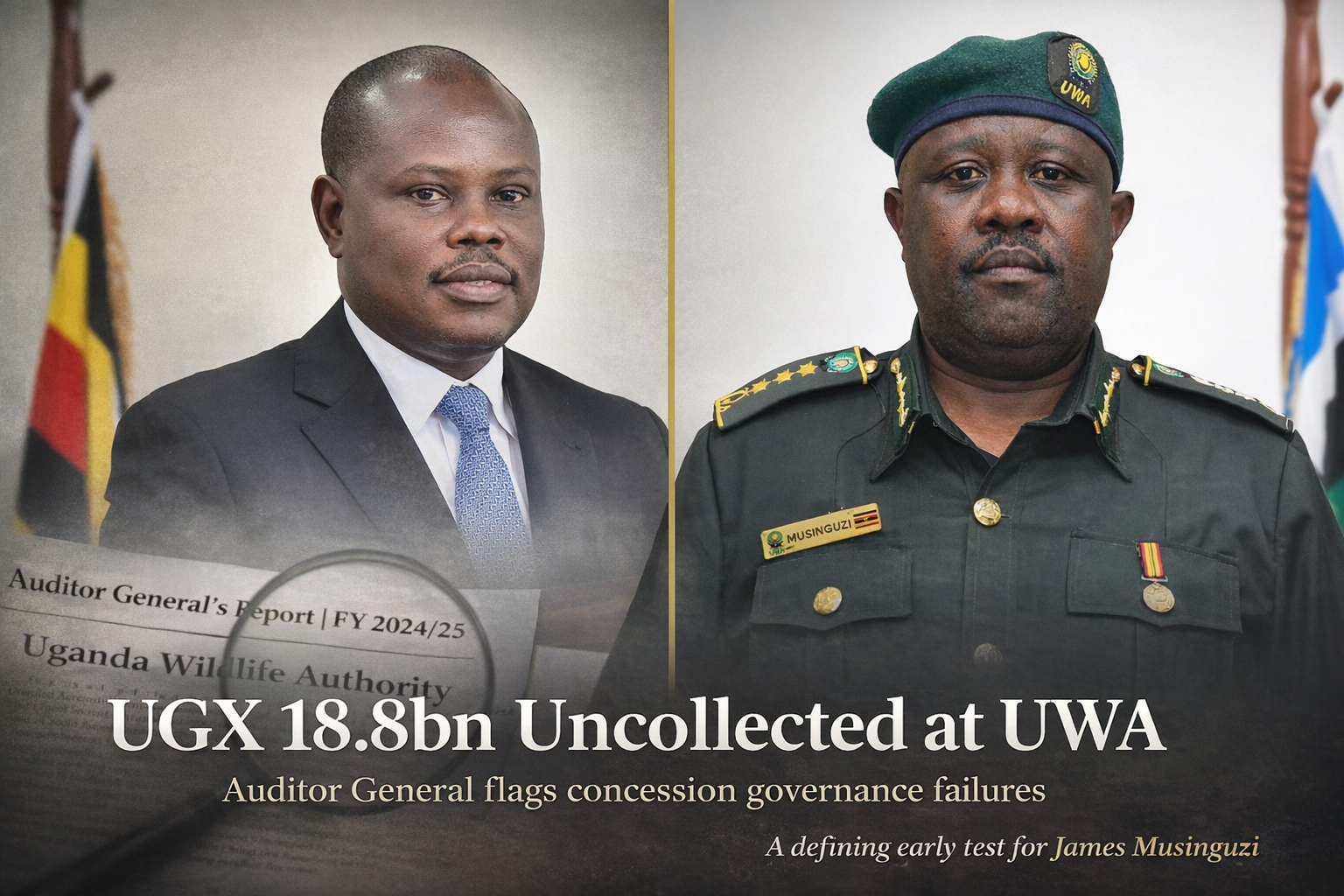
The Uganda Wildlife Authority (UWA) lost billions of shillings in concession revenue and accumulated a growing backlog of unpaid wildlife compensation claims in the 2024/25 financial year, as weak contract management, delayed enforcement, and governance lapses undermined both conservation financing and community trust.
According to the Auditor General’s Annual Report to Parliament for the year ended 31 December 2025, delayed and unpaid concession fees amounting to UGX 18.80 billion were recorded across UWA-managed protected areas—raising questions about revenue assurance, regulatory oversight, and the sustainability of Uganda’s wildlife conservation model.
UWA oversees 55 tourism concessions across national parks and protected areas, a framework designed to mobilise private capital for tourism infrastructure while generating non-tax revenue to fund conservation and park management.
However, the audit found that governance weaknesses are significantly eroding the effectiveness of this model.
Ten concessionaires were found to be operating without formal concession agreements, exposing the Authority to legal, financial, and enforcement risks. In other cases, concessionaires continued operating under expired contracts, contrary to contractual provisions and basic governance standards.
The Auditor General attributed the UGX 18.80 billion in delayed or unpaid concession fees to weak compliance by concessionaires, delayed submission of reports, and insufficient follow-up by UWA management—effectively allowing revenue leakages to persist across high-value tourism assets.
Delayed projects, delayed returns
Beyond unpaid fees, several concession projects were found to be non-operational or significantly delayed, limiting the rollout of planned tourism infrastructure such as lodges and visitor facilities. This, the Auditor General notes, has postponed expected revenue streams, reduced visitor capacity, and weakened the economic return on protected areas that require continuous funding for enforcement and ecological management.
Compounding the challenge, UWA lacked audited accounts and audit certificates from several concessionaires, making it difficult to independently verify revenues tied to variable charges such as bed-night fees—a core income stream in premium tourism zones.
Collectively, the report warns, these weaknesses undermine UWA’s ability to realise the full economic value of wildlife tourism, even as conservation costs continue to rise.
Compensation delays risk community trust
 IHUNDE RESORT: A Lakeside Sanctuary on Bulago Island, Lake Victoria
The audit also raised red flags over the Wildlife Compensation Scheme, a critical mechanism intended to mitigate human–wildlife conflict by compensating communities for death, injury, and property damage caused by wild animals outside protected areas.
During the 2024/25 financial year, the Compensation Verification Committee received UGX 4.09 billion and handled 1,346 claims, of which 1,308 were verified and approved. Yet by year-end, only UGX 1.08 billion—just 27%—had been paid, leaving UGX 2.96 billion outstanding.
In addition, 1,109 new claims were received during the year, but only 164 were verified, leaving 945 cases pending and pointing to growing inefficiencies in verification and disbursement processes.
The Auditor General cautioned that such delays prolong financial hardship for affected communities, weaken confidence in the compensation framework, and risk undermining community cooperation in conservation—potentially escalating human–wildlife conflict.
The findings land at a time when government policy increasingly positions tourism as a priority growth sector and wildlife as a strategic national asset. With tourism expected to finance a significant share of conservation costs, revenue leakage at UWA directly affects Uganda’s broader fiscal and environmental sustainability goals.
Weak concession governance also sends the wrong signal to serious long-term investors, particularly those willing to commit capital to eco-tourism projects that require regulatory certainty, enforceable contracts, and transparent revenue-sharing arrangements.
Auditor General’s recommendations
To address the gaps, the Auditor General urged the Uganda Wildlife Authority to tighten its concession governance by swiftly regularising all undocumented and expired concessions through the timely execution of formal agreements. The report further called on the Authority to strengthen monitoring and enforcement of concession fee obligations, while requiring all concessionaires to submit audited accounts and comply fully with reporting requirements to improve revenue assurance and transparency.
On the compensation side, the Auditor General recommended improvements in workflow management to speed up the disbursement of approved claims and reduce prolonged delays. In addition, UWA was advised to enhance the capacity of the Compensation Verification Committee in order to clear backlogs, restore public confidence in the compensation system, and safeguard community cooperation in wildlife conservation efforts.
For James Musinguzi, this now crystallises into one of the defining early tests of his tenure as Executive Director of the Uganda Wildlife Authority. Without tighter contract enforcement across tourism concessions, stronger internal controls to secure revenues, and faster, more credible compensation processes for affected communities, the Authority risks weakening the very conservation compact on which Uganda’s wildlife economy depends—one that hinges on investor confidence, community buy-in, and the sustainable financing of protected areas.