Over the past year, Absa Group has been hard to miss in East Africa. From boardroom visits and executive engagements to high-profile financing deals and infrastructure transactions, the bank has steadily increased both its visibility and its footprint across the region.
Part of that renewed presence reflects leadership dynamics at the top. Kenny Fihla, who became Absa Group Chief Executive in July 2025, has made several trips to East Africa since taking the helm, signalling the strategic importance the group attaches to the region. But the growing visibility has not been limited to executive visits or media appearances. Behind the scenes, Absa has been busy deploying capital, structuring large transactions and positioning itself at the centre of some of the region’s most consequential investment projects.
In other words, the bank has been putting its money where its strategy is.
When CEO East Africa Magazine caught up with Saviour Chibiya, Absa’s Regional Chief Executive responsible for operations across several African markets outside South Africa, during his visit to Kampala this week, he was unequivocal: East Africa represents one of the continent’s most compelling economic frontiers, and Absa is keen to play a central role in financing and accelerating the region’s ambitious growth plans such as Uganda’s bold aspiration to grow its economy tenfold to USUSD500 billion by 2040.
Countries such as Uganda, Kenya and Tanzania, he said, have consistently recorded GDP growth of between 5% and 6% in recent years, outperforming many global peers and positioning the region as one of Africa’s fastest-growing economic blocs.
“When you look at countries like Uganda and other East African economies, these economies have achieved five to six per cent economic growth in recent years,” Chibiya says. “And the ingredients to even accelerate that growth are already there.”
This conviction, he said, is shaping the Johannesburg-based banking group’s strategy across the region. Absa is increasingly positioning itself not merely as a commercial lender, but as a financier of the infrastructure, industries and investment flows expected to underpin East Africa’s next phase of economic expansion.
Absa’s Ambition: Becoming the Bank of Choice for Development
At the centre of that strategy is a clear ambition: Absa wants to become what Chibiya describes as “the bank of choice for economic development” across the markets in which it operates.
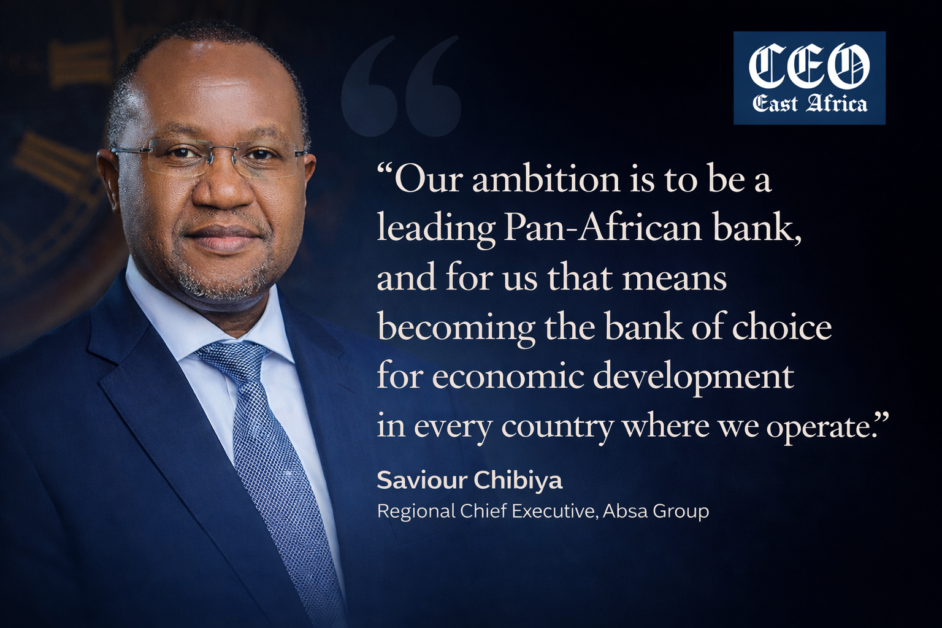
“First of all, it is to be a leading Pan-African bank,” he explains. “And what that means for us is to be the bank of choice for economic development in all the countries where we operate.”
The ambition is unapologetically bold.
“At this point in time, we don’t believe in being number two,” Chibiya adds. “Our ambition, and it is a journey, is always to be number one.”

For Absa, that ambition translates into a strategy built around deploying capital, strengthening talent, investing in technology, and building deep sector expertise in key sectors that drive economic productivity—energy, infrastructure, telecommunications, tourism, and agriculture—rather than purely consumption-driven retail lending.
“We have to have the best people, we have to train our people, we have to deploy capital, and we have to invest in technology and products that are required,” Chibiya told the CEO East Africa Magazine.
Uganda’s Growth Story
Uganda, in particular, sits prominently within Absa’s East African strategy.
The country’s economy is currently estimated at roughly USD50 billion, but government planners have set an ambitious goal: expanding GDP tenfold to USD500 billion by 2040.
It is an aspiration that may appear aggressive, but Chibiya believes such bold targets are necessary.
“You need bold ambitions,” he says. “If you want to grow your economy tenfold, then a lot of things must change—from policy to how businesses scale and how industries develop.”
Uganda’s economic fundamentals offer reasons for optimism, Chibiya believes. The country possesses vast agricultural potential, a rapidly expanding population, growing regional trade connections and the long-anticipated start of commercial oil production expected around 2026.
“You’ve got the natural resources, the land, the weather and everything fundamental for growth,” Chibiya says. “And now with the discovery of oil, that is really going to help in diversifying the economy.”
Yet resources alone are not enough.
Equally important, he argues, is the human factor.
“You also have resilient people,” he says. “People are becoming more creative and more entrepreneurial. When you combine human capital with natural resources and the right policies, that can drive a lot of economic growth.”
Financing the Backbone of Growth
Absa’s belief in East Africa’s growth story is not just theoretical. The bank has already participated in a series of large project financings across the region, many of them focused on infrastructure and energy—the sectors that economists often describe as the backbone of long-term development.
Over the past few years, Absa has been involved in transactions worth nearly USD1 billion across East Africa.
Among them:
- USD346 million financing for the Government of Tanzania to support infrastructure development aimed at facilitating trade.
- USD200 million financing for infrastructure projects in Zanzibar, where Absa served as Mandated Lead Arranger.
- USD92 million financing for the Kenya Roads Board to support road network expansion in Nairobi.
- USD80 million financing for Kenya’s KenGen geothermal energy projects, helping expand renewable power capacity.
Uganda itself features prominently in that portfolio.
Absa participated in a USD170 million syndicated facility for MTN Uganda, helping finance the expansion and upgrade of Uganda’s largest telecom operator’s network infrastructure.
The bank also financed USD50 million for the Uganda Electricity Distribution Company, supporting the rehabilitation of the national electricity grid.
Taken together, these projects illustrate how Absa sees its role evolving: as a financier of the systems that power economic productivity.
“Power is an area where across the continent we still have a deficit of infrastructure,” Chibiya explains. “We have played a huge role in financing power projects across many countries.”
The same applies to telecommunications and transport networks, which underpin digital connectivity and trade.
 After 29 Years in Court, Government Ordered to Pay UGX 512.9 Million in Kamuli Land Dispute
Connecting Global Capital to Africa
Beyond its own lending capacity, Absa increasingly sees itself as a bridge between African investment opportunities and global capital pools.
This is particularly important at a time when large infrastructure projects across the continent require billions of dollars in financing.
“We are not just looking at our balance sheet,” Chibiya says. “We are looking at how we attract more investment into the continent and facilitate trade between Africa and the rest of the world.”
To achieve that, Absa is strengthening relationships with investors and financial institutions across multiple regions.
“Our opening of offices across the world—whether in the United States, China or the Middle East—is about tapping into savings in those regions so that we can fund activity on this continent,” he explains.
The approach reflects a broader shift in African banking. Rather than simply intermediating domestic deposits, large regional banks are increasingly acting as structurers of cross-border capital flows, connecting international investors with African projects.
Equally important is improving how Africa itself is understood globally.
“Part of attracting investment is helping people understand the continent,” Chibiya says. “There are headlines in the news that sometimes do not reflect the reality of the opportunities.”
From Consumption to Production
For Uganda and many African economies, however, the biggest challenge remains structural.
Historically, much of the continent’s economic activity has been consumption-driven or based on the export of raw commodities. Chibiya argues that the next phase of growth will depend on moving beyond that model.
“You need scalable businesses,” he says. “In agriculture, for example, we still have a lot of small-scale farming. To grow the economy, those businesses need to scale.”
That means investing in technology, skills and productivity.
“You (Uganda) need to create ecosystems where primary produce can be processed and exported,” he explains.
Value addition—whether in agro-processing, manufacturing or industrial production—will ultimately determine whether Uganda can achieve its USD500 billion economic target.
Banks, in turn, must help finance that transition.
“It is not just about funding,” Chibiya says. “It is also about helping customers access markets, facilitating trade and providing sector expertise that allows businesses to grow.”
Building Africa’s Own Capital Base
Another major challenge for African economies is their dependence on external capital flows.
Periods of global financial volatility often result in investment retreating from emerging markets. Chibiya believes the long-term solution lies in building stronger domestic financial systems.
“Primarily, we need to have more local savings,” he says. “Whenever you rely on foreign capital, it will always be a challenge depending on where that capital comes from.”
Deepening financial inclusion and mobilising deposits, therefore, remain central to Absa’s strategy.
| Year | Deal | Role | Country | Amount | Purpose |
| 2023 | Kengen | Lender | Kenya | USUSD 80m | Financing of Geo-thermal power for the country |
| 2023 | Revolutionary Government of Zanzibar | Mandated Lead Arranger | Zanzibar | USUSD 200m | Economic development of Infrastructure projects across the country to facilitate Trade |
| 2022 | Government of Tanzania | Mandated Lead Arranger | Tanzania | USUSD346m | Economic development of Infrastructure projects across the country to facilitate Trade |
| 2025 | Kenya Roads Board | Mandated Lead Arranger | Kenya | USUSD92m | Development of road network within Nairobi |
| 2025 | Uganda Electricity Distribution | Lender | Uganda | USD 50Mn | Rehabilitation of the national grid for supply of power to the country |
| 2024 | MTN | Syndication Partner | Uganda | USD 170Mn | One of the syndication banks that provided facilities for upgrade and expansion of the network |
Through technology investment, new financial products and broader financial education, banks hope to expand the continent’s domestic capital pool—reducing reliance on external funding sources.
The Long View
Despite global uncertainties—from geopolitical tensions to volatile commodity markets—Chibiya remains optimistic about East Africa’s long-term trajectory.
The region’s economies have demonstrated resilience, and their diversification is increasing.
“When you look at the past economic growth in countries like Uganda, the ingredients to accelerate that growth are already there,” he says.
Regional integration will also play a crucial role. Initiatives such as the East African Community (EAC) and the African Continental Free Trade Area (AfCFTA) promise to open larger markets, enabling businesses to scale beyond national borders.
For Absa, the strategic logic is clear: banks that position themselves early in this transformation could play a central role in financing Africa’s next chapter.
And that, Chibiya suggests, is exactly the journey the bank is embarking on.
“What’s more important is our purpose. We believe in empowering Africa’s tomorrow,” he says. “And we say it is a journey—one step at a time.”