It began over dinner at Nairobi’s exclusive Muthaiga Club, an establishment where East Africa’s captains of industry often mix business with leisure.
As Patrick Mweheire, then Regional Chief Executive of Standard Bank Group for East Africa, settled into a quiet evening of conversation, his friend and client Amos Nzeyi, Chairman of Crown Beverages Limited (CBL) — Pepsi’s bottler in Uganda — dropped a bombshell.
In his usual composed tone, Nzeyi told Patrick that they were planning to invest $100 million in Kenya.
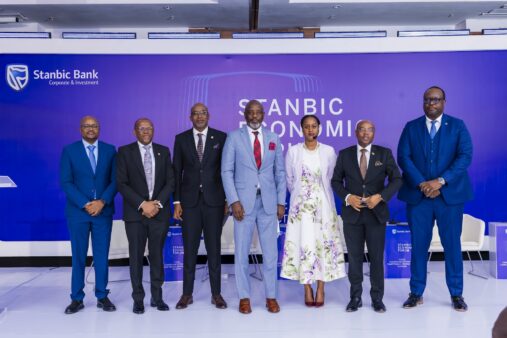
Mweheire, as he narrated to over delegates gathered for the 3rd episode of the Stanbic East Africa Business Summit 2025, said he nearly choked on his steak.
Mweheire is not an insensitive business executive, but rather the idea of a Ugandan company investing nine figures in Kenya simply wasn’t part of East Africa’s banking deals playbook, a playbook that the investment banker has participated in writing over the last decade.
Until that moment, most large capital flows had always gone the other way: Kenyan capital expanding south or west into Uganda and Tanzania.
“Usually it’s the other way around,” Mweheire said.
But Nzeyi and his partners, including Dr. Margaret Kigozi and Chris Kayoboke, were not talking theory. They were preparing to buy SBC Kenya Limited, PepsiCo’s bottler in Nairobi, and link it with Crown Beverages in Uganda to create one of East Africa’s most formidable beverage groups.
When the Rulebook Didn’t Exist
Mweheire further recounted how inside Stanbic, the idea initially caused both excitement and confusion.
“When I convened the bankers in the bank to try and get this deal over the line, there was only confusion, because we had never, as a bank, actually done that reverse investment.”
The deal team — spread between Nairobi and Kampala — faced a novel challenge: how to structure a cross-border acquisition in which capital flowed uphill, from Uganda into Kenya.
“We have to change the documentation because it’s a historical thing,” he added.
What followed were months of structuring, regulatory navigation, and confidence-building between two markets with very different banking environments.
Just last week, the story came full circle.
Stanbic Bank Uganda and Stanbic Bank Kenya, both members of the Standard Bank Group, announced a USD 45 million long-term funding package to support expansion for the two PepsiCo bottlers — $30 million for Crown Beverages in Uganda and $15 million for SBC Kenya.
The SBC Kenya is part of the Pepsi bottlers’ USD100 million investment deal that also includes capital infusion by shareholders and support from Pepsi.
According to Paul Muganwa, Executive Director and Head of Corporate and Investment Banking at Stanbic Uganda, “This transaction exemplifies how our Positive Impact framework translates ambition into action,” he said, adding: “By structuring a cross-border solution in partnership with our colleagues in Kenya, we are advancing inclusive growth across financial, enterprise, and industrial dimensions.”

The investment, he added, will stimulate job creation, enhance local manufacturing capacity, and strengthen regional trade linkages, particularly benefiting young people, women, and farmers within the value chain.
From Nairobi, SJ Kok, Head of Corporate and Investment Banking at Stanbic Bank Kenya, echoed the sentiment: “Our ability to collaborate across our country teams underscores the power of our regional network. Through our established relationship with Crown Beverages Limited in Uganda, we were able to seamlessly extend support to SBC Kenya and design a funding structure that met the complex requirements of a brownfield expansion. This is a strong example of how we bring Standard Bank Group’s regional ecosystem to life for our clients.”
The Crown Beverages–SBC Kenya transaction is not an isolated case but part of a broader wave of game-changing cross-border investments Stanbic is enabling across East Africa. The bank, according to Mweheire, is also supporting another Ugandan client, industrialist Sikander Lalani, who is investing almost USD 50 million in Mombasa, as well as another Tanzanian client who had just acquired a major cement business in Kenya. These, he said, were clear proof that the flow of capital in East Africa was finally beginning to move in multiple directions — “the clients have caught on, the sovereigns have caught on” — signalling a new era where Stanbic’s regional financing model is actively driving intra-African investment and integration.
Standard Bank’s East African Bet: Vision, Numbers, and Purpose
When Patrick Mweheire talks about East Africa, he doesn’t speak in metaphors — he speaks in numbers. To him, the region isn’t just a promising market; it’s a strategic growth vector for Africa’s largest bank.
Mweheire, in his remarks at the Stanbic conference, revealed that the region now sits among the top three strategic priorities of the group — alongside playing a leading role in renewable energy and building a leading private bank. Out of 15 strategic ideas pitched to the group’s Johannesburg headquarters, “playing a key role in the growth of East Africa” (by 2028) was voted into the top three, making it Standard Bank’s only regional growth vector.
The logic is hard to miss. With a combined population of 500 million and a GDP of roughly USD 500 billion, East Africa, including Ethiopia, which is part of the Stanbic East Africa region, is now home to five of Africa’s seven fastest-growing economies — Ethiopia, DRC, Uganda, Kenya, and Tanzania — all expanding above 5% per annum, according to Mweheire. He noted that foreign direct investment inflows have soared from USD 5.2 billion in 2000 to nearly USD 93 billion by 2024, now accounting for 30% of regional GDP — a clear signal that global capital is following the region’s growth momentum.
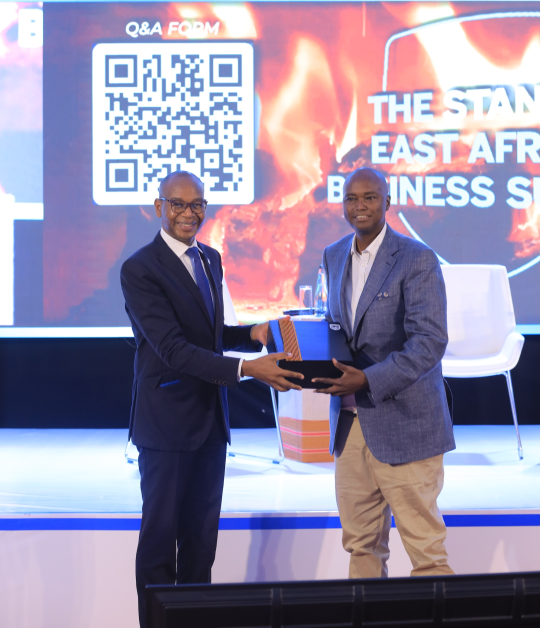
But the most compelling data point is intra-regional trade. Paul Muganwa, Executive Director and Head of Corporate & Investment Banking at Stanbic Bank Uganda, revealed that trade between the eight EAC states now stands at USD 124 billion, comprising USD 56 billion in imports and USD 69 billion in exports, growing at a compound annual rate of 11.3% over the past five years — faster than any single country’s GDP. He emphasised that, “It’s a fantastic proxy for how East Africa’s integration is accelerating,” adding that Kenya’s top export market is Uganda, while Uganda’s top export market is Kenya — an economic symmetry rarely seen elsewhere in Africa.
Patrick Mweheire reinforced this by noting that intra-EAC trade now accounts for nearly 40% of total trade activity, compared with about 12% for Sub-Saharan Africa as a whole. That means East Africa trades nearly four times more with itself than other African regions do — an impressive indicator of deepening interdependence. He further pointed out that intra-EAC trade has grown threefold, from USD 3 billion in 2018 to USD 9 billion in 2025, signalling not only a rising volume of goods and services but also a shift in mindset — from isolated national economies to a connected regional marketplace.
This regional flow is increasingly being financed and enabled by Stanbic. Through its Borderless Banking platform, launched in 2021, the bank has already facilitated over USD 430 million in real-time cross-border trade flows, primarily between Uganda and Kenya — proving that digital innovation can move capital faster than policy frameworks ever could.
And the numbers supporting integration are equally striking. The East African Community’s 2025 connectivity blueprint includes 2,500 km of new rail, 5,600 km of oil and gas pipelines, and 123,000 GW of additional power capacity — all underpinned by governments dedicating about 12% of their fiscal budgets to integration-related infrastructure. Muganwa noted that this convergence of public investment and private capital creates one of the most investable regional corridors on the continent.
For Standard Bank Group, these numbers are more than statistics — they’re validation. As Mweheire put it, “Capital is not an issue. It’s never been. There’s lots of capital, looking for home, looking for deals…We just need to fix the structural problems… package the deals, make them bankable.”
Joshua Oigara Weighs In: Building Competitiveness and Connected Growth
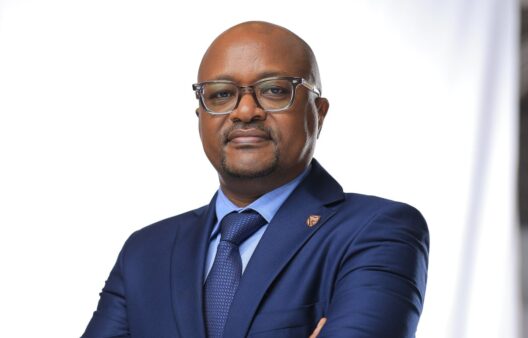
If Patrick Mweheire provided the data to justify Standard Bank’s East African ambitions, Joshua Oigara brought the urgency and optimism to drive them forward. As the new Regional Chief Executive for Standard Bank East Africa, Oigara sees the region not as a collection of markets but as a single, connected growth ecosystem that must move faster, think smarter, and compete globally.
 Ruparelia Group Wins Key Entebbe Land Case, Clearing Path for the New Mega Speke Resort and Convention Centre, Entebbe
In his reflections ahead of the Stanbic East Africa Business Summit 2025, Oigara wrote that “what started as a regional dialogue has become a strategic platform to shape East Africa’s next chapter.” With regional GDP projected to hit USD 1 trillion by 2030, he argued that the bloc remains “the continent’s fastest-growing and most connected.” The year’s summit theme — Connected and Resilient: Scaling East Africa’s Regional Advantage — “affirms a simple truth,” he said: “integration builds resilience, and resilience must evolve into global competitiveness.”
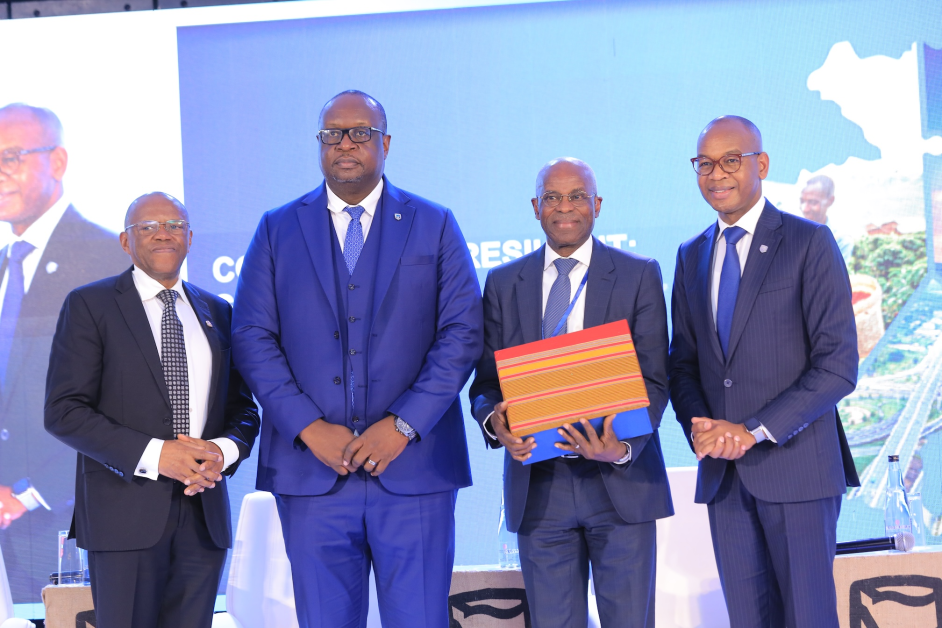
At the summit, Oigara reflected on East Africa’s evolution through the decades — from the founding of the East African Community in 1967, its collapse a decade later, to its rebirth and golden jubilee today. “We don’t have another 25 years to wait for our diamond jubilee,” he told delegates. He reiterated that the future is now and lies in digitisation, artificial intelligence, and the rise of SMEs; the nerve centres that will define the next phase of Standard Bank’s competitiveness.
Oigara described East Africa as a region of “resilient energy,” noting that it now contributes half a billion people and a potential USD 1 trillion economy. Yet, he cautioned that economic optimism must translate into productivity and competitiveness. “We are the noisiest region in Africa — but often about the wrong things,” he said with characteristic humour. “Our digital noise is louder than Nigeria’s, yet we are growing faster. We must start making noise about what’s working — our youth, our infrastructure, our financial connectivity.”
He credited the revival of the Stanbic East Africa Business Summit — first convened in 2010 and rebooted by Mweheire in 2022 — as a crucial space for aligning public and private ambitions on such high-potential sectors such as infrastructure, agriculture, energy, and digital finance.
Oigara said that for Stanbic and Standard Bank, the summit is not just a networking event but rather an opportunity to engage with fellow leaders to shape the next chapter of East Africa’s connected advantage.
“East Africa is our home. At Stanbic, we are financing 202 million dollars in cross-border infrastructure, leading the region’s largest Sustainability Linked Loan, and working to triple our SME market share to 9 percent by 2028. Digital platforms are enabling borderless banking under AfCFTA. AI-powered lending and strategic partnerships are expanding access to capital and fuelling growth for more than 10 million SMEs,” he wrote on LinkedIn, ahead of the summit.
As he takes over the regional mantle from Mweheire, Oigara emphasised that Standard Bank’s next chapter will be defined by collaboration, technology, and inclusion. He pointed to Stanbic’s Business Incubator and partnerships with global institutions like the European Commission, the Gates Foundation, and the Tony Blair Institute as proof of how African banks can blend development finance with commercial ambition.
Looking ahead, Oigara said Standard Bank will continue investing heavily in infrastructure, energy, and digital transformation. He cited the group’s role in the East African Crude Oil Pipeline (EACOP), renewable energy corridors, and digital banking ecosystems as examples of its commitment to long-term regional impact. He stated that without infrastructure, there could be no integration. He added that they estimated the African continent would need USD 300 billion in new infrastructure and ESG over the next five years and affirmed their readiness to finance that transformation.
“Africa for us is really the bedrock of who we are. It is home for us. So every single part of what we build, we want to be a long-term player, supporting your businesses and your innovations across the markets,” Oigara told the meeting.
Mumba Kalifungwa: Uganda at the Heart of Regional Integration
While Oigara’s vision is about connecting markets, Mumba Kalifungwa, Chief Executive of Stanbic Bank Uganda, brought that vision to the ground level — showing what integration looks like in practice. His message at the Stanbic East Africa Business Summit 2025 was clear and deliberate: Uganda is no longer landlocked; it is land-linked.
Standing before an audience of regional business leaders, Kalifungwa declared, “We (Uganda) sit at the geographic centre of East Africa, a location that is not just symbolic, but strategic.” He explained how Uganda’s investments in modernised border posts, regional highways, energy interconnections, and trade facilitation systems have turned the country into a gateway for cross-border opportunity rather than a terminal market. “This connectivity is not just about moving products,” he said. “It’s about moving potential — enabling entrepreneurs, women, and youth-led enterprises to reach new markets and become part of regional value chains.”
Kalifungwa sees Uganda as an essential lever in East Africa’s integration story — a “natural bridge between markets, a reliable partner in trade, and a dynamic platform for inclusive growth.” As the largest bank in Uganda and part of Africa’s biggest financial services group, Stanbic, he argued, is uniquely positioned to make that transformation tangible. “When you bank with us at Stanbic Uganda, you are banking in East Africa, and you are banking on the continent,” he said. “Your capital can flow to your customers, your products can follow your potential, and your enterprise can follow your ambition wherever in the region it leads.”
That commitment is backed by numbers. Kalifungwa disclosed that Stanbic Uganda currently holds UGX 5 trillion (approximately USD 1.5–2 billion) in loans and advances — spread across the entire economy: UGX 2 trillion in large corporates, UGX 1.6 trillion in personal and private lending, and UGX 1 trillion dedicated to small and medium businesses. “We have the risk appetite to lend to key sectors that drive growth,” he said, adding that the bank’s focus remains on understanding business fundamentals rather than collateral. “People often think we lend against collateral, but that’s a misconception. What matters is your business model, your cash flow, and our confidence in your ability to generate returns.”
Kalifungwa’s tone combined conviction with challenge. He pushed back against the perception that Ugandan banks are reluctant to lend. “We are in the business of lending, and we are here to solution for you,” he said. From infrastructure to manufacturing and energy, Stanbic Uganda continues to anchor growth sectors across the economy. “Capital is never the issue,” he reminded delegates. “It’s really about opportunity, risk appetite, and the ability to design projects that make sense.”
SIDEBAR: 10 NUMBERS THAT YOU SHOULD KNOW
| Theme / Category | Key Figures | Insight / Significance |
| Cross-Border Capital Flows | USD 45 million | Joint funding by Stanbic Uganda & Kenya for Crown Beverages (UG) and SBC Kenya — a milestone in reverse investment flows. |
| USD 100 million | Total investment by Crown Beverages & partners in Kenya’s Pepsi bottler — a first of its kind Uganda-to-Kenya deal. | |
| USD 430 million | Value of cross-border trade already facilitated through Stanbic’s Borderless Banking Platform since 2021. | |
| Regional Growth & Scale | 500 million people | Combined population of East Africa — one of Africa’s most dynamic economic zones. |
| USD 500 billion → USD 1 trillion (by 2030) | Regional GDP trajectory — set to double by 2030. | |
| 5% | Annual GDP growth in five of Africa’s seven fastest-growing economies (Ethiopia, DRC, Uganda, Kenya, Tanzania). | |
| Intra-Regional Trade Integration | USD 124 billion | Current trade between 8 EAC states — 11.3% annual growth over five years. |
| 40% vs 12% | Intra-EAC trade now forms 40% of total regional activity — four times higher than the Sub-Saharan average. | |
| Infrastructure & Investment Drive | 2,500 km rail + 5,600 km pipelines + 123,000 GW power | The EAC’s 2025 connectivity blueprint, with 12% of national budgets committed to integration projects. |
| USD 300 billion | Estimated infrastructure & ESG finance required across Africa over the next five years – Standard Bank has positioned itself to fund a major share. | |
| Stanbic Uganda’s Leadership Role | UGX 5 trillion (≈ USD 1.5–2B) | Stanbic Uganda’s total loan book — driving lending across corporates, individuals, and SMEs. |
| UGX 245 billion / 88,000 entities | Loans extended to women, SACCOs, and SMEs — inclusion through Stanbic for Her and related programmes. | |
| Capital Readiness | USD 1 billion (Kenya) + USD 300M (UG & TZ each) | Liquidity pool available for bankable deals under Standard Bank’s regional appetite. |
| Strategic Horizon | Top 3 global priority | East Africa ranked among Standard Bank Group’s top three strategic pillars (alongside Renewable Energy & Private Banking). |
Beyond the balance sheet, Kalifungwa highlighted the bank’s role in SME empowerment and inclusion. Through programmes like Stanbic for Her and partnerships with SACCOs, Stanbic has extended UGX 245 billion in loans to over 88,000 entities, often at interest rates significantly below market prime. These initiatives, he said, reflect the bank’s determination to make access to capital fairer and more affordable.
For him, Uganda’s transformation is about mindset as much as it is about money. Hosting the East Africa Business Summit in Kampala, he said, was symbolic of that shift — proof that Uganda is not just a participant in regional integration but one of its drivers. “As we look ahead,” he concluded, “our shared future as a region will be defined by how well we connect — to each other, to new opportunities, and to a common purpose. Together, let us build a more connected, more resilient, and more prosperous East Africa.”
An Ambitious Region Needs a Big Bank
East Africa is no longer waiting for its moment — it is building it. The region’s governments, entrepreneurs, and financiers are aligning around one shared vision: to turn ambition into transformation. And in this emerging chapter, Standard Bank has positioned itself as both a catalyst and a collaborator — bringing together the will, the plan, the people, and most critically, the resources to power regional growth.
As Joshua Oigara put it, “The challenge really is how to become more competitive as we build the future of the region — and that’s one aspect which we need to learn as a collective.”
Patrick Mweheire, who has long championed this regional cause, is quick to dispel one persistent myth. “Again, capital is not the issue. We just need to fix the structural problems… package the deals, make them bankable,” he reiterates. He said that for example, at Standard Bank, there is over USD1 billion for big deals at Standard Bank Kenya and another approximately USD300 million each in Uganda and Tanzania.
“There is no lack of appetite to invest,” he reckons.
That frank assessment captures the essence of Standard Bank’s East African playbook. The bank has both the liquidity and the will — what it seeks are well-structured opportunities that can translate potential into performance. It’s a reminder that finance follows form: once the frameworks are right, the flow of funds is inevitable.
And the flow is already happening. In the past year alone, Stanbic Bank has led or co-financed several high-impact regional projects — from the USD 45 million cross-border funding for Crown Beverages Uganda and SBC Kenya, to the recent USD 36 million capital injection for Quality Chemical Industries Limited (QCIL) in Uganda. The QCIL deal will enable the construction of a second WHO-compliant manufacturing facility, expanding access to affordable medicines across Africa. For Mumba Kalifungwa, it represents a milestone in purpose-driven finance. “This is a milestone transaction — ambitious in scale, catalytic in purpose,” he said.
These transactions speak to the bank’s broader mission: financing development that multiplies opportunity. Paul Muganwa, who structured both the SBC and QCIL deals, described them as examples of “positive impact in motion” — designed not just to grow businesses but to build ecosystems. “When we finance growth, we ensure it is growth that matters,” he said, pointing to the bank’s Positive Impact framework that aligns every deal with social and industrial outcomes.

From Kampala to Nairobi, Dar es Salaam to Kinshasa, the group’s leadership is synchronised around one philosophy: that East Africa’s transformation demands scale, patience, and partnership.
For Oigara, it’s about competitiveness — building regional value chains, accelerating SME growth, and embedding technology into the financial architecture of trade.
For Kalifungwa, it’s about positioning Uganda as the “land-linked” hub of regional opportunity — where cross-border flows of goods, people, and capital converge.
For Muganwa, it’s about translating finance into tangible impact — connecting capital to inclusion, and inclusion to prosperity.
And for Mweheire, it’s about structure — bridging the last mile between liquidity and productivity.
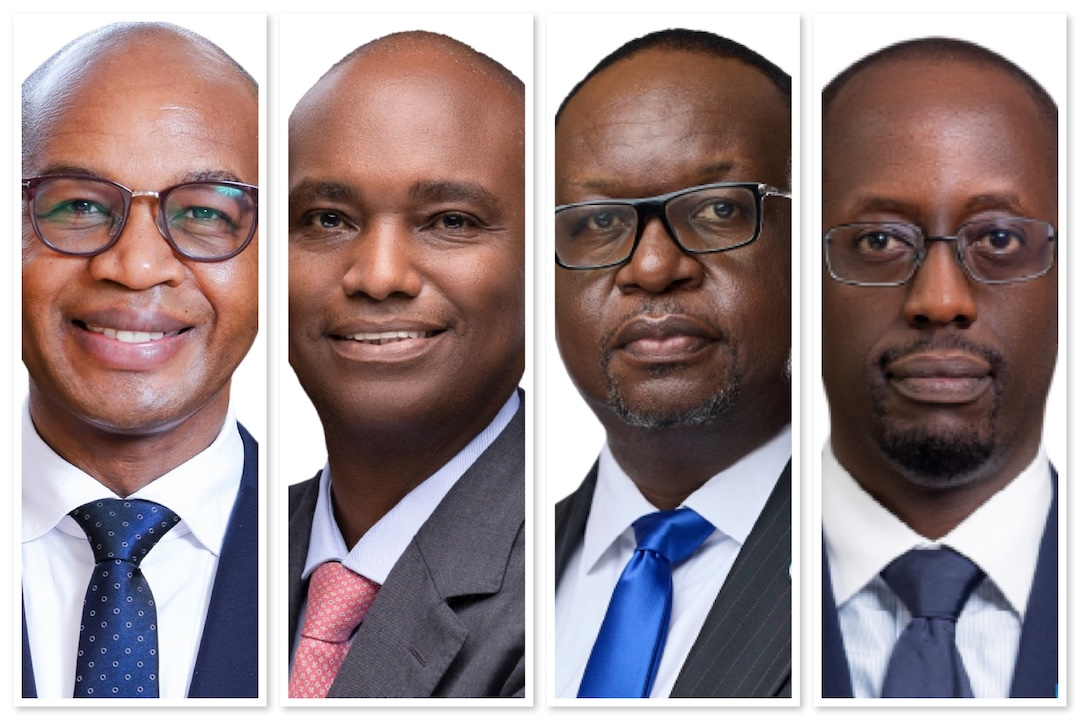
Together, they represent the four ingredients East Africa needs most:
- The will — a leadership corps determined to build Africa’s growth from within.
- The plan — a coherent strategy that unites trade, finance, and infrastructure into one integrated vision.
- The people — skilled bankers, advisors, and entrepreneurs who understand both the risks and rewards of frontier markets.
- The resources — billions of dollars already available and waiting for well-structured, bankable opportunities.
In a region defined by aspiration and acceleration, an ambitious region needs a big bank — one capable of underwriting its dreams, financing its transformation, and connecting its economies to the world.
That bank is Standard Bank — bold in its vision, disciplined in its execution, and steadfast in its belief that Africa’s future will not be imported; it will be financed, built, and owned right here.