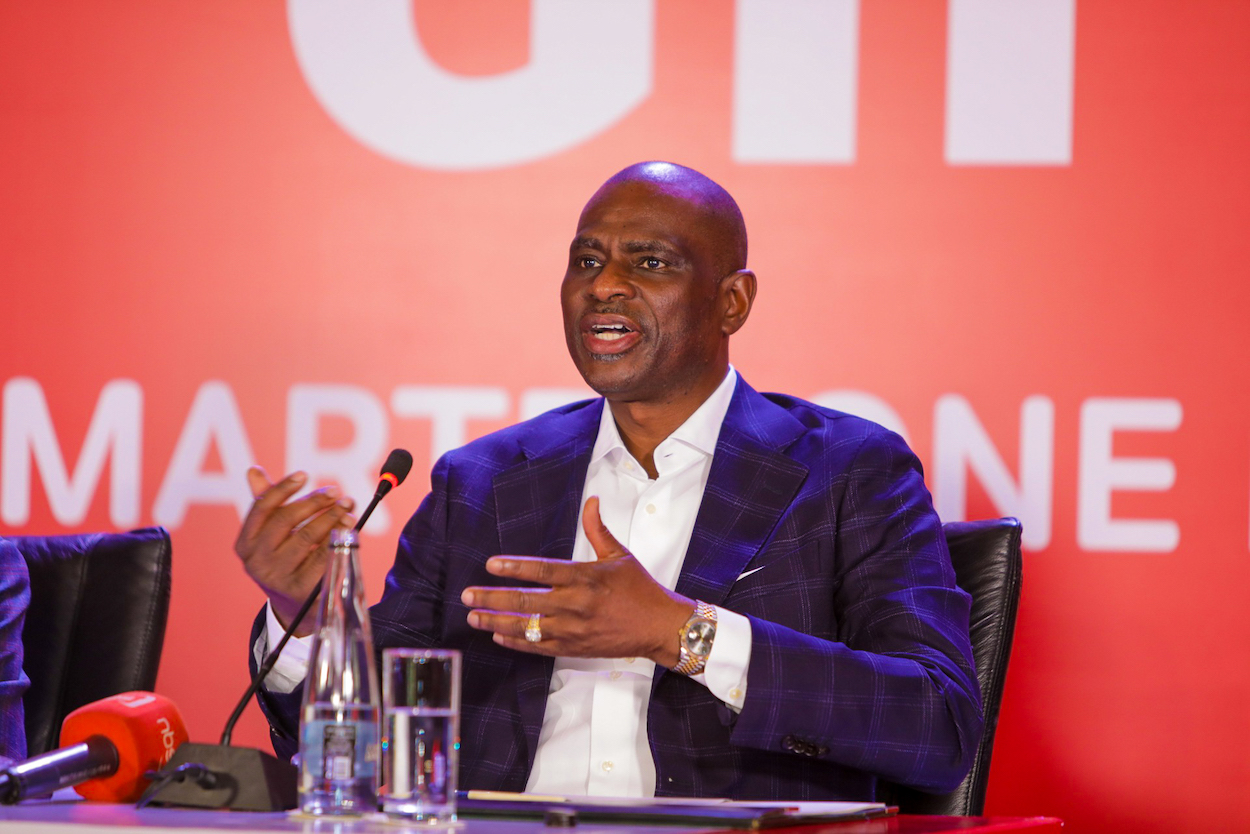
“I don’t think we have dug into the space of bankers or the space of banking. We have just discovered a need that is not being met by conventional banks,” he says.
“If you look at the model of most banks, they thrive on high-margin, low volume of customers/transactions model. That is their model. Their prices are huge, and their branches are not many. For mobile money, it is quite different. It is a large volume of customers and very small margins,” he further explains.
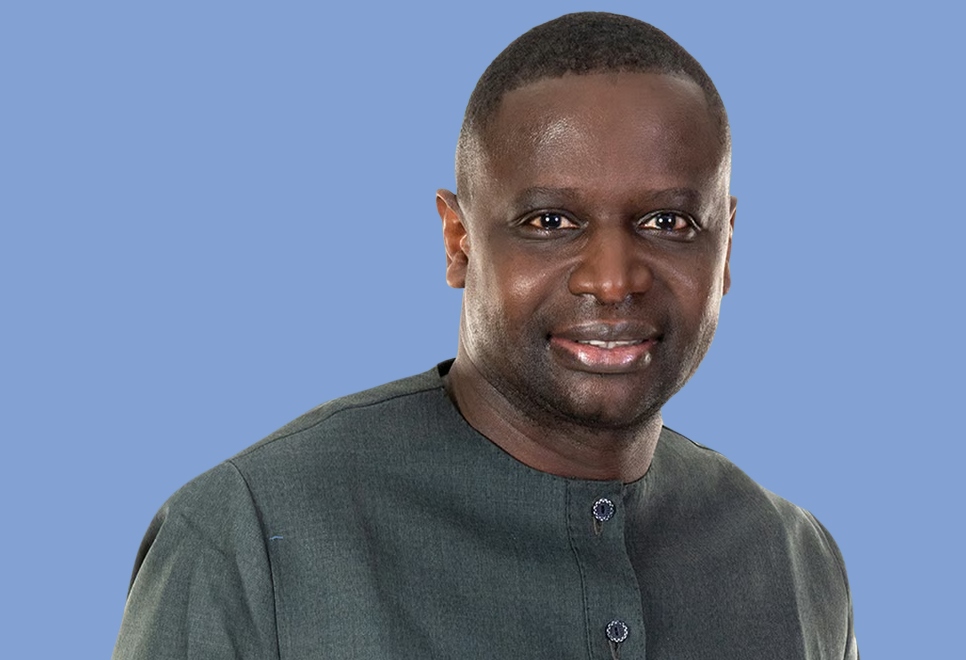
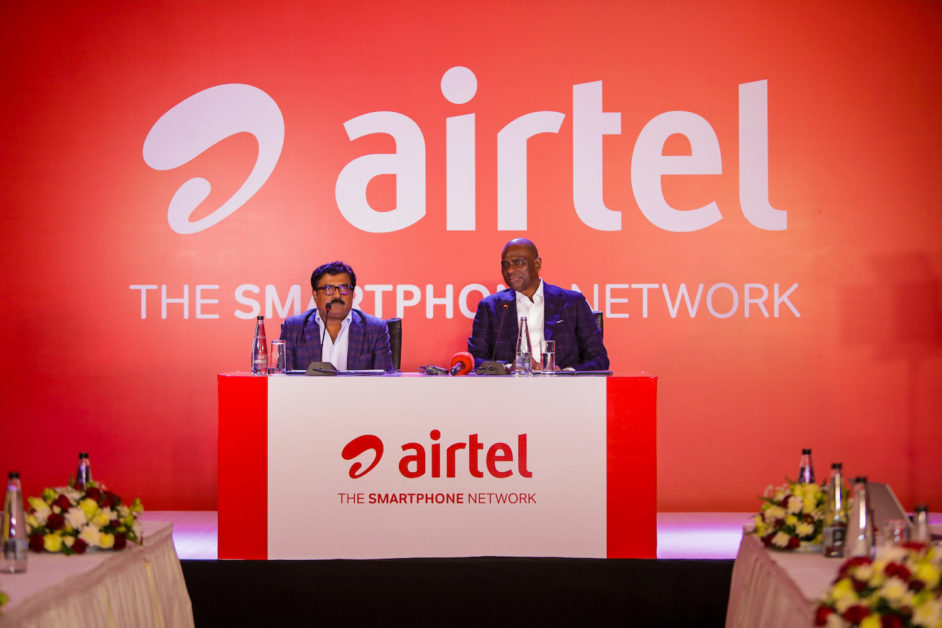
“We are bringing financial services to those who are excluded or those who are disadvantaged. That is our purpose. It is complementary to what the banks are doing. We are not taking the cake away from the banks but just creating another niche and making sure everyone joins the financial community,” Mr. Segun, who was on a recent visit to Uganda, told media in an April 26th meet and greet session at Kampala Serena Hotel.
“I still believe there is enough space for banks and telcos to do their thing. Banks and telcos complement each other. The banks are going to be around to give huge loans to projects and we are not going to be in a position to give loans of millions of dollars,” he told another journalist who asked the same question minutes.
“We want to be able to serve those who are disadvantaged⏤ men and women who live in rural areas where banks are unable to put branches and make it easier for them to access formal financial services at their fingertips, which is very complementary to what the banks are doing,” Mr. Segun, who oversees the operations of Airtel, in 14 African countries restates.
But while the banks do not want to openly accept it and the telco fintechs are happy to deny it, probably to buy themselves more time to dig in and dig deep, the facts on the ground speak for themselves, for if it looks like a duck, swims like a duck, and quacks like a duck, then it probably is a duck.
Both Airtel Mobile Commerce Uganda Limited (trading as Airtel Money) and MTN Mobile Money Uganda Limited (trading as MTN MoMo), take deposits just like the banks do- although in the former, deposits are called wallet balances, and are held in mobile wallets, the equivalent of bank accounts. Mobile wallet balances for the two largest telco fintechs grew 22% from UGX1.48 trillion to UGX1.8 trillion. That is just about 5.7% of bank industry deposits, which stood at UGX31.6 trillion in 2022, having grown 12.5% from UGX28.2 trillion in 2021.
Both banks and the fintechs make money from the sending and receiving of money and the key here is the volume and value of transactions. According to a Bank of Uganda report, which also now regulates the fintechs, the number of mobile money transactions grew by 21.9% in 2022 from 4.3 million to 5.2 million. The value of transactions grew 19.2% from UGX138.9 trillion to UGX165.6 trillion in 2022. Over the last 5 years, the number and value of transactions have grown by a CAGR of 22.7% and 18.4% respectively.
Compared to the banking industry, in 2022 there were 1,490,849 Real Time Gross Settlement (RTGS) transactions transacting a total of UGX557 trillion. This was a 21% increase in the number of transactions and an 8.4% increase in the value of transactions from 1,231,714 to 1,490,849 and UGX514.1 trillion to UGX557 trillion respectively. Over the last 5 years, the number of transactions has grown by a CAGR of 14.5% from 757,334 to 1,490,849 while the volume has grown by a CAGR of 10.4% from UGX339.2 trillion to UGX557 trillion.
RTGS, although not the only form of money transfer in the banking system, is one of the most dominant especially as the Central Bank moves to limit the usage of cheques.
It is however important to note that while the value of mobile money transactions is roughly a third of RTGS, there are only two telcos against 25 banks. The other factor to consider is that the generation of mobile-money-first-and-banks-next users is increasing. The telcos too are venturing into spaces, previously the preserve of banks such as lending and now selling insurance.
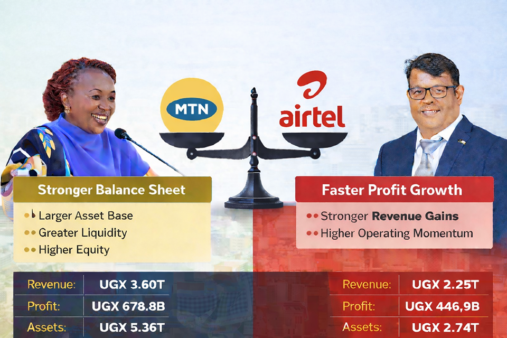
The telcos are also digging in, raking in large profits and building a tough muscle in the game. According to the just-released numbers, the combined net profit for the two telco fintechs rose 93.1% from UGX197.2 billion to UGX380.7 billion⏤ UGX218.6 billion for Airtel Money and UGX162.1 billion for MTN MoMo. While the fintech’s profit is only 29.5% of the banking industry profitability (UGX1.29 trillion), it is important to note that fintechs’ profitability grew 93.1%, and banks’ only grew 34.1%.
Transforming lives by bridging the digital and financial divides
Mr. Segun, however, insists that the numbers are only a means to an end and the end here is Airtel’s corporate purpose⏤ Transforming Lives⏤by investing inprograms and initiatives aimed at accelerating the reduction of barriers to a safer, equitable society.
“We are doing this by accelerating digital and financial inclusion and bridging the digital and financial divides,” he says.
“Through our mobile money business which is one of the largest in this country, we are making it easier for men and women to access financial products. We also bridge the digital divide through the network coverage that covers 95% of the population,” he said, adding: “In today’s world, you can’t survive unless you are part of the digital community. The digital community changes lives and gets people out of poverty. It brings people and families together.”
 Ruparelia Group Wins Key Entebbe Land Case, Clearing Path for the New Mega Speke Resort and Convention Centre, Entebbe
He also believes that at the end of the day, it is not about who is eating whose cake but rather about who is meeting the needs and aspirations of the country and the people.
“What I have discovered is that whether you are rich or poor, we all have the same ambitions and needs. We need an enabling environment. We need an environment that makes it cheaper for those at the bottom of the radar/ladder to enjoy the financial products being enjoyed by those at the top of the ladder but make it cheaper and easier,” Segun says, reiterating that: “Once again, we are not taking anything away from the banks. We are just complementing what the banks are doing and making sure that we bring in a lot more people into the financial community⏤ bridging the financial divide and creating prosperity for all.”
He however admits that in the medium to long term future mobile money and data/internet are going to become key drivers of the telco’s revenue growth and sustainability.
“In Africa, if our revenue is USD100, forty-five (45%) is from voice, 35% from data and the rest from mobile money and other services. But we continue to see data getting bigger and bigger and we even see some voice calls getting onto data- data calls. So it’s no surprise data is getting bigger. We also expect our mobile money business to become bigger and bigger,” he adds.
He reiterated the company’s commitment to Uganda, which he said is a trouble-free operation in the group.
“We really identify with the agenda of the Government⏤ Innovation and ICT transformation at the core of Uganda’s National Development Plan (NDP III) and Vision 2040. We will do whatever it takes to make sure that Uganda becomes an icon in the digital world,” Segun affirmed.
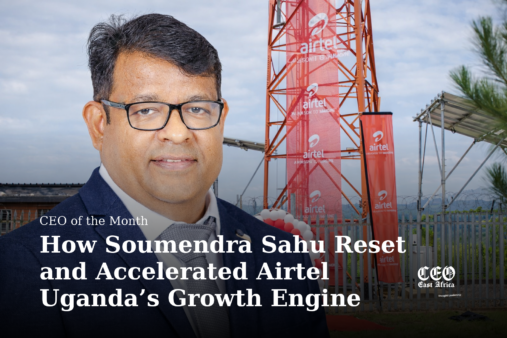
“Airtel Uganda is one of the best-performing operations and I am very delighted with the reception we have enjoyed in Uganda. I am very happy with our performance,” he told the media, adding: “In terms of market share, we are competing very efficiently with the other player in the market. It is a very good market.”
“Uganda is very special for us. It is a special market. I would like to thank the people of Uganda for making us their preferred telecom partner, for making us the preferred choice for connecting with friends, and families and for connecting and operating their passions. It is a privilege that we don’t take lightly. Thank you for accepting us in your homes, offices etc.”
The company currently covers 95% of the population with a 4G network and recently completed 5G readiness tests. 5G will be rolled out as soon as the telco secures the spectrum from the government.
We want to share in our prosperity with Ugandans
Segun also spoke about the telco’s license obligation to list on the exchange and said this will happen by the close of the year.
“We have to list by the end of the year. We take our obligations and vision very seriously. We will make sure that we abide by the rules of the listing. Very soon we will announce how we are gonna do it. But we are determined to fulfil the requirements of our license so we will make sure it happens,” he said.
He confirmed that the telco has been “talking to a number of advisors” and has made some appointments.
“We are doing everything to make sure that we have a very successful IPO. We don’t want this to be a tick-in-the-box, that’s not what we want. We want it to be a successful IPO. We want Ugandans to benefit from our prosperity. That is why we requested for an extension to be sure we do the right thing and I have all the confidence in my team in Uganda. I have confidence in the advisors that we have appointed that it is going to, in a way create value for Airtel, create value for Uganda and create value for the investors,” he reaffirmed.