
Minus offering telecommunication services, MTN Uganda’s investment into sponsorships and corporate social responsibility (CSR) has kept it’s brand popular and closer to the hearts of millions of Ugandans. MTN’s flagship sponsorship and CSR activity to date is the annual Kampala Marathon. The 14th edition of this marathon is slated for 19th November 2017. One man at the center of this year’s marathon event is Olivier Prentout, the new chief marketing officer of MTN Uganda. The CEO Magazine’s Nicholas Kalungi and Juliet Hildah Namulundu held a candid discussion with him on MTN Marathon, Telecommunication Industry, his journey and everything about him. We now bring it to you!

You are a well-traveled marketer with experience from across Africa. How has the journey been so far?
The journey has been very interesting so far. I moved in Botswana in 1992, which means that I have spent more time in Africa than in Europe. The Botswana journey was basically from a self-made graphic designer to a fully-fledged agency owner. I have been working in events management, music promotions, activations, and telecommunication.
I have worked in Botswana, East Europe, Chad, and Tanzania. From a designer to an agency owner, brand manager, marketing manager and now chief marketing officer. Before coming here, my last job was at Tigo in Tanzania. It was exciting because Tanzania is a unique market. For the last three months, I have been in Uganda, getting down with working on new challenges and opportunities.
MTN has been Uganda’s market leader for years. However, the last two years have been shaky and threatened the MTN position (Sim Registration, issues with UCC and aggressive competition). Is MTN still the market leader and with what market share?
Currently, we are slightly above 55% so we are still a strong market leader. However, it is difficult to give the actual numbers because we are still analyzing the impact of the sim card registration. We had to disconnect a couple of thousands of our subscribers due to the fact that they were not complying with the SIM Registration regulation. As a result, we need a few more months to monitor and understand which disconnected subscribers are back, who % market share translates to some 11.5 million active subscribers. In the coming weeks, we shall know whether this number has increased or dropped.
How much did the SIM Registration exercise affect MTN Uganda?
Obviously, SIM Registration came with huge consequences. But for me, I feel it was an opportunity to have gone through the sim card registration process. One, it is important that we know who is holding an MTN line because where the world has reached, it is hard to know who your enemy is and as telecoms, we have the responsibility to help the government identify the wrong people.
Secondly, it is good for us to know our customers and understand their demographics and target better our products, and services.
SIM Registration was a big exercise for us. We had to bring in additional teams to make it happen. It was a good initiative which has since become a company project and when all the departments work together, they provide success. It is because of this that I am actually very happy that it happened.
How do you rate Uganda’s telecom industry?
Uganda’s telecoms industry is very competitive. We are not only competing on the voice battle-line but also banking through mobile money, data, other value-added services and even on technologies we are using. Such competition is healthy because if it is not there, then you will become complacent. We need to always remember to value our customers because they pay the bills. When you have competition, if you do not do something right, customers will move on. At the end of the day, it is the consumer that benefits from the competition and therefore the more the competition; the better it is for the consumer. And for me, everything starts and ends with the customer.
The government in September issued a directive to MDAs to procure and use only UTL telephony and mobile internet services. What do you think of this new development?
My position would be to say that we have been made aware of the directive through media. It appears to be an ongoing discussion within Government and therefore we can’t be directly involved.
If implemented, what will be the impact of such a move on Uganda’s telecommunication sector?
We do a lot of business with Government as the Second National operator and leading Telecoms provider in Uganda. If we were deliberately excluded from providing services to Government it would negatively impact our business and be a breach of the sector policy that fully liberalized telecom companies as well as our license which legally places us at par with UTL.
Market statistics indicate that customers continue to shift from traditional voice to internet communication. What effect does this have on the overall telecommunication industry?
I like this topic because there is a misconception that voice has stopped growing and is greatly declining. This is not true. Voice is still growing, it is not dead and it is far from death. I believe that for the next five to ten years, the voice market will still remain a major revenue contributor to telecoms. For obvious reasons, as a young market, you have got more people coming and all they can afford is the basic feature phone that can make calls. Plus, a bigger percentage of the older people also prefer voice as their best form of communication.
However, this doesn’t rule out the fact that data is growing too. Data is very attractive and has endless possibilities. Information, music, business, sports and almost everything uses the internet. Talk about the famous Social Media. Ten years ago, nobody thought that Social Media will have even half the influence it has today.
But in all, both voice and data are very important.
4G technology continues to be rolled out with Airtel being the latest entrant in this mix. Is Uganda ready for 4G LTE technology? What does it take for a customer to enjoy the much marketed 4G experience?
4G LTE is a technology. First and foremost, it has a huge financial implication meaning that if you want to be a 4G user, there are a couple of boxes that you must tick. Firstly, you need to be with in a station which is equipped with an LTE equipment. You then need a device that works with 4G technology, a 4G sim card and lastly, you have to change your phone settings to 4G. But even with the presence of all this, a number of our customers are still not on 4G.
4G LTE is good to have for great speeds, streaming HD, and high data jobs.
I will be honest that the 4G technology is ahead of time. Rolling out 4G is great but there is still a long life of 3G. For me, a good 3G connection is as good as 4G.
To be specific;of 4G customers is not very big but grows month on month.
MTN recently won several awards at the 2017 Digital Impact Awards Africa including Best Financial Inclusion Product – MoKash. How many customers are using MoKash and how much has been transacted to date?
We have about 3 million registered MoKash customers, from which 1.5 million are active. The rest are dormant, come and go. We have disbursed close to Ushs40bn since the launch of the service. It is changing lives and enabling financial inclusion.
To us, MoKash and other micro-loan services coming up are an opportunity for telecoms in East Africa where mobile money is powerful to facilitate financial inclusion. People now have access to quick loans and savings without going through the whole process of banking registration or falling prey to loan sharks.
But MoKash has so many cases of instability. There complaints around delays in requesting, approving and disbursing loans. What are you doing about this?
 Allan Chekwech Steps into Daniel Kalinaki's Big Shoes at NMG Uganda
Like you know, this is a new product. Remember we work with other partners so for a transaction to be successful, our systems have to communicate with other systems and vice-versa. True, we have honestly received queries around MoKash in the past. I can however comfortably tell you that the product is now more stable and works faster. From our caller center reports, customer queries around MoKash have significantly reduced.
Does MoKash and other micro-loan products than replacing banks?
That is not possible. Even with the huge success of micro-loans and mobile money as a whole, there is still roam for banks. You will not use MoKash to get a mortgage. And remember that even for MoKash, we are working with banks, in this case, CBA. Plus, even banks are now launching products that compete with mobile money. Both Telecoms and Banks shall continue to co-exist and work as partners.
The 14th edition of the MTN Kampala Marathon is upon us. What is that x-element/ woo factor in this edition?
What is different this year is being able to decide the charitable cause you are running for. Unlike the previous editions, this year, every participant has a chance to choose from the two identified causes, one he/she is running for. This year, we started with two causes. Participants will run for either improving Maternal Health or reducing Child Exposure to Cancer. If this works well, then next year we can open it to more. And of course, the 5km family run that was added this year is a great addition.
Why has MTN Marathon failed to attract leading elite runners from Kenya, Ethiopia and all-over the world?
This could be as a result of timing. Maybe the time when the marathon is on the main elite runners like you have called them are preparing for another major marathon. I believe UAF can give the best answer to this.
On our part, we provide everything to make this marathon bigger, better and competitive every year. I know people have been complaining about the prize money. But this year, we have increased the prize money to Ushs20 million. Hope this will attract more big names. Even though we need more elite runners on the Kampala track, our prize money must be manageable. We rather have the money go to charity in our country than have it go out of the country as prize money.
MTN Marathon had started to lose its civic excitement and traction owing to failure by organizers to fully publicize how the charity proceedings were being used. Several complaints were posted across the internet. What are you doing differently this year to address these concerns?
I don’t want to comment on the past because I wasn’t here. I have heard some of those issues. This is why we decided to have well defined, impactful yet quick to execute causes. I told the organizing committee this year that let us direct the proceedings to causes that people can directly identify with. We plan to invite a few people and the media to be a part when we are delivering the Marathon proceedings.
What is the 2017 organizational budget for the MTN Marathon?
This year’s Marathon marketing and management budget are Ushs1.2 billion.
How much money will go the charitable causes this year?
It will be about Ushs500 million. But with more participant and donations, this figure can increase.
There are some voices that MTN Uganda invests so much in marketing the Marathon than the actual charitable causes. For example, we know for the fact that over the last 14 years, some Ushs2.8 billion have been raised for charity by participants. However, in the same period, about Ushs10 billion has been spent on organizing and marketing the marathon. Does this add up?
The Marathon marketing budget clearly comes from MTN Uganda Marketing department annual allocations. It is allocated at the start of the year and planned to be used for this purpose. While MTN Uganda Marketing team manages the marathon marketing budget, MTN Marathon proceedings are managed by MTN Foundation. MTN, the Business and MTN Foundation operate differently. So, the business invests the marketing money while the foundation receives the event proceedings and use them for the agreed on charitable causes. It would be wrong if its MTN Foundation that was spending all that money in organizing the marathon. Hope this clears that misunderstanding.
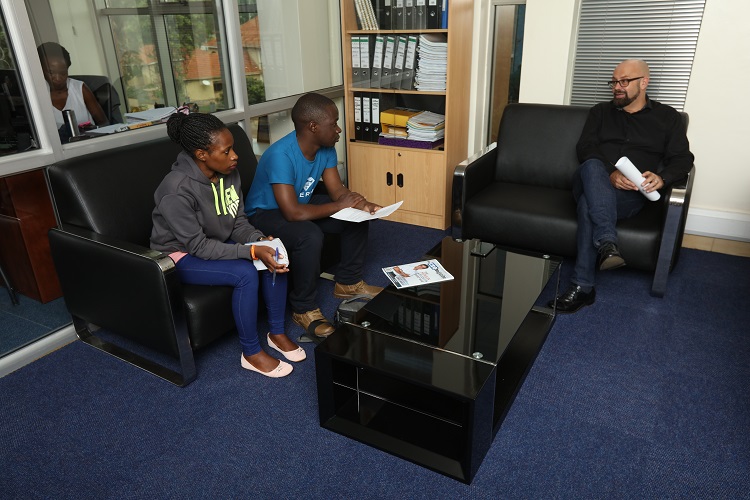
About Olivier Prentout.
What has been your best and worst career decision?
BEST: They are so many but the greatest I think was the impact I made on the music in Botswana including flying in international superstars and giving a platform to the local artists.
WORST: As a businessman for over twenty years, I have done mistakes but the biggest mistake I think is trusting people. I have trusted people and they have let me down. But I continue to trust and believe in people.
Your views about Uganda.
I find Uganda so lovely. I did not know that there could be a good place in Africa such as Uganda. The education system is good, there is quality food and the people are very welcoming. I have never been in a country where immigration officers are as welcoming and helpful like in Uganda. For now, the only challenge is traffic but I am managing it.
What does success mean to you?
To me, success means putting a smile on people’s faces.
Away from work, how do you spend your free time?
Family comes first. I am married with four kids so I spend some good time with them. I love motorbiking, traveling and deejaying. I am a diehard Arsenal fan and never miss those matches.
Favourite quote.
“Just do it