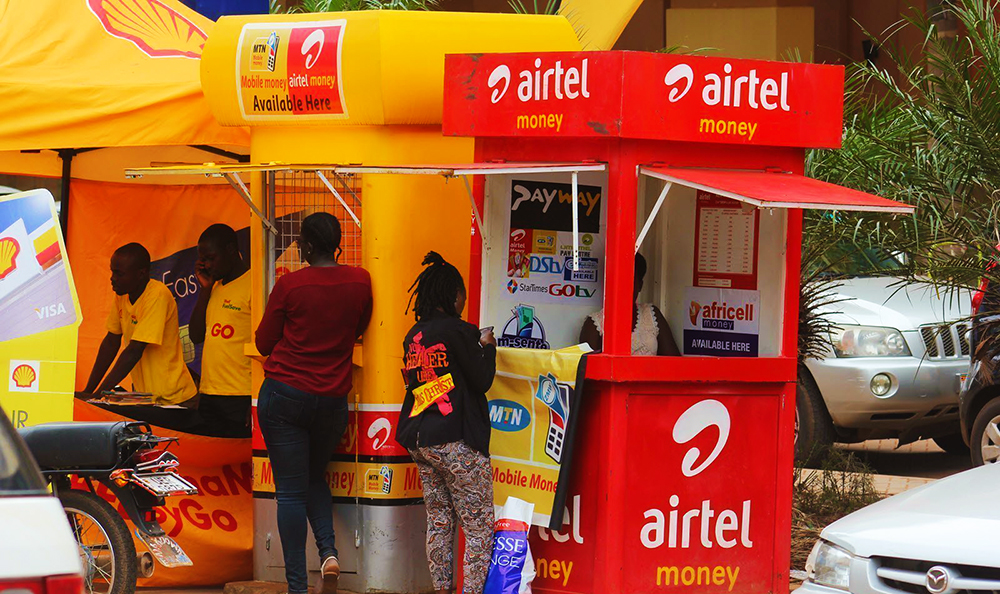
In Uganda’s fast-evolving digital financial landscape, two telecom titans—MTN MoMo and Airtel Money—are locked in a high-stakes, trillion-shilling duel. Their battlefield? Mobile money. Their weapons? Revenue, reach, profitability, and performance. The recently released FY2024 comparison by Crested Capital confirms what many market watchers have sensed for years: MTN MoMo is the bigger fintech giant, but Airtel Money is delivering sharper profit margins.
A tale of two fintech titans
The year 2024 saw both MTN MoMo and Airtel Money break through the UGX 800 billion revenue ceiling, with MoMo finishing stronger at UGX 981.94 billion ($267.92 million), a 10.03% lead over Airtel Money’s UGX 892.40 billion ($243.5 million). This cemented MTN’s dominance as Uganda’s largest mobile money platform by income.
Yet, it’s Airtel Money that turned that revenue into superior profitability. The red-branded challenger posted a profit after tax (PAT) of UGX 310.96 billion ($84.85 million)—19.55% higher than MoMo’s UGX 250.16 billion ($68.26 million).
This curious divergence—higher revenue versus higher profit—has ignited a deeper debate in investor circles: Is it better to be big or to be efficient?
Bigger balance sheet, broader reach
On nearly all balance sheet metrics, MTN MoMo stands taller. By end of 2024, MoMo’s total assets clocked in at UGX 1.63 trillion ($445.92 million), 38.21% more than Airtel Money’s UGX 1.01 trillion ($275.52 million). MoMo’s mobile money deposits also outpaced its rival significantly—UGX 1.37 trillion versus Airtel Money’s UGX 838.20 billion, a 63% lead.
“MTN MoMo has clearly built the broader financial infrastructure, commanding greater float value, bigger asset size, and deeper customer penetration,” the Crested report notes.
Leaner machine, better margins
However, when it comes to margins, Airtel Money is punching far above its weight. Its operating margin stood at 49.19% compared to MoMo’s 36.64%. The net profit margin was equally impressive—34.85% versus MoMo’s 25.48%. Even more striking is the Return on Assets (ROA): 30.79% for Airtel Money, nearly double MoMo’s 15.31%.
These figures indicate a leaner, more optimized operational model at Airtel. While MTN MoMo is delivering scale, Airtel Money is extracting more value from every shilling earned.
Profitability vs market share: Who’s winning?
Over the last three years, both fintech arms have posted impressive compound annual growth rates (CAGR). MoMo led in revenue growth at 22.26% CAGR, but Airtel Money wasn’t far behind at 18.88%. However, in earnings before interest and tax (EBIT), Airtel Money surged ahead at 25.71% CAGR versus MoMo’s 19.33%.
“From an investor lens, Airtel Money is showing better yield and discipline. But MoMo’s scale positions it as a systemic player in the digital finance sector,” said a financial analyst who reviewed the data.
Dividend machines: What if they were listed?
In FY2024, MTN MoMo paid out UGX 303.22 billion ($82.73 million) in dividends, amounting to 59.93% of MTN Uganda’s total dividend payout. If it were listed independently, it would rank as the second-highest dividend payer on the Uganda Securities Exchange (USE).
On the other hand, Airtel Money is estimated to have paid out UGX 291.70 billion ($79.59 million)—not far behind, but still lower than its own GSM parent, Airtel Uganda, which paid UGX 315 billion.
 World Bank bans PwC Africa, Rwanda and Kenya affiliates from Bank Group-financed projects over fraudulent practices
These numbers have raised an important question: Are Ugandan investors missing out?
“With fintechs now outperforming traditional banks in profitability, a public listing of MoMo or Airtel Money could unlock tremendous value for local investors,” noted Crested Capital in their commentary.
Outshining banks
Remarkably, both MoMo and Airtel Money posted profits higher than many of Uganda’s top commercial banks. In 2024, Absa Bank Uganda recorded UGX 177.87 billion in PAT, Housing Finance UGX 71.13 billion, and Equity Bank Uganda just UGX 20.45 billion. Even Standard Chartered Bank reported a modest UGX 19.09 billion.
This outperformance is not just symbolic—it signals the shifting locus of financial power in Uganda from traditional banks to telco-led digital finance.
Policy watch: Call for localization and listing
The findings have added momentum to growing calls for greater localization and public participation in Uganda’s fintech economy. The Bank of Uganda has licensed over 40 payment service providers, but the two market leaders remain private units of their telecom parents.
“In the same way UCC required telecoms to list locally, there’s a strong case for regulators to push fintechs—especially those of systemic significance—to go public,” said one policy expert.
Such a move could deepen Uganda’s capital markets, increase transparency, and broaden ownership of the country’s digital economy.
Final word: Two winners, One market
Whether you view it through the lens of size or efficiency, Uganda’s mobile money space has produced two powerhouse performers. MTN MoMo, with its heftier assets and revenue base, is the undeniable heavyweight. Airtel Money, meanwhile, is proving that precision and profitability can rival brute financial strength.
In a space as dynamic as fintech, it’s possible—perhaps even likely—that both players will continue to win. But how they win, and for whom, is what will shape the next chapter of Uganda’s digital finance story.