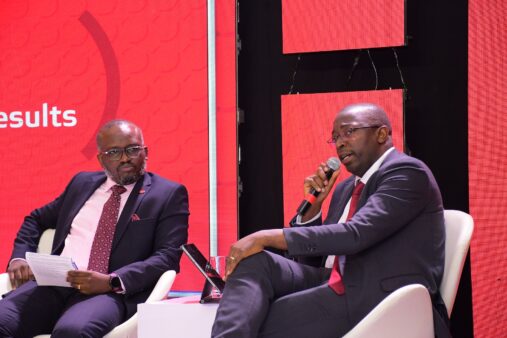
Johnson Agoreyo, the United Bank for Africa, Uganda Managing Director/Chief Executive Officer has been recalled back to the United Bank for Africa Group Headquarters in Lagos, Nigeria; CEO East Africa Magazine can exclusively reveal.
Mr. Agoreyo who has been UBA Bank’s boss since June 2016, confirmed the news to us this afternoon.
Yes, it is true. I have been notified that I have been recalled to Group. My colleague, the Chief Executive Officer of UBA Gabon will be replacing me as CEO, as soon as the airspace opens.” He told this reporter in a phone interview, adding: “In the meantime, I will be here in transition mode.”
Asked what role he will be taking up at Group level, he said it was not yet clear.
“That’s premature for now. We are waiting for the dust to settle because of the pandemic,” he said.
Agoreyo was the bank’s 6th CEO in 12 years and at a four years served in Uganda, he is the longest serving MD of the Bank.
“Normally the group restructures its CEOs every after 3-4 years and by this May, I had completed my fourth year in Uganda, so this change was expected,” he said, adding that in fact two other CEOs in the East African region- Tanzania and Zambia, had also been shuffled.
Not much is known about Ms. Chioma Mang, the current CEO of UBA in Gabon that is replacing Agoreyo. She too has been in Gabon for 4 years. Her appointment is subject to Bank of Uganda approval.
Agoreyo’s four years in Uganda
Mr. Agoreyo further told this reporter in the interview his four years in Uganda were characterized by growth upon growth and that he leaves Uganda with his head held high.
Related
 MTN vs Airtel: Balance Sheet Strength Meets Earnings Momentum in the Race to Win the Telecom Market
“When I came to Uaganda in June 2016, the UBA franchise in Uganda was at risk because of the state of the bank’s finances- underpinned by 8 years of losses and huge Non-Performing Loans,” he said.
“In fact BoU had given the Bank a warning via a MoU, but by December 2016, we were profitable and by 2018, BoU had lifted the MoU because of the strong risk management and corporate governance practices we put in place. Our ratings were moved from unsatisfactory to satisfactory by the regulator,” he added.
According to the bank’s audited and published figures, in the four years he has been at UBA, bank assets have grown by an above-industry compounded annual growth rate of 27%, from UGX172.9 billion in 2016 to UGX449.3 billion at the end of 2019. As a result, the bank has been able to end years of losses, turning the corner into profitability for the fourth consecutive year. After tax profit at the bank rose by 63% to UGX8 billion in 2019.
“When I came in, UBA was in the last position (25th out of 25 banks) regarding profitability, but by end of 2019, we were in the 12th position on profitability and the 15th in deposit liabilities,” he said adding that by end of 2020, UBA could be among the top 10 most profitable banks.
He also said that during his time, he led the bank to obtain a Bancassurance license as well as joining the agent banking platform.
“I also grew the bank from 9 to 15 branches as well as grew our ATM network from 9 to 25 ATMs. We also relocated the headquarters from Spear House to bigger and better headquarter premises,” he said.
Asked why UBA was opening more brick and mortar branches when other more profitable banks were closing branches, Agoreyo said that, it was important first to build scale before going branchless.
“It was part of the bank’s 2020 strategy. There is only so much you can do in terms of digitalization- but first you have to build scale and presence in key strategic locations like Gulu and other parts of Kampala where we opened branches,” he said, adding: “Of course that impacted slightly on our cost to income ratio, but we are beginning to see growth in customer base and transactions from the new branches and we expect to sustain that,” he said.