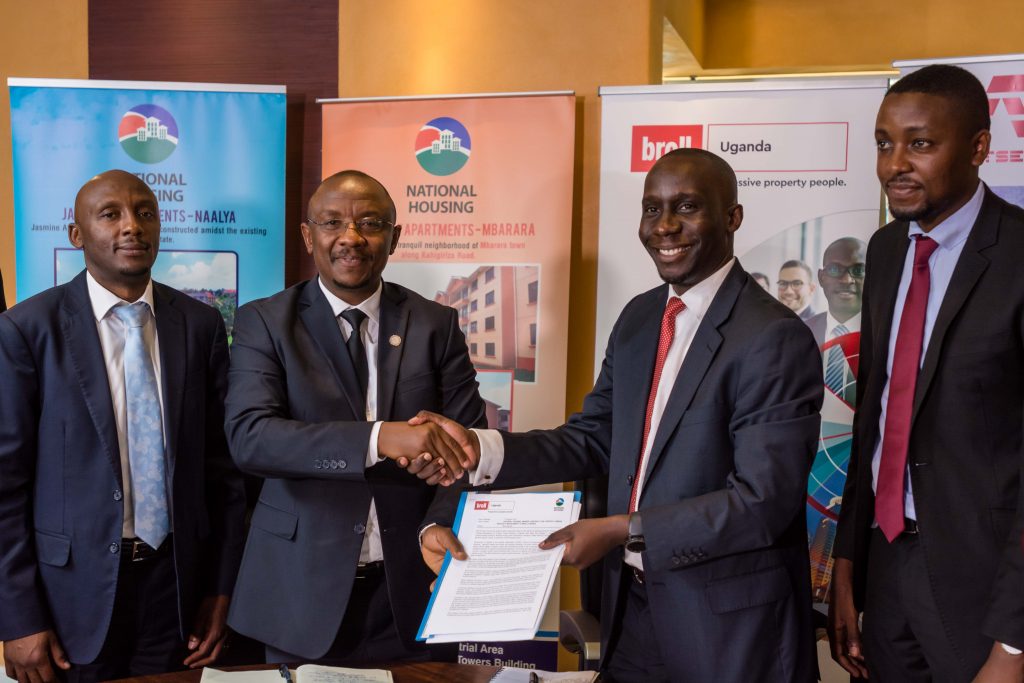
You have been in this market since 2017, but not much has been heard from you until recently when you signed a contract to manage Crested Towers from National Housing and Construction Corporation. What have you been up to in these 2 or so years?
At the time when Broll came into this market, we had an affiliation with CBRE- the biggest global real estate consulting firm, through whom we were managing an occupier services contract with Standard Chartered Bank. With occupier services, we were largely embedded within the bank to advise them on their real estate strategy; where they can save costs, facilities management, data management, and all that.
Of course along the way, we picked up clients such as AIG Insurance before they sold their building, B.A.T and British Council.
The occupier services business is quite different from investor services where property management and the likes fall. By its very nature, it does not require a lot of big physical presence as much of the work can be and is done online; so we did not need a very big operations corner.
Today we have about 7 people within Broll Uganda. Some of whom are embedded within our clients offices and others sit right here.
But more importantly, Broll Group runs a connected operation across Africa with a lot of shared services online. For example my finance team seats in Port Elizabeth, South Africa while the Africa IT support desk sits in Sandton, Johannesburg. We leverage a lot of technology and work off the cloud- the physical team here may be small- but in reality we are a big team.
If there is a property developer out there, who owns 2 or 3 shopping malls down town, why should they be excited that Broll is in town? Do they need you anyway?
Why they would need a company like Broll is for very many reasons. One is, if they are interested in opening up to true accountability and transparency of their property- how much rent is coming in, when is it coming in, which tenants are paying, do they have leases etc., they then need a professional like us.
When we come to you, we deploy our certified property management system which loads elements such as leases, escalation etc.; every little detail on you property that you need to make proper decisions. The system generates reports in real time at the click of a button- if at any one time you wanted to know how many tenants have paid, how much is outstanding or the lease expiry profiles- on a click of a button, you get a report.
The other service we offer is the day-to-day running of the building and tenant management. Usually investors do not want to get involved in the daily interfacing with tenants/clients. So if you want to outsource that to someone who is professional, who has been tested in the market across Africa, again you would want to speak to Broll.
Broll is also good at maintaining our clients’ buildings and maintaining the investment value of these assets. Our facilities maintenance teams are always there to do your preventive maintenance, log all maintenance calls, come up with budgets etc.; to the minutest detail like why do I have to replace 10 bulbs on this floor every week? We will then come in and do diagnostics- may be the problem is the entire wiring of the floor/building and we will have that rectified.
Then there are value-adds such building condition audits; for example are the cables laid 10 years ago still relevant for you? Aren’t you putting a lot of load on the building? What is the risk exposure from a fire point of view?
Using our tested platforms, you find that you save a lot of money in terms of how quickly you can get the information that you need to make the necessary decisions.
For example, should you want to refinance and get into structured real estate, banks are going to ask you for these reports. They want to know what is your profit and loss statement; what are your cash flows like etc. With our Broll Online system, we are we are able to offer you all that, but also take care of the building fabric and most importantly use best practices and certified systems that have been audited and tested in delivering that quality.
What particularly attracted you to the Uganda market? Do you see huge prospects for yourselves?
From a Broll perspective, we looked at Uganda as not having a lot of competition from an international or regional perspective. We only have one international player. There are some good local players in the market, but we thought there was room for an alternative regional/international player to offer the market, an alternative approach.
But also, if you look at the demographics of Uganda- population growth, growth trends in middle income, foreign direct investment etc., Uganda has a big potential.
Then if you follow the FDI into the East African region- the MNOs and the private equity firms; the trend is to go to Nairobi first and then Kampala next. So you could say, we are in effect following the path of growth in the region. After Nairobi, Kampala was naturally next.

But for us the low-hanging fruit that actually got us into this market was the occupier services contract with Standard Chartered Bank that required local presence. That was our soft landing. This then opened up more opportunities for us in the market and we then had to bring in property management into the market as well.
However we have to be careful to separate our occupier services and property management roles. You cannot be a property manager and represent an occupier in the same building. So, when it comes to that, you have to disclose and say guys I cannot represent you, I am managing this building.
How different are you? How do you differentiate yourselves from the others existing in the market?
One of the unique value propositions for Broll is the systems that we use- Broll Online. It is customized and owned by Broll. It keeps evolving and it’s not in black and grey. The modules that work in Kenya may not work in Uganda.
If you look at our facilities management approach. Again, we are certified in that. So, if we talk about systems, health and safety, cleaning, approach, methodology etc., all this has been worked out overtime. Most importantly I think we are able to offer a service quicker, better and cheaper because with our model, we use a lot of shared services with other group offices, so we are leaner, thus our pricing point tends to come out more competitive, compared to other players I would think.
Are you able to put a number to, say if you use Broll, you are able to save this average percentage in costs compared to other providers and maybe this is how much value in dollars/shilling that we will add to your business? Is there a number that you can put hands on?
Let me put it this way- from an occupier services angle, our fee to value ratio is 1:16. For every 1 dollar you pay us, we save you 16 dollars. So, if you get into a lease of say 18 dollars per sqm and your escalation is at 4%- we can be able to go back and seat with a land agent or managing agent of a property and negotiate it from USD18 to USD15 and may be your escalation to 2%- that sort of thing.
It is not just that alone but also we can advise you where you can save money. We do optimization studies, we do demographic analysis, all these sort of reports that help decision makers to come up and say we need to locate our offices in place X because the spend per member of staff is so much compared to place Y. So for every USD1 you pay us, we save you USD16 and that is the bench mark from an occupier services point of view.
 World Bank bans PwC Africa, Rwanda and Kenya affiliates from Bank Group-financed projects over fraudulent practices
Who are some of the clients you handle right now in Uganda from the various services that you offer?
For property management we work with National Housing & Construction Corporation as well as Uganda Development Bank (UDB)- they have taken back the former MTN Towers. We are going to help them refurbish it and they are going to move into the building.
For occupier services we work with British Council, Standard Chartered Bank, KFC and B.A.T. For integrated services we work with AIG. On top of that we have the Cushman & Wakefield client list – all in four years.
Given the trend so far, we see more opportunity to grow.
Given your understanding of the regional property markets, if I had money today and wanted to invest in property, where and how would you advise me to invest it? Where are the opportunities and where am I likely to make good money?
Obviously the first thing, I would want someone to put their money where their mouth is, because the decision to invest in real estate can be painful at times. Usually I ask people what is their risk appetite? What is their return objective? Answering these questions, helps in decision making. For example, if your risk appetite is high, you may want to be in for a long term. So, you start looking for projects that are going to be kept for say 10 to 15 years before earning income. Others will tell you ours is low risk so we want in and out- so in that case we can advise you to build apartments. It is difficult to zero in a decision for someone unless you understand where they are coming from- their risk appetite, their return objectives and their capital structure.

But in terms of the market right now, if you could get maybe 2 acres of land in Kira/Namugongo side or along Gayaza Road and you put a small street mall you can make money because these are neighborhoods that are coming up. If you can do a 6,000- 8,000 square meters mall, you can make some money because the retailers are there, disposable income is growing and our GDP per capita is $600 something dollars. As these fundamentals keep growing, our purchasing power is growing and people are spending. Instead of driving all the way from Gayaza to come to Acacia Mall, if there was another Street Mall along the way, where I can take my family for shopping and other lifestyle indulging, it would be really good- so retail property investing in a good location is still good.
I think affordable housing is the other big thing that people need to know. And by affordable, I do not mean low-cost. If you can get another good site like the Millennium Developers are doing, I think they are churning out a number of units- most of them are bought off plan.
I would not advise someone to get into commercial office space right now especially grade, B, C &D. No. If you have a prime site, maybe do top grade A green-rated real estate so you can attract the likes of European Union because we do not have a green-rated building in Kampala. If you are going to do grade A office space, do it at the highest level, make it green-rated like PDM Holdings has done in Nairobi, with The Courtyard.
Green rating, involves a number of things such as energy efficiency, recycling your water, more of natural lighting, having a court yard, an energy mix that among others includes solar etc. We do not currently have a green-rated building in Kampala.
Green developments is not a random thought, you have to go through a deliberate process and the return on investment is worth it. Uganda is beginning to see more and more sophisticated occupiers that are beginning to start demanding for these kinds of offices. There is a big green agenda out there and the green dividends are promising.
Kampala is one city with disorganized developments. It is common to find a 6-10 storey building with no parking. People who can afford and know how to do the right things are not doing them. How do you think this can be managed?
I think we need to do a lot of educating in the market on how to go about the real estate value chain because more than often, someone who is doing a development that is not planned or well thought-out is basically trying to put square pegs in a circle hole.
The ideal situation is someone comes up with an idea, sits down with professionals, whether it’s Broll or any other person, but let them guide you through the investment process. So, if your appetite is a shopping center, they will tell you whether your site is fit for a shopping centre. They will guide you on how much parking you need, whether you have the right kind of access etc. But that sort of thing would apply to what I would call a genuine investor. Someone who has bought their land, came up with an idea and went to the bank for financing; this kind of person would definitely need advice from professionals.
But most times, for an informal investor who has sold his coffee and wants put up a property, they will not think about that. All they dream about is a big building in the city centre and how they do it is secondary.
But the days of such speculative investors is numbered. Think about what would happen to many of the downtown developers if the taxi park was relocated from downtown Kampala- what will happen? We are already seeing banks getting out of Kikuubo because the numbers are no longer as attractive as they used to be. So imagine if the Old and New Taxi Parks were taken to Nateete or Banda what will happen to those developments?
Whereas some of the investors in such projects are what I can call old money class, with their own unique sources of funding, for the new developers in the market who are using bank finance, the dynamics are changing. You cannot do it as business as usual.

You need to sit down, run the numbers and come up with a business plan, come up with an optimal capital structure and put up a development that is going to work against the shifting dynamics- because if you don’t and you had taken debt for example, any slight change could bite hard. What developers need to do is to have a long term view to a long term investment- if you want to put USD10 million dollars in a building, you lose nothing to speak to professionals, let them guide you through the process, get the right proposition and then create the right product at the right time.
And even us professionals we should not feel shy to tell a developer that something is not going to work with clear reasons- because today people are buying land at USD4 million downtown. What are you going to offer to get a return for USD4 million dollars on just land? I hope that by Broll coming on board, we will add on what all the other guys have done over the years to try and point the investors in the right direction and be able to give them professional advice.
A couple of months ago there was talk of the Land Lord and Tenants Bill that is going to regulate rent and many other things. There has been a lot of pushback from the market especially the landlords. The tenants on the other hand appeared to be happy because it was favoring them. As Broll, what is your general take on this legislation?
First of all, we need legislation; no doubt about that. We need to regulate the real estate sector and the practitioners therein. However, how to do it is what is important because you cannot for example assume the rules that are going to play for someone who has a downtown shop on a 20 sqm space, selling second-hand shirts will be the same rules that will apply for Shoprite that is taking out a 10-year lease with heavy capital investment in the building. The two have to be regulated differently.
Where we stand as Broll and I think other colleagues in the industry will agree with me is that you do not want to regulate to the extent of which currency rent is being paid in, what level of escalations are allowable and what charges can a landlord make. It becomes very difficult because remember the rent agreement, is a mutual discussion- no one is signing that agreement with a gun on their head.
For example, whereas an investor like NSSF who finances their investments in Shillings wants to charge in Shillings, should be free to do so, just like an investor out of South Africa who has bought Metroplex Mall in dollars and is expecting dollar returns should be allowed to charge in dollars. If you are now telling them that they cannot charge rent in dollars, you are going to dry up FDI into the sector.
I think much as we need legislation, we should not regulate to curtail growth in the sector. Somethings are better left to the forces of demand and supply.