In this interview with Muhereza Kyamutetera for our #WomenFixingUganda series, Crystal reflects on her journey, her values, and her mission as a nation builder—to rebuild trust at the intersection of taxpayers and the state.
Beyond the role, beyond the title—who is Crystal Kabajwara, and what fundamentally drives the work that you do?
Yes, I like to describe myself as a nation builder. This is because, at the core of what I do is building trust and integrity within Uganda’s tax system. For me, tax is not just about revenue collection—it’s about creating a system that people believe in. Because when you build trust into the system, you make it sustainable, and that is what ultimately finances the needs of government and drives national development.
And how I do that is anchored in two things.
First, my faith. My faith in God is paramount—it shapes how I think, how I lead, and how I make decisions. Second, my values. I call them AIRE—inspired by the Jamaican “IRIE”, but mine stands for Accountability, Integrity, Responsibility, and Excellence.
Those four values guide everything I do. And when I’m able to bring them together in my work—when I’m accountable, when I act with integrity, when I take responsibility, and when I strive for excellence—that’s when I truly feel AIRE.
That’s a powerful way to frame your work. Now, you’ve mentioned the Tax Appeals Tribunal—and I think for many Ugandans, we are more familiar with the traditional court system. If someone has a dispute, they think of the commercial court or the High Court. So help us understand this: what exactly is the Tax Appeals Tribunal, how is it different from the ordinary courts, and how do taxpayers actually access it when they have a dispute?
The Tax Appeals Tribunal is a government institution, and our role is to resolve disputes between taxpayers and the Uganda Revenue Authority (URA).
Now, by design, URA’s mandate is to collect and administer taxes, while taxpayers naturally seek to minimise what they pay. So, there will always be tension—there will always be disagreements.
And when those disagreements arise—whether it’s about an assessment, enforcement action, or how tax has been applied—that’s where we come in. The taxpayer comes to the Tribunal to have that dispute resolved fairly and independently.
In terms of the court system, we are what is called a Court of First Instance in all tax matters. That means if you have a tax dispute, you don’t go to the High Court first—you come to the Tax Appeals Tribunal.
What also makes us different is how we operate. Our setting is intentionally more accessible and less formal than the traditional courts. We encourage taxpayers to come as they are—you don’t necessarily need a lawyer or an accountant.
We already have that expertise within the Tribunal—lawyers, accountants, and business professionals—so our role is to guide you through the process. You come, you tell your story, we listen, and we help navigate the issues.
We also prioritise mediation. We have a team that sits down with both the taxpayer and URA to try and resolve the dispute amicably. And only when that doesn’t work do we proceed to formal litigation, where a panel of three experts hears the matter and makes a determination.
So at its core, the Tribunal is about making tax justice accessible, fair, and efficient for everyone.
So in a way, it’s almost like a “come as you are” space. You don’t necessarily need a lawyer—you come, you tell your story: this is what URA said, this is where I disagree, and this is my position. And then the Tribunal steps in to guide, interpret, and help resolve the matter. Is that a fair way to understand how it works?
Exactly—and that approach is very intentional.
You first have to understand the context in which we operate as a country. Uganda’s economy is largely informal, driven by small and medium enterprises, many of them family-owned. These are the businesses powering the economy—but many of them are not trained in tax, accounting, or law. Some don’t even speak English.
So we have deliberately created an environment that is open and accessible to everyone.
For example, we recently had a taxpayer who told us, “I only speak Rukiga.” None of us on the panel spoke Rukiga, so we brought in an interpreter to ensure they could be heard. In another case, the taxpayer spoke only Luganda—so we conducted the hearing in Luganda.
That’s how flexible the Tribunal is. We meet people where they are.
And this approach has made a real difference. By relaxing rigid procedures and focusing on access to justice, we’ve been able to resolve more disputes and significantly improve our performance.
Now, let’s bring this closer to the everyday Ugandan. Many businesses start informally—you wake up with your one million shillings, begin trading, focus on survival and growth… and only later realise that URA has been tracking your activity, especially with systems like EFRIS. At that point, panic sets in. There are gaps, maybe mistakes in compliance, and people don’t know where to begin—or they’re simply afraid of coming forward. So what would you say to such taxpayers? And where does the Tribunal come in to support them through that process?
We do see many of those cases—but often, they come to us at the tail end, after URA has already audited the business and raised assessments. At that point, the amounts have accumulated, and the business is struggling to comply or to pay.
So the first thing I always tell taxpayers is this: no matter how small your business is, it cannot grow or scale if you are not tax compliant. Eventually, URA will catch up with you.
The key is to build compliance from the very beginning.
If you can’t afford a full-time accountant, outsource one. And in our context, we also have extended family networks—someone you know who understands accounting can help you put your books in order. Today, there are also many affordable professionals who can support you.
But beyond that, basic record-keeping doesn’t require an expert. If you buy goods or services, keep the receipt. File it. These days, you can simply take a picture and store it on your phone or computer. It’s really about being intentional and organised.
Because tax is a risk—and non-compliance is a very big risk.
We’ve seen businesses that started small, grew successfully, but ignored tax along the way… and then suddenly face assessments running into billions. At that point, it becomes very difficult—even for the Tribunal—to help.
So my advice is simple: build tax compliance and tax risk management into your business from day one.
And this is also a call to professionals—lawyers, accountants, advisors. There is still a lot of sensitisation needed in the market. We shouldn’t only operate for profit; we also have a responsibility to give back, to educate, and to support small businesses to get it right early.
But let me take you back now—because you didn’t start as Chairperson of the Tribunal. How did this journey begin? What drew you into the legal and tax space—and what has kept you going all these years? And just to push you a bit—was it a deliberate choice, or did you, in some way, stumble into tax and then fall in love with it?
It’s interesting—I get that question all the time: how did you end up in tax?
And I always say, I didn’t choose tax… tax chose me.
My mother actually worked at the Uganda Revenue Authority, but as a secretary for many years. She would come home talking about her bosses with so much respect and admiration, and sometimes about her work—but it never really occurred to me that I would follow that path.
I went on to study law, and at Makerere, I took taxation as one of my options. But at that stage, like most students, you’re not thinking too deeply about where it will lead.
Later, when I went to pursue my master’s at the London School of Economics, I had actually applied to study human rights law. But when I got there—quite literally—I walked into a taxation class by mistake. I was lost.
And that moment changed everything.
There’s a line in the movie Jerry Maguire where someone says, “You had me at hello.”
That’s exactly what taxation did to me. It had me at hello—and I never left.
That’s interesting—you sound like those early explorers. I’m told whenever they got lost, they would say they had discovered something. So in your case, you got lost… and ended up discovering your career in tax?
In life, you make the most of any opportunity that comes your way. Sometimes what looks like getting lost… is actually the beginning of something much bigger—you just have to be open enough to recognise it and run with it.
So before the Tribunal, many of us followed your journey at PwC—but I’d like us to go further back. Because a lot of people today, especially younger professionals, look at where you are and assume it all happened quickly—they want to arrive in three or four years without really understanding the journey behind it. So take us back to the beginning: how did it all start? What was your upbringing like—and how did that shape the person you’ve become today?
That’s a long story—but I’ll try to keep it brief.
My childhood was… difficult. My parents separated when I was about three or four years old. For a number of years, my mother wasn’t with us, so from around five to ten, I was raised by my father and my stepmother—and it wasn’t an easy environment.
Eventually, we were taken to live with my mother. From Primary Seven onwards, she raised us—but at the time, she didn’t even have a job. I still don’t know how she managed. She had gone back to school through mature entry at Makerere University, and it took about three years before she eventually found work at URA.
In those early years, there was real lack. There were days when you didn’t know where the next meal would come from. But one thing my mother always told me—as the firstborn—was:
“Crystal, I don’t have much to give you. You can see what I earn. But you must work hard. We don’t have godfathers. We don’t know big people—but you will succeed.”
And as a firstborn, you carry that responsibility. You become a kind of deputy parent. She would bring the little money she had, place it on the table, and we would plan around it. It wasn’t enough—we couldn’t afford things like meat—but it taught me discipline and responsibility very early.
I went to Nabisunsa Girls’ School, and I’m grateful for the friends I had there—many of them supported me with small things like pocket money when my mother couldn’t. I focused on my studies, and that became my path.
At the time, I actually wanted to become an economist—I was very good at it. But my headmistress, Mrs Lubega, had other plans. She insisted that I apply for law on government sponsorship. I didn’t have much choice—she made sure of it.
So I went to law school, got on government scholarship, and excelled. I was on the Dean’s List. For me, the options were very clear: either you excel, or you look for godfathers—and I didn’t have godfathers. I only knew God the Father.
And that’s really how my journey began. From there, I went on to earn a scholarship to the London School of Economics.
So this was straight after the Law Development Centre?
Yes—straight after LDC.
It was another scholarship, this time from the UK Government, on behalf of the Government of Uganda. So I’m truly a beneficiary of these public education systems—what we now refer to as Universal Secondary Education and similar initiatives.
I often say I’m a real beneficiary.
I’ve been incredibly blessed to receive a good education and build a solid career, largely because of those opportunities to study without financial burden. And because of that, I always feel a deep sense of responsibility—I remain very beholden to the systems and structures that made it possible.
And then PwC—at the time, one of the most sought-after employers, and still is today. How did that transition happen for you? Was it also part of that same journey of God, grace and opportunity you’ve been describing?
Yes—interestingly, I didn’t even go through a formal interview.
At the time, I was in the UK writing my dissertation, which was on international tax treaties—a very long and complicated topic. As part of my research, I came across articles by Francis Kamulegeya. I read them and thought, this is someone I need to speak to.
So I reached out to him, introduced myself as a student doing research, and he agreed to speak with me. We had a conversation—and somewhere along the way, he asked me a simple question: “What do you plan to do after your studies?”
And I said, quite honestly, “I don’t know.”
Then he asked, “Would you like to join PwC?”
I said, “I’ll think about it.”
The next thing I knew, he had sent someone to meet me in London. It wasn’t really an interview—it was more of a conversation. And shortly after that, I had an offer letter.
The only problem? The pay.
It was UGX 800,000. I remember thinking, people actually earn this little?
But I’ve never regretted that decision.
And that’s a lesson I always share with young people today: choose purpose over money. When you’re evaluating opportunities, don’t just look at the salary—ask yourself, will this still matter 10 years from now?
For me, that’s why I accepted that offer.
So you made the decision—and just like that, you left London and came straight back home?
Yes, I came back to Uganda and joined PwC on the 3rd of September 2007.
I remember arriving over the weekend—and by Monday, I was already in the office. That’s how my career began. I met my team, settled in, and got straight to work.
And I’m truly grateful for the opportunities I received there. Within about two years, I was seconded back to the UK—this time to specialise in international taxation and transfer pricing.
That experience really shaped my career and is what set me on the path to becoming a specialist in that field.
That’s interesting—and I’ve actually had a conversation with Francis as well. His journey was quite similar: he went abroad, built his career, and then made the decision to come back home. And yet, for many people, once they leave Uganda, the plan is never to return. So for you, what influenced that decision—to come back home, even at a time when the financial reward wasn’t particularly attractive?
You know, that temptation is always there—whether to stay abroad or come back home.
And I remember, before I left, Francis told me something that stayed with me. He said: “You’ll be tempted to remain in the UK, but you have to ask yourself—do you want to be a small fish in a big pond, or a big fish in a small pond?”
At the time, I didn’t fully understand what he meant. But when I got there, it became very clear.
In Uganda, you are among the best—you’ve excelled, you’re at the top of your class, you’re visible. But when you get to the UK, you become just another statistic… and not just any statistic—a black statistic. I remember the first three or four months were actually quite difficult for me. I felt lost.
And in that moment, the decision became easier.
I kept thinking about the fact that the Government of Uganda had paid for my education. I was on scholarship. Every fibre in me could not accept staying behind, because I knew I could come back and make a difference—even at that young age.
So when my secondment ended and I received offers from other Big Four firms in the UK—offers that were financially much better—it took a lot of discipline to say no.
But for me, it was clear: there is a reason God placed me in Uganda, not in the UK. My purpose is to serve my country.
The UK has enough people to serve it. Uganda needs us more.
I hear you—and that’s a powerful journey. Looking back at everything you’ve gone through, especially the challenges and the odds you had to overcome, how much do you think that background has shaped the person—and the leader—you are today?
Absolutely—without a doubt.
My mother was a low-income earner. She was a secretary earning about UGX 500,000, yet she had three children to raise and several dependents to support. But what stands out for me is this: I never heard her complain. Not about her job, not about her income.
Every single day—whether it was raining, storming, or scorching—she would wake up, get into a taxi, and go to work. No excuses. No complaints. She would come back home, tell us about her day, speak highly of her bosses… they were always wonderful, somehow.
She served with dignity and with compassion. She gave her best, every single day.
And growing up with that kind of example shaped me deeply. It taught me that service is not about how much you earn—it’s about how you show up. In fact, money has never been my primary motivation.
So when I make decisions, I always ask myself: am I choosing money, or am I choosing purpose? What more can I do—for my country, for my family, for others?
We didn’t have much, but our home was always full of people—relatives, extended family, everyone. And there’s a saying: “Omutima tegufunda”—it’s not the house that is small, it’s the heart.
So for me, those experiences didn’t just shape who I am—they defined how I lead, how I serve, and what I value.
Listening to you, it reminds me of how many families were raised—especially in the 80s and 90s. Back then, if one person made it to Kampala, their home became everyone’s address. There was that strong sense of community, of shared responsibility. But today, it feels like that is slowly fading. People are more individualistic—everyone is keeping to themselves. Even in moments of crisis, people are more likely to lock their doors than step out to help. Do you feel that we are losing that sense of humanity and community? And what does that mean for us as a society?
Yes, times have definitely changed. These days, the wall fences are higher than the houses—we are all locked away in gated homes and communities. And naturally, that creates distance. We are, in a way, closing people out.
But it’s also a function of development. With urbanisation has come new realities—crime, fear, and the need for security.
I remember growing up on Bukoto Street—we didn’t have walls. You could walk into your neighbour’s compound, into their house. There was openness, there was community.
But beyond that, the social structure has also shifted. In the past, people moved from the village to stay with relatives in the city. Today, everyone has moved to Kampala or other urban centres—so everyone now has their own place, their own address.
When I go back to the village now, I’m often struck by how quiet it is. You mostly find older people. The younger generation has moved to the cities.
So in many ways, the dynamic has flipped—we now have more people concentrated in urban areas, and fewer in the countryside. And with that shift, the sense of community we once had has inevitably changed.
So during your time at PwC, I remember at some point you became more visible—writing, sharing insights, and really stepping into thought leadership. Was there a moment when you felt, “I’ve moved beyond just working—I’ve now arrived at a place where I need to lead and make a broader impact”? Or has your journey into leadership and influence been more organic—something that just evolved over time?
I think from the very beginning of my career, leadership was ingrained in us. At PwC, one of the core values was leadership—and we were constantly reminded: you must lead yourself before you lead others.
I joined PwC at around 23 or 24, and I stayed for about 16 years. So imagine hearing that message over and over again for all those years—lead yourself, lead others. It eventually becomes part of your DNA. It’s wired into you.
To be honest, I’ve never really thought of myself as just an employee. Others may have—but I didn’t. I always saw myself as someone responsible, someone who needed to step up. If a colleague didn’t show up, you don’t say, “That’s not my problem.” You call them, check on them, and if needed, you take on their work alongside yours. That sense of ownership was just expected.
Now, like any career, there were ups and downs. But I think the real turning point for me came during COVID.
Everything slowed down—the airports were closed, movement was restricted—you were forced to sit still and think. And in that stillness, you begin to ask yourself the harder questions: Is this really it? What more can I do? How can I be more impactful?
And we were always encouraged to think that way—to reach beyond the immediate, beyond your workplace, your circle, your comfort zone.
So when things opened up again, I made a conscious decision to do things differently. I began to see my work not just as a job, but as a platform—to influence, to educate, to reach a wider audience.
Because the truth is, many of us don’t fully utilise the opportunities we have. We treat our jobs as just a means to earn a living. But the moment you shift your mindset and begin to see it as an opportunity to make a difference, everything changes.
And that’s really what happened for me—that’s what led to the writing, the taxpayer education, and the shift you started to see.
I’ve always been curious about this. The longest I’ve personally stayed anywhere is about seven years—but when someone says they’ve worked in one place for 16 years, that’s a significant stretch. Looking back at your own journey, what do you think it takes—for both the individual and the organisation—for someone to stay and grow in one place for that long?
And especially in today’s environment, where organisations are struggling to retain talent—and there’s that saying that people don’t leave jobs, they leave leaders—what advice would you give to leaders on how to build environments where people actually want to stay and thrive?
Well, like I mentioned earlier, I already had a template from my mother—she worked at URA all her life and never complained. So in many ways, I was already wired for consistency and commitment.
But beyond that, the environment I was in really mattered. PwC gave me opportunities—to grow, to learn, to be taught, and also to teach others. And as long as that continued, I had no reason to leave.
Also, while it may look like 16 years of continuous service, there were defining moments in between. For example, I was seconded to the UK for two years. Not many organisations offer that kind of exposure. And when I came back, I was re-energised—ready to apply what I had learned and contribute differently.
So it never really felt static. It felt like a journey that kept evolving.
For me, it came down to three things: being in an environment where you are encouraged, affirmed, and challenged. That balance is very important.
And then, of course, the nature of the work itself. Tax is a dynamic field—it keeps you thinking, it keeps you growing. And PwC, in my view, is one of the best places to build that kind of career.
So I took the opportunity—and I made the most of it.
Let’s talk about the transition. Moving from the private sector—especially at a global firm like PwC—into government, even within the same country, must feel like stepping into a completely different world.
How was that shift for you?
And take us back to the beginning—how did that move even come about? Because from the outside, many of us saw you as someone on a clear trajectory within PwC, potentially stepping into a major leadership role there. So what led to that decision—and what was the transition like when you finally made the move?
But you know, the Bible says: man plans, and God disposes. You can have the best-laid plans, but ultimately, God has His own.
For me, I genuinely thought I would spend my entire career at PwC—grow through the ranks, make partner, and probably retire there. I was on that path.
But COVID changed everything. It forced a pause. It made you reflect. And I began to ask myself deeper questions: What more can I do? How can I be more impactful? How do I make a bigger difference?
So my decision to leave PwC wasn’t out of frustration or dissatisfaction—not at all. It was simply the pull towards purpose. The opportunity to make a greater impact.
PwC is an incredible organisation—it has some of the best and brightest people. And I always say, when I left, they replaced me with equally capable people. They have the resources.
But when I looked at government, I saw something different. I saw a platform—a space where, with my skills and experience, I could contribute to something bigger… to strengthening our tax system and making a meaningful difference at a national level.
So for me, the decision became clear.
As for how I got to the Tribunal—it wasn’t something I planned. The opportunity came to me. I received an email saying I had been nominated for the position. Someone had put my name forward.
And again, I always say this—I don’t have godfathers. I don’t have big connections. I only have God the Father.
It’s interesting, because people often assume that when you get to certain positions, it must be because of who you know. I remember hearing a story of some young ladies wondering whether I was “connected”—whether I knew someone who knew someone.
But for me, it has always been faith, consistency, and doing the work.
I applied, went through the process with the Judicial Service Commission—and to be honest, the entire time, I thought it was a joke. I kept asking myself, what are the chances I get this role, when I don’t know anyone?
But as it turns out—God had other plans.
So at that point, you were probably thinking—maybe I’m just here to escort someone else to the finish line?
I actually thought that too. So when I finally received the appointment letter, I was almost in disbelief—like, is this really happening?
I spoke to my employers at the time, and they were incredibly supportive. They blessed the decision and encouraged me to go and serve the country. In fact, they told me, “If you go and find challenges, this door is always open—you can always come back.”
And that’s how I made the transition to the Tribunal.
I’m truly grateful—and happy—to be serving my country.
Listening to your journey, I still feel like—yes, there was divine alignment—but there was also preparation on your part. Because opportunities don’t just land anywhere; they find someone who has been doing the work.
And I’ve said this before—sometimes the unemployment challenge we talk about is not just about lack of jobs, but also about a gap in employable skills and, more importantly, how people show up in the opportunities they already have.
So when you reflect on your own journey, what do you think you were consistently doing right that positioned you for these opportunities?
And if you were speaking to a room full of young professionals—or even people already in their careers—on something you strongly believe in, like excellence, what would you tell them about how to show up, how to work, and how to stand out in what they do?
That’s an interesting question.
Like I mentioned, I’m the firstborn—and I usually say I suffer from firstborn syndrome. As a firstborn, you don’t really have the luxury of getting things wrong. You are expected to lead, to set the example. I was essentially a co-parent with my mother—a deputy parent.
So from a very young age, I had to step up. I had to do the right thing, at the right time, consistently. My younger siblings could afford to play, to make mistakes, even to bring home a bad report and recover. For me, that option simply wasn’t there.
And that shaped me.
Now, when it comes to excellence, for me it is deeply rooted in my faith. I believe the God we serve is a God of excellence—a God of order, of structure. If that is who He is, then why shouldn’t we reflect that in how we live and work?
I know some people may say, “There she goes again, preaching…”—but that is my truth.
Excellence, for me, means no shortcuts. It means doing things properly, to the best of your ability. I come from a system where you are trained to be disciplined, to respect resources, to work within structure. So for me, that mindset doesn’t change.
Excellence is a culture. It’s about doing the right thing—even when there is no reward, no recognition.
That’s how I was raised.
And if recognition comes, then that’s just the icing on the cake. But you don’t work for the icing.
Because the truth is—what you consider excellent, someone else may still criticise. Even here, people will say, “She’s too much.”
But that’s okay. You have to stay true to your values—and true to yourself.
You’ve mentioned something very interesting—God in the workplace. It’s something I’ve been hearing more about lately. I was speaking to a CEO recently, and she said something that stayed with me—that as a leader, everyone is constantly drawing from you… and if your cup runs empty, you have nothing left to give. So you have to keep going back to God to refill.
So, for you, how has your faith practically shown up in your leadership? How has God guided you in your day-to-day decisions, especially in moments of pressure or uncertainty?
I’ll start with our national motto: “For God and my country.”
For me, that sums up everything.
The first question I always ask myself is: Is this aligned with God? How would God view this decision?
And then comes the second level—my country.
So if I am asked to do anything that goes against those two—my faith and my country—it doesn’t matter how attractive it looks, how much money is involved, or what benefit I may gain…
I will pass.
How do you deal with the pressure that comes with that? Because the moment you openly anchor yourself in faith, people begin to hold you to a higher standard. They expect more from you—and sometimes it can feel like you’re not allowed to fail, even in small ways.
So how do you navigate that pressure and still remain authentic without feeling overwhelmed?
I’m the one who sets my boundaries—and I know where those boundaries are. So regardless of the pressure that comes, I’ve learned to stay anchored. And this is something that has been cultivated over time. I was raised in a home where faith was central—my mother was very grounded, and we prayed together as a family. So from a young age, these values were instilled in me.
And the truth is, I face that pressure every single day.
I work in a very sensitive office. On one hand, there’s pressure from government to unlock revenue—they would be happy if every decision went in favour of URA. On the other hand, you have taxpayers who will try to reach out, sometimes even sending emissaries, trying to “facilitate” outcomes.
Those pressures are real.
But if you’re not grounded in God, and you don’t have a clear value system, you will buckle.
For me, it is a daily exercise.
When I left PwC, they told me, “We know where you’re going—it won’t be easy. If things get too difficult, the door is always open.” And I can tell you, in the first six months, I seriously contemplated going back.
Everything felt overwhelming. It felt like a jungle. There were competing voices, resistance, tension—I kept asking myself, why do I have to fight for everything?
But in that moment, I had to go back to the source.
I told God, “I don’t know how to do this job. You brought me here—now show me how to lead, how to run this office, how to do this work.”
No one had trained me to write judgments. So I sat down—and I did it with God. And the more I did it, the better I became.
So I fully depend on God.
If it were not for Him, I would have left a long time ago. But I felt clearly that He was telling me: “I don’t deal with quitters. Go back. Finish the work.”
So every day, I show up—and I keep going.
I saw recently in the papers that as the Tribunal resolves more cases, more people are now turning to you—which, in a way, also brings even more pressure.
So how is it on that front? As performance improves and expectations rise, how are you managing that growing demand and pressure?
People come to us because they trust us. They trust that we are fair, objective, and independent. And that’s very important. Because even when a taxpayer doesn’t get the outcome they were hoping for, they can still look at the process—and the judgment—and see that it was arrived at fairly.
You may not like the decision, but you can understand the reasoning behind it.
Of course, in tax—as in life—there are always two sides. A taxpayer may still disagree and choose to appeal to the High Court. That’s perfectly fine. Even URA may not always agree with our decisions. But what matters is that both sides know the process was fair and independent.
And when people trust the process, they will come.
So yes, we are seeing a significant increase in cases. The last time I checked, by December, we had recorded about a 32% increase compared to the previous year.
That growth brings pressure—on our resources, on our people, and on the system. But at the end of the day, we remain guided by one principle: for God and my country.
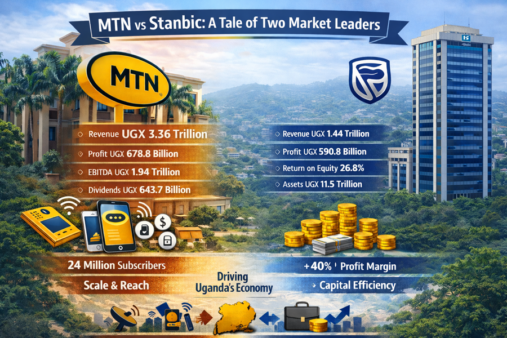
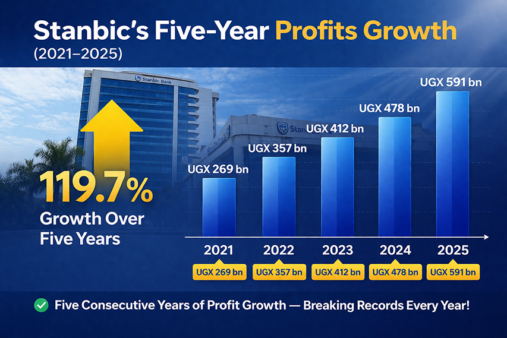
 MTN and Stanbic: A Comparative Look at Two Market Leaders
The decisions you make have very real consequences—sometimes running into billions of shillings. They can shape businesses, even determine whether some survive or not.
And I imagine, especially in that transition period from PwC into the Tribunal, that weight must have been quite heavy—realising that every judgment you sign off has a direct impact on people’s lives and livelihoods.
So how do you carry that responsibility? What gives you the peace of mind to sleep at night—and still wake up the next day ready to make another difficult decision?
I think it comes down to one thing: integrity.
At my former workplace, we were taught what they called the acid test for integrity. If whatever you’ve done today appeared on the front page of the Daily Monitor, New Vision, or Bukedde tomorrow—how would it look? Would you still be able to sleep at night?
And that’s exactly how I approach my work.
If I have done the right thing—if I haven’t bypassed any process, cut corners, or favoured anyone—I will sleep very well. Even if you took my judgment and printed it word for word on the front page of a newspaper, I would still sleep peacefully.
Yes, the pressure is there. But which job doesn’t have pressure?
At the end of the day, you must be guided by your values. Because if you don’t have a clear value system, that’s where compromise begins.
And let me be honest—having values will make you enemies. I didn’t have enemies until I joined government. People will oppose you when you say, “This is not right, I’m not going to do it.”
But over time, people begin to understand your boundaries—and they adjust.
For us at the Tribunal, we’ve built a culture of excellence. If we say 9:00, it’s 9:00. In fact, many days we start at 8:30—and 8:30 is 8:30.
Because excellence begins with the small things—like keeping time, respecting the people you serve, respecting the institution, and ultimately, respecting your country.
If you walk in late simply because you are the Chairperson, what message are you sending? That you don’t respect your work, your institution, or even yourself.
And people are watching—including your own children.
So for me, it always comes back to values, discipline, and doing the right thing—consistently.
I’ve been following the work of the Tribunal quite closely—and it’s clear there has been significant transformation, both in terms of performance and perception. I’ve even spoken to some of your users, and they acknowledge that the process has become more efficient and more responsive.
And this is happening despite clear resource constraints—I mean, even the Auditor General’s report pointed to some of the operational challenges you’re dealing with.
So looking at that journey—driving change, bringing people along, and delivering results against the odds—
what do you think it truly takes to transform an institution? And perhaps more importantly, what leadership lessons have stood out for you through that process?
That’s a very good—and very valid—question.
Because coming from the private sector, you quickly realise that the motivations are different. The private sector is driven by profit, while government is driven by service delivery. But there is one common thread—and that is efficiency.
So when I joined the Tribunal, I had a choice to make. I could either come into government and conform—“this is how things have always been done”—or I could say, we can do better. We can move from simply existing… to actually performing.
And of course, when you choose that path, you will face resistance. People will tell you, “This is how we’ve always done things. This is how government works. Who do you think you are?”
But my question was always: why can’t we change how government works? Why can’t we be more efficient?
Because the Tribunal sits at the intersection of government and business. We deal with taxpayers—with real businesses—so we cannot afford to operate like an institution that is just existing. We must be responsive, efficient, and purposeful.
Now, the transformation journey was not easy. In fact, it was quite difficult at the beginning.
My first instinct was to push—to tell people, do this, do that. I’m naturally a pusher. But I quickly realised that pushing people doesn’t create lasting change. It creates resistance.
So I had to change my approach.
I shifted from pushing… to selling a vision.
I began to tell my team: this is who we are, this is what we are here to do. We are not just processing cases—we are nation builders. Every decision we make has real consequences. You are either unlocking revenue that will build hospitals and schools, or you are making decisions that could affect businesses and livelihoods.
So I had to give context—to connect their daily work to a bigger purpose.
Because once people see purpose, they stop treating work as just a job… and start seeing it as impact.
And I’ve seen that shift happen. It didn’t happen overnight—transformation never does. It’s a medium- to long-term journey.
I remember one colleague—when I had just joined, if I called over the weekend, it would be a problem. “I don’t work on weekends.” Today, I call that same person, and the response is, “How can I help?”
That’s the change.
When people buy into the vision… when they understand the why… everything changes.
Even the conversations around money change. In the beginning, there were complaints—“we’re not paid enough.” Now, those complaints have reduced significantly, because people are driven by something deeper—purpose, impact, contribution.
And that, for me, is what truly transforms an organisation.
That’s very interesting. And as you’ve been speaking, there’s a clear thread that keeps coming through—God, and your mother.
But beyond those two strong anchors in your life—and you can still include them if you wish— who would you say have been some of the biggest influences on your journey so far? People who have shaped you, guided you, or left a lasting impact on how you think and lead?
Apart from God and my mother?
No—you can still emphasise them, of course. But I’m also curious about others along the way—people who’ve influenced you, shaped your thinking, or guided your journey.
I’ve been very blessed when it comes to people.
As you mentioned earlier, I only worked with one organisation before joining the Tribunal—and a big influence in my life was Francis Kamulegeya, who recruited me and was my boss until he retired.
He had a profound impact on my career. Technically, he taught me much of what I know in tax. But beyond that, he shaped how I think about leadership.
In our team, it was mostly women—about ten women and one or two men—and he constantly encouraged us to aim higher. He would tell us, “Don’t limit yourselves. Speak up. Speak your mind.”
He created an environment of trust, of excellence, of celebrating achievement. And he pushed us.
I remember he would call you into a meeting and say, “Come along.” And as you’re walking in, he tells you, “By the way, you’re leading this meeting.” Not to take notes—no—you’re leading.
So you walk in, completely unprepared, sweating… but you learn. You think on your feet. You make mistakes. And then afterwards, he walks you through it. That’s how we grew.
He didn’t just teach—he sponsored our growth. He pushed me to go to the UK, to specialise, and he has always been available even beyond PwC.
Another key influence was Titus Mukora from Kenya. He introduced me to transfer pricing at a time when it wasn’t even known in Uganda. That was around 2008. He came to lead a major project and asked, “Who wants to join me?” I put up my hand—and that became my entry point into that field.
Then there are the women who have spoken into my life through different platforms. I volunteer with several women’s organisations, and one that stands out is Pillars in the Palace.
There’s a lady there—Charity Byarugaba—who had a profound impact on me. She once told me, “Crystal, you’re not just doing tax. You are a nation builder.”
That statement changed everything for me. It shifted how I see myself, how I approach my work, how I show up.
So yes, I’ve had people who have held my hand along the way—mentors, leaders, encouragers. And I truly believe I’ve been blessed.
And because of that, I made a decision to give back.
For the past two years, I’ve been running a mentorship programme for young professionals between the ages of 22 and 35. I don’t advertise it—I take in a cohort each year, and we walk a journey together.
And it’s incredibly fulfilling—seeing people come in one way, and leave transformed. Setting bigger goals, thinking differently, challenging themselves.
Because ultimately, what was given to me… I feel a responsibility to pass on.
Building on what you’ve shared about your mother—and the role she played in shaping you—I’m reminded of something I once heard: that the best way to fix a nation is to fix the family. Because that’s really where leadership begins.
And sometimes, when you look around—from how we behave on the roads to how people even try to secure opportunities for their children—you start to wonder what kind of values we are passing on to the next generation.
So, from your perspective, how important is the family in shaping leadership? And what does it mean for the kind of society we are building if we get that foundation right—or wrong?
Absolutely—leadership starts in the family. It is first taught in the family.
These days, there is a tendency to think that teachers will parent our children for us. That is why people go to extreme lengths—even bribing to get children into certain schools—thinking that the school will somehow teach them values and manners. But my view is simple: if those things are not taught at home, the school will not magically produce them. In fact, the child may end up negatively influencing others instead.
So yes, parenting plays a critical role in shaping future leaders—through what we teach, what we model, and the environments we create.
But at the same time, we also have to be honest: many of us come from broken or dysfunctional families. I did. My father had three wives and a large family. That kind of environment comes with conflict, intrigue, and a lot of emotional complexity. And the truth is, those things do not just stay in childhood—you often carry them into adulthood.
If you grow up in a conflict-ridden environment, you develop survival mechanisms. Some people become defensive. Some become compulsive liars. Some learn to pass blame. And then those behaviours show up later—in the workplace, in relationships, in leadership.
So as an adult, you have to do the hard work of self-assessment. You have to ask yourself: what are the limiting behaviours I picked up along the way? What habits are stopping me from becoming my full self? What do I need to unlearn?
For me, for example, growing up with a stepmother where I never felt good enough meant I was always trying to prove myself. Then I moved in with my mother, and as the firstborn, in a very strict environment, I became highly disciplined—but also very strict, and even perfectionist.
Now, if you carry that unchecked into the workplace, you can end up demanding too much from people, becoming overly rigid, and not leaving enough room for others to grow. So you have to learn how to balance it. You have to recognise, there is something here I need to work on.
That is why self-awareness is so important.
Because as you rise in leadership, it stops being only about technical competence. At that level, things like emotional intelligence begin to matter even more. Can you empathise? Can you affirm others? Can you help people grow, instead of simply judging them?
Those are the things you must intentionally work on if you are going to become a better leader.
Just a moment ago, you spoke about growing into accountability—moving away from blame and really owning your actions. And it takes me back to where we started, when you introduced your values—AIRE: Accountability, Integrity, Responsibility, and Excellence.
These are words we hear often, sometimes even loosely… But for you, on a personal level, what do each of these values truly mean? And how do they show up in how you live and lead every day?
I’ll start with integrity.
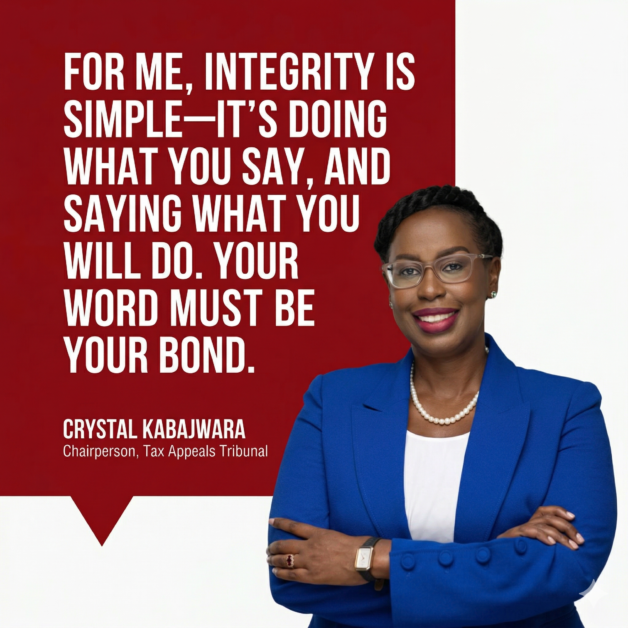
For me, integrity is simple—it’s doing what you say, and saying what you will do. Your word must be your bond.
I don’t believe in this idea of “reading between the lines.” No—be clear. Is it a yes, or is it a no?
Because especially in government, things can become very fluid—answers can shift depending on who is asking or what is at stake. But for me, integrity means consistency.
If I tell you I will do something, I will do it. If I say I’ll be somewhere at 10:00am, I will be there at 10:00am. If I say I am somewhere, then that is exactly where I am.
Not this “Oli wa awatufu?”—where you adjust your answer depending on the circumstances, instead of simply saying exactly where you are. For me, integrity means being consistent and truthful—regardless of the situation.
For me, integrity is about being clear, being honest, and being dependable—every single time.
(Laughs) In Kampala, they say when you ask someone, “Where are you?”—the answer depends on what you want.
So first they’ll ask you, “Why?” …and then decide what to tell you based on that.
If you’re bringing money, suddenly they are very nearby.
(Laughs) I always find that question funny—“Oli wa awatufu?”—as if there are two versions of where you are.
But that’s exactly where integrity comes in.
Now, when it comes to responsibility, for me it is about being able to stand by the consequences of your actions.
If I make a mistake, I own it. I don’t pass it on to someone else. If I make a decision, I accept both the good and the bad that comes with it. Because there are always two sides to every coin.
Many people want the good outcomes—but when things go wrong, they step back. For me, responsibility means saying, “I made this decision. It didn’t work out. I will do better.”
But I’ve also seen that people struggle with responsibility because of the environments they work in. If people are punished harshly for failure, they become afraid to make decisions. And when people are afraid, they stop thinking, they stop trying, they stop innovating.
That’s why I believe in what I call failing forward. You must allow people to try, to make mistakes, and to learn—of course, not carelessly—but in a way that encourages growth.
At the Tribunal, I always tell my team: speak up. If you believe a decision is right, explain it. Even if it turns out not to be the best decision, as long as you can logically justify it, we can work with that.
Now, excellence—for me, excellence is doing your best, consistently. It’s not settling for average or mediocrity.
If you’re producing something, make it the best. If you’re offering a service, let it be the best possible experience.
I often give a simple example—the Uganda Driver Licensing System. The last time I was there, I was served efficiently and got what I needed in about 19 minutes. That’s excellence.
And I always ask my team—why can’t we be like that? When people come to the Tribunal, they should know what to expect. There should be certainty, efficiency, and professionalism.
Finally, accountability.
Accountability is being able to explain what you did, why you did it, how you did it, and what the outcome was. It’s about being answerable—to your leaders, to your stakeholders, and to the public you serve.
And accountability requires humility. Because you must be willing to report, to explain, and sometimes to be questioned.
For example, at the Tribunal, the law does not require us to produce quarterly or half-year reports to the Minister. There is no strict provision for that.
But because I value accountability, we do it anyway. We prepare reports—quarterly, half-yearly, annually—because it is the right thing to do.
So for me, AIRE is not just a set of words—it’s a way of working, a way of leading, and a way of living.
There’s something you touched on earlier—the ability to make tough decisions.
And I think, culturally, Ugandans are very warm, very polite people—but sometimes that can also make it harder to be direct. People will avoid saying the hard thing as it is.
Yet in your role—especially around tax justice—you often have to make and communicate difficult decisions, whether people like them or not.
So how do you strike that balance?
How do you communicate hard decisions with empathy, but still remain clear, firm, and truthful? And what advice would you give leaders on handling those moments without losing either their humanity or their authority?
Well, I’ll start with the hard decisions—because empathy and firmness are actually not separate; they work together.
First, I operate with clear non-negotiables.
There are things I do not compromise on—integrity, excellence, and conduct. Issues like bribery, corruption, or abuse of process are simply off the table. I don’t take bribes, I don’t entertain them—non-negotiable.
And over time, people who engage with me come to understand those boundaries. When you cross certain lines, you will know—this is not a space for negotiation.
Now, beyond that, when it comes to the actual work we do—resolving tax disputes and advancing tax justice—I bring in context and empathy.
Because yes, the law is there. But we must also understand the environment in which we operate. Uganda’s economy is largely informal—driven by small and medium enterprises, many of them family-run.
You cannot treat a small, family business the same way you treat a large multinational with full legal, accounting, and tax teams.
So when a taxpayer comes before me—let’s say Kyam Limited—I don’t just look at them through the strict lens of the law. I look at them within the Ugandan context.
The law may say you must have document X, Y, and Z. But this is a business that may not even have a formal board, may not have accountants, may not have the resources or systems that big corporates have.
So for me, fairness is not just about applying the law rigidly—it’s about applying it intelligently, in context.
It’s about asking: what information is available? What is reasonable in this situation? How do we arrive at a fair outcome?
That is where empathy comes in.
But—and this is important—empathy does not mean tolerance for wrongdoing.
If you come before me and you have falsified documents, or deliberately tried to mislead the process, then empathy stops there. Because you must come with clean hands.
So it’s a balance.
You are firm on your values—non-negotiable where it matters—but you are also fair, human, and contextual in how you apply the law.
And that, for me, is how you deliver hard decisions—with both clarity and empathy.
I hear you loud and clear—so in a way, fairness is a two-way street. For you to be treated fairly, you also have to come in good faith and do the right things on your part.
Now, looking at the Tribunal’s journey—it has clearly come a long way. But I’m sure, like any institution, it’s still evolving and not yet where you ultimately want it to be.
So as we look ahead—say over the next five years—what should taxpayers and users of the Tribunal expect? What are some of the key changes or improvements you are working towards?
One of the government’s key priorities right now is digitalisation. The world is moving towards digital and e-commerce economies, and as a Tribunal, we must move with the times.
So one of our main focus areas is digitising our processes, systems, and procedures—not just to improve how we work internally, but also to make it easier for taxpayers and all our users to access our services.
We are already in the middle of that journey, and our hope is that by the end of the next financial year, we will have a fully functional digital system in place.
What that means in practical terms is that you will no longer need to physically come to the Tribunal to file documents. There will be an online interface where you can submit your documents, and we can review and authenticate them without the need for physical paperwork.
And even for us as a Tribunal, it will significantly improve efficiency. Right now, I still go home with large files over the weekend to read. With digitalisation, all of that will be accessible on a device—it simplifies how we work.
Ultimately, this will improve service delivery and turnaround times. And that is critical—because the faster we resolve disputes, the faster money is unlocked, whether back into government revenue or back into businesses as working capital.
So for us, digitalisation is not just about technology—it’s about making the system faster, more accessible, and more responsive for everyone.
You’ve mentioned digitalisation—and of course, there’s a much bigger conversation now around technology and AI, and how it’s reshaping how we work.
From where you sit—especially having seen the evolution of the sector over the past two decades, and engaging with peers globally—how do you see technology changing the way institutions like the Tribunal operate?
And I want to bring this closer to people. For students, young lawyers, and professionals just starting out—how should they be preparing for this shift? Do they still need to approach learning the same way—cramming case law, memorising processes—or are there new skills and ways of thinking they should be developing?
And I’ll be honest—even as a parent, it raises real questions. When you see how fast things are changing, you start wondering: what should we really be preparing our children for?
So from your perspective, how do we navigate this shift—both as professionals and as parents?
Technology—and especially AI—is a game changer. There’s no running away from it.
And I think one of the most important things we must all begin to do is continuously assess our digital fitness—just like we assess our physical fitness. Can you keep up? Are you equipped for where things are going?
That requires three things: learning, unlearning, and relearning.
The unlearning part is especially important for the older generation. Because the way we are moving—for example, at the Tribunal, once our digital platform is fully rolled out—things will change fundamentally.
What happens to law firms that are used to filing physical documents? They will have to adapt. It means people who may not have been comfortable with computers must now learn how to use them—how to file online, how to navigate digital systems.
But it doesn’t stop there.
Once you are in a digital environment, you must go a step further—into data analytics. How do you interpret information? How do you use dashboards? How do you turn data into insights that can inform decisions and engagement?
And that means acquiring new skills.
I always tell people—the information is out there. The internet is full of free learning platforms. You just have to be intentional about investing in yourself.
Start with the basics—Microsoft Excel. That is the foundation. From there, you can build into data analysis, and then into more advanced areas.
Now, for students and young professionals, this is even more critical.
Today, many people graduate with first-class degrees. So what sets you apart? It’s the extra skills. Can you code? Can you use Python? Have you explored emerging technologies?
Those are the things that will differentiate you.
And for parents, it’s the same conversation. Just as Maths and English were once the foundational subjects, today you must add technology—coding, computing, robotics, AI. These are no longer optional—they are essential.
So the earlier we adapt, the better prepared we will be—not just as individuals, but as a country.
And for us as parents—what choices do we really have? Do we simply go with the flow, or is there a more deliberate role we should be playing in preparing our children for this new world?
You don’t just go with the flow—you take initiative.
Start with what you have. Open your computer. Google. Go to platforms like Coursera or edX—there are so many free courses available. And even the paid ones are very affordable—sometimes as little as $10.
And then you teach yourself. That’s really where it begins—being intentional about learning and staying ahead.
We’ve talked a lot about work, leadership, and tax—but I’m curious about the person behind the role. Who is Crystal outside the Tribunal? When you’re not in the Chairperson’s seat, how do you unwind? What do you enjoy, and how do you spend your free time—if you have any?
Free time? (Laughs)
I actually live by a very clear hierarchy—and it’s what keeps me balanced.
First is God. Second is my family. Third is my work. And then everything else comes after that.
So if work ever conflicts with family, I will choose family—every time.
But to make sure those priorities don’t clash, I have to be very intentional with my time. I wake up at 5:00am. If I wake up at 6:00am, I won’t be able to fully meet my responsibilities to God and to my family.
So I start my day with God, then I get my children ready for school and take them. That’s non-negotiable.
That’s why I’m not the kind of person who will be in the office at 7:00am. At that time, I’m with my children—and that matters more to me. Because at the end of the day, when the job is gone, it’s my family that remains.
And the children remind me of that in their own way—they even tell me, “Mommy, your job is boring!” (Laughs) They say I spend the whole day listening to people or watching “TV”—which is really just Zoom or Teams.
But outside of work, my time is really centred around family. My spouse needs time, my children need time, my friends need time.
We keep it simple—family trips, road trips, spending time together. If I’m going anywhere, it’s usually with them.
That’s what keeps me grounded—and that’s what keeps me going.
It’s been a rich and insightful conversation—but as we wrap up, there’s always that one thing that stays with people. So as a closing thought—drawing from your journey, your leadership experience, and everything you’ve learned along the way— what message would you like to leave for leaders out there?
I think, as a closing thought, I would go back to what I see every day from where I sit at the Tax Appeals Tribunal—a breakdown of trust.
There is a trust deficit between taxpayers and government. Taxpayers don’t trust government, and government doesn’t trust taxpayers. And that is not a good place for any country to be.
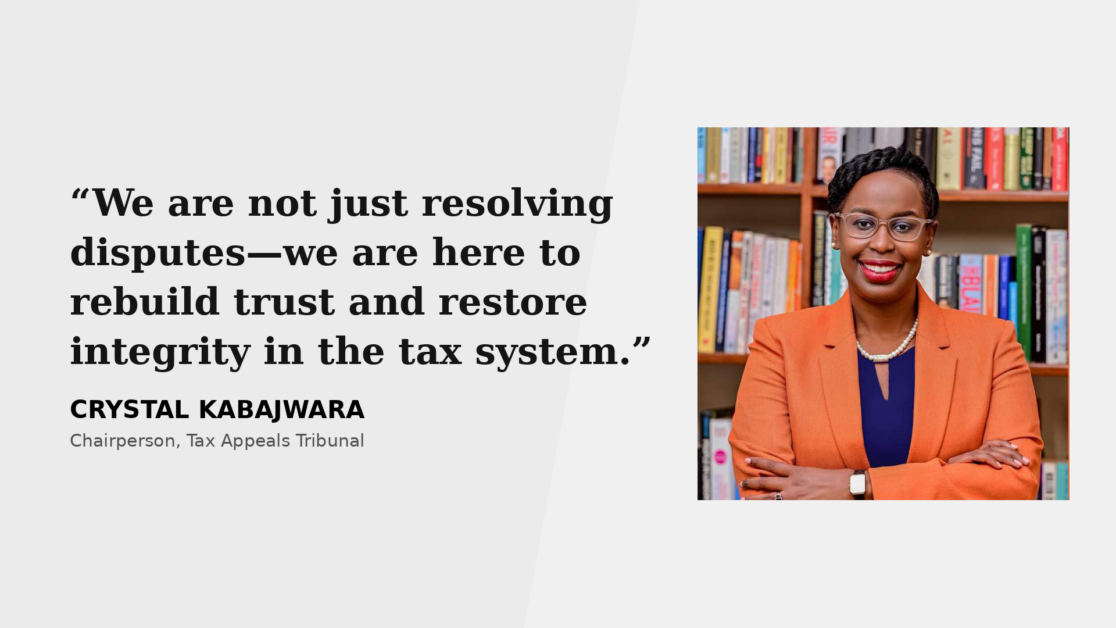
That is why, as a Tribunal, our role is not just to resolve disputes—we are here to rebuild trust and restore integrity in the tax system. Because without trust, you cannot have a sustainable system.
Our tax-to-GDP ratio is currently about 13.5%, and the ambition is to move it to 18–20%. But we will not get there if trust is broken.
We must collect taxes sustainably. We must enforce tax laws fairly. And we must apply the law in the context of our country—without losing sight of our broader economic goals.
Uganda has bold ambitions—to grow the economy tenfold, from USD 50 billion to USD 500 billion. And this growth is anchored on the ATMS pillars:
- Agro-Industrialisation
- Tourism Development
- Mineral-based Industrialisation
- Science, Technology, and Innovation
All of this requires a strong, trusted, and sustainable tax system to finance it.
And because the Tribunal sits at the intersection of government and business, our role is to bring both sides to a win-win position—one that supports growth, stability, and long-term national development.
For leaders, my message is simple: Leadership is not a popularity contest.
You will face pressure. You will be tempted to compromise your values—to fit in, to make things easier. But you don’t have to.
Be guided by your values. Do the right thing. Deliver value to the people you serve, to your country, and ultimately, to God.
Because in the end, that is what our national motto calls us to: For God and my country.
Thank you so much, Crystal—it’s truly been a pleasure having you.
I’ve personally taken away a lot from this conversation. In fact, from today onwards, whenever I hear “I feel IRIE”, I’ll be thinking about something much deeper.
It’s been a great learning experience, and I hope we can continue having these conversations—because, ultimately, as this year’s International Women’s Day theme reminds us, “give to gain.” The more we share knowledge, the more we all grow.