
Uganda’s Tax Appeals Tribunal (TAT) has resolved 146 tax disputes and unlocked UGX203.4 billion back into the economy in the first half of the 2025/26 financial year, as the quasi-judicial body intensifies its focus on mediation and high-value case disposal to reduce backlog and improve access to tax justice.
In its FY26 Half-Year Performance Report for the period 1 July to 31 December 2025, the Tribunal said the results reflect a deliberate strategy aimed at improving both speed and value of dispute resolution. “As of 31 December 2025, we resolved 146 cases and unlocked UGX. 203 billion into the economy,” Chairperson Crystal Kabajwara said in the report’s foreword.
The Tribunal’s half-year performance also marks a sharp improvement compared to the same period in FY25. TAT says it is “ahead of our FY 25 half-year performance by 57% in the number of disputes resolved and by 182% in respect to total monies unlocked into the economy.”
This performance matters not only for government revenue but also for private capital and investor confidence, because unresolved tax disputes can lock up large sums for years, affecting business liquidity, project execution, and compliance behaviour across the economy.
A two-pronged strategy: high-value disputes and small claims
The Tribunal attributes its stronger performance to a “two-pronged strategy” that balances the disposal of complex, high-value disputes with faster resolution for smaller claims.
“This reflects our two-pronged strategy: focusing on complex high-value disputes while providing a quick, flexible approach to resolving smaller claims,” Kabajwara said.
The Tribunal’s report indicates that the UGX203.4 billion unlocked in H1 was achieved through a combination of rulings, consent judgments, withdrawals, and abated or dismissed matters.
A month-by-month breakdown shows that the largest amounts were unlocked in November (UGX77.3 billion), followed by September (UGX34.4 billion) and December (UGX29.1 billion).
Mediation remains central as ADR grows.
A key pillar of the Tribunal’s strategy is Alternative Dispute Resolution (ADR), particularly mediation, which it says remains the fastest pathway for settling disputes without full litigation.
“A significant number of the disputes were resolved via mediation, which continues to remain central to resolving disputes rapidly,” Kabajwara noted.
The report also states that mediation is “the quickest way to resolve disputes,” and is aligned with TAT’s broader strategy of prioritising ADR over litigation.
The increasing reliance on mediation reflects a broader trend in tax administration, where both taxpayers and revenue authorities are under pressure to resolve disputes faster, reduce court congestion, and avoid prolonged uncertainty.
New disputes remain high as tax in dispute rises to UGX394bn
Despite the improved disposal rate, the Tribunal continues to face heavy inflows of new disputes, which are steadily increasing the total caseload.
In the first six months of FY26, TAT registered 199 new applications with a total tax in dispute of UGX394 billion.
While the number of new applications fell by 10% compared to the same period in FY25, the total value of tax in dispute rose by 32%, suggesting that the disputes being filed are increasingly higher-value and potentially more complex.
The Tribunal also notes that new applications typically peak in the first and third quarters of the financial year, as they immediately follow June and December, the busiest tax collection months.
However, the Tribunal cautions that the number of disputes filed remains high, increasing pressure on its limited systems and resources.
H1 performance exceeds FY26 growth target
TAT’s performance metrics show it is exceeding its own annual growth targets.
In FY25, the Tribunal resolved 266 disputes and unlocked UGX506 billion. For FY26, its target is to increase both the number of disputes resolved and the monies unlocked by 30%.
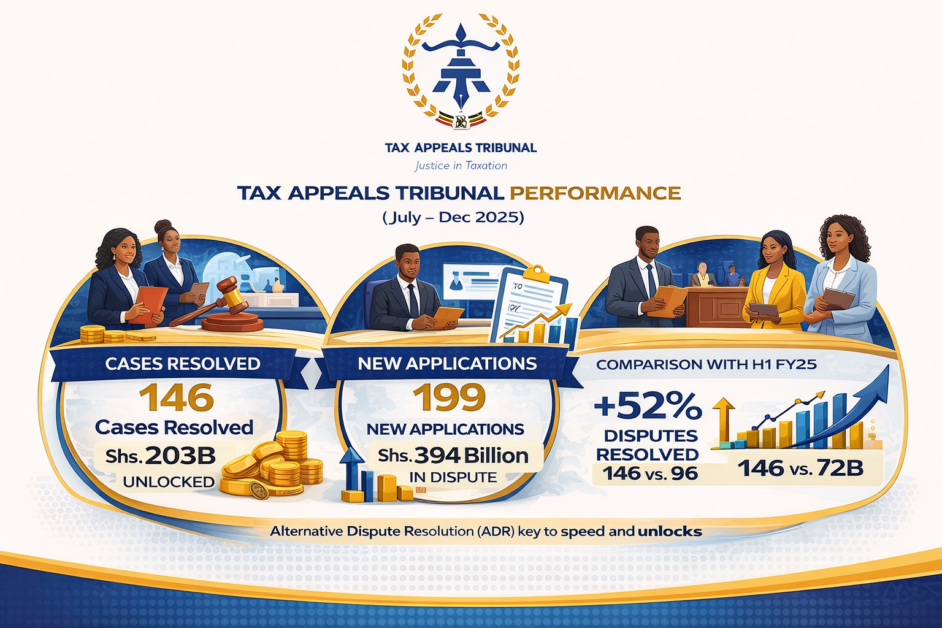
But by the half-year mark, it had already resolved 146 disputes, up from 96 in H1 FY25, a 52% increase. The value unlocked rose from UGX72 billion to UGX203 billion, a 182% increase.
Caseload hits 517 cases as disputed tax reaches UGX1.5 trillion
As of 31 December 2025, the Tribunal’s pending caseload stood at 517 cases with a total disputed tax of UGX1.5 trillion.
The report highlights a significant structural imbalance in the caseload: a small number of high-value disputes account for the overwhelming majority of disputed tax.
Cases where the tax in dispute is UGX5 billion and above represent only 10% of the number of pending cases, yet account for 77% of the total disputed tax.
On the other hand, lower-value disputes where the disputed tax is UGX200 million and below make up 44% of the pending caseload but account for just 1% of total disputed tax.
This distribution, the Tribunal says, reinforces its priority: “Unlocking high-value cases speedily while increasing access to tax justice for small businesses remains the key priority for the Tribunal.”
Backlog reduced sharply as older cases dropped to 51
 Africa Takes The Stage: From Raw Supply To Brand Ownership
TAT reports that it has made strong progress in reducing backlog by focusing on older cases filed in 2023 and earlier.
The Tribunal states that cases filed prior to 2024 have reduced from 211 as at 30 June 2024 to 51 as at 31 December 2025.
However, a large proportion of the current caseload is now made up of new disputes: cases filed in 2025 account for 64% of the pending caseload.
This indicates that while backlog reduction is progressing, the system remains exposed to high inflows—particularly high-value disputes—meaning the Tribunal’s ability to sustain gains will depend on both resourcing and process efficiency.
Full-year projections: UGX660bn target still within reach
Looking ahead, the Tribunal says it is confident of meeting its FY26 targets of resolving 350 disputes and unlocking UGX660 billion.
The projections table in the report indicates that beyond the 146 cases already resolved (UGX203bn), there are 76 cases awaiting judgments worth UGX271bn, and an additional 106 disputes expected to be resolved through mediation worth UGX151bn.
If these projections hold, the Tribunal would remain slightly short of its annual target by 22 cases and UGX35bn, a gap it expects to close in the second half of the financial year.
“We are confident we will meet our FY 26 performance target of resolving 350 disputes and unlocking UGX. 660 billion back into the economy,” Kabajwara said.
Funding shortages remain the biggest constraint.
Despite the improved performance, the Tribunal’s report raises serious concerns about funding and operational capacity, warning that its ability to deliver dispute resolution services and expand access to taxpayers across the country is constrained by limited resources.
The Tribunal says that although membership increased from five to nine members in 2022, its budget has remained static at UGX7.7 billion.
It notes that this constraint was highlighted by the Auditor General in the FY25 audit report.
TAT also reports that its total staff complement is only 29, including personnel in regional registries in Mbarara, Gulu, Arua and Mbale. The Tribunal says it has significant resourcing gaps in its technical and research department and lacks HR and planning functions due to insufficient headcount.
Mediation, one of its key strategies, is also under-resourced. The Tribunal says it has only four mediators, yet demand for ADR is high.

The report further points to logistical constraints affecting its regional operations. Regional registries have no vehicles, limiting their ability to reach and sensitise taxpayers beyond their locations. It gives the example of the Gulu Registry, which is intended to serve Northern Uganda but cannot travel beyond Gulu due to a lack of transport.
In addition, while the Tribunal conducts regional circuits six times a year, only two vehicles are roadworthy, meaning members often travel in a single vehicle to attend upcountry circuits, which it says poses a significant risk.
The Tribunal also reports that it does not have a budget for training and capacity building, and that members, mediators and staff largely self-fund their professional development.
A key institution in Uganda’s investment and compliance ecosystem
TAT’s report positions the Tribunal as a critical institution for both fiscal stability and private sector confidence.
“Despite the TAT’s pivotal role in unlocking government revenue and private capital held up in the justice system, which are needed to invest in key growth areas and in building investor confidence, the Tribunal continues to grapple with significant funding shortages,” the report states.
This framing underscores the Tribunal’s growing importance in Uganda’s tax ecosystem, especially as the government continues to tighten revenue mobilisation efforts and as taxpayers become more likely to challenge assessments in a tougher compliance environment.
Outlook: Strong momentum sets TAT up for a stronger H2 FY26
As the Tax Appeals Tribunal (TAT) enters the second half of FY26, its ability to meet its annual performance targets will depend on whether it can sustain its improved disposal rate while managing rising caseload inflows—particularly high-value disputes that account for the bulk of disputed tax.
If the Tribunal meets its target of unlocking UGX660 billion by the end of the financial year, it would reinforce its role as one of the most economically consequential dispute resolution institutions in Uganda, with a direct impact on liquidity, public revenue, and investor confidence.
However, the FY26 half-year results are not emerging in isolation. They follow what the Tribunal itself described as a “strong performance” in FY24/25, where it resolved 266 disputes and unlocked a historic UGX506 billion.
In that FY25 performance report, the Tribunal said it exceeded its annual target of increasing case disposal by 30%, with monies unlocked growing by 131% from UGX219 billion in FY24 to UGX506 billion in FY25.
That record-breaking FY25 performance—combined with FY26’s strong first-half momentum—suggests that the Tribunal is not only operating with improved internal efficiency, but is also steadily building a repeatable model of dispute disposal, anchored on mediation, data-driven decision-making, and increased daily sessions.
For now, TAT’s half-year performance signals both momentum and pressure: faster results, higher-value disputes, and a caseload that remains heavy—against the backdrop of limited funding, staffing gaps, and operational constraints that threaten long-term efficiency.
Still, the Tribunal remains optimistic. “I would like to specifically thank our members, mediators and staff for their dedication and commitment,” Chairperson Crystal Kabajwara said, as the Tribunal positions itself to “finish FY 26 on a stronger note.”