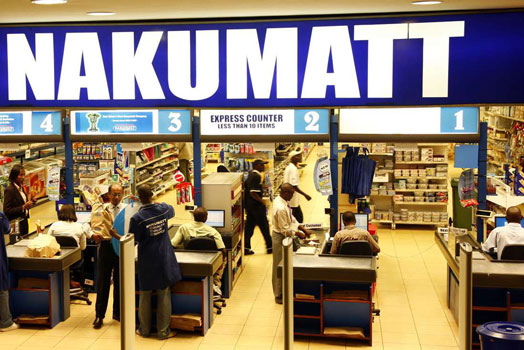
Standard Chartered Bank Kenya has issued a statutory notice to Nakumatt Investments, paving the way for the possible auction of several properties linked to the collapsed supermarket chain over loan arrears totaling about $14.3 million.
The notice, issued under Section 90 of the Land Act, gives Nakumatt 90 days to settle the outstanding debt or risk the sale of properties used as collateral for loans extended to Nakumatt Holdings.
According to the notice, Nakumatt Investments created charges over several properties in Mombasa, Nakuru, and Nairobi as security for credit facilities advanced by Standard Chartered Bank Kenya.
The securities include a charge dated February 11, 2011, over Land Reference Number MN/I/9626 in Mombasa securing Ksh4.05 million plus interest, and another charge dated February 11, 2011, over Nakuru Municipality Block 9/47 securing Ksh20 million plus interest, costs and expenses.
The bank also holds a charge dated January 27, 2012, over Land Reference Number 209/4063 in Nairobi, securing Khs39.2 million plus interest, as well as another charge dated January 27, 2012, over Land Reference Number 209/4058 in Nairobi, securing Ksh29.3 million plus interest.
The properties collectively form the collateral securing the credit facilities advanced to Nakumatt Holdings.
The bank says the loans are now in default and has formally demanded settlement of the secured amounts.
The debt includes several credit facilities owed by Nakumatt Holdings. These comprise $331,872.95 linked to an overdraft facility, $6.99 million tied to a term loan, and Ksh967.17 million related to an import invoice finance facility, equivalent to roughly $6.97 million.
Combined, the obligations amount to about $14.3 million in loan arrears.
In the statutory notice, the bank warned that failure to rectify the default within the 90 days would trigger enforcement measures allowed under Kenyan law, including the sale of the charged assets.
“If Nakumatt Investments has not paid the secured amounts within 90 days after the date of publication of this notice, Standard Chartered Bank Kenya Limited will proceed to exercise the remedies available to it under the charges and the Land Act, including selling the charged properties.”
The properties used as collateral include Land Reference Number MN/I/9626 in Mombasa, Nakuru Municipality Block 9/47, and two Nairobi properties identified as Land Reference Numbers 209/4063 and 209/4058.
The statutory demand follows a High Court judgment in Nairobi dated November 10, 2025, relating to the enforcement of the lender’s rights over the secured assets.
Nakumatt Investments retains the right to seek relief in court under the Land Act if it wishes to challenge the enforcement process.
Regional legal battles.
The enforcement action comes as former Nakumatt executives continue to face legal disputes across the region tied to the retailer’s collapse.
 Ruparelia Foundation to Hold Free Eye Camp in Bukedea in Honour of Rajiv Ruparelia
In February 2025, the Commercial Division of the High Court in Uganda ordered Kenyan businessman Atul Shah, the former chief executive of Nakumatt, to pay Megha Industries Uganda $358,431 (about UGX 1.3 billion) and UGX 24.3 million for breach of a lease agreement linked to defunct Nakumatt Uganda.
The case, presided over by Justice Patience T.E. Rubagumya, stemmed from unpaid rent and utility bills for retail space at Victoria Mall in Entebbe.
Court found that Shah, who had signed a Deed of Suretyship under a 2017 tenancy agreement as a co-principal debtor, was personally liable for the unpaid rent after Nakumatt Uganda was dissolved without settling the debt.
Justice Rubagumya ruled that Shah had unjustly benefited from the lease agreement while failing to meet his obligations.
Court ordered him to pay the outstanding sums together with UGX 85 million in general damages, 20% annual interest on the unpaid principal, and 6$ annual interest on general damages until full payment is made.
Megha Industries, the owner of Victoria Mall and represented by Katende, Ssempebwa & Co. Advocates, successfully argued that Shah was bound by the suretyship contract and could not evade liability.
Background
Nakumatt was once East Africa’s largest supermarket chain, operating more than 60 outlets across Kenya, Uganda, Tanzania, and Rwanda.
However, a 2020 Daily Nation report indicated the retailer collapsed under debts estimated at over Ksh35.8 billion (about $355 million) after years of aggressive expansion financed by high-interest bank loans.
The company’s fortunes declined rapidly from a peak annual turnover of about $700 million to insolvency as suppliers went unpaid and store shelves emptied.
Investigations into the collapse pointed to a mix of financial mismanagement, internal fraud, and external shocks. Reports cited widespread inventory “shrinkage” involving employees and suppliers, as well as a 2018 write-off of stock worth Ksh18 billion.
Major events, including the 2009 Nakumatt Downtown fire, the 2013 Westgate Mall terror attack, and the demolition of one of its Nairobi branches, also inflicted heavy financial losses.
By 2017 and 2018, the retailer had entered a severe cash flow crisis, leading to evictions from prime retail locations and ultimately forcing creditors to vote for liquidation in 2020 after several failed restructuring attempts.
The latest move by Standard Chartered highlights continuing efforts by lenders to recover debts linked to one of East Africa’s most dramatic corporate collapses.