Stanbic Bank Uganda has revealed that it committed more than UGX 270 billion in debt financing to the East African Crude Oil Pipeline (EACOP), reinforcing its role in funding large-scale energy infrastructure in the region.
The disclosure, made during the bank’s 2025 annual financial results announcement on March 23 in Kampala, relates to financing that was deployed last year as part of the first tranche of external funding for the project.
EACOP disclosed the closure of this first tranche of financing in March 2025, secured from a syndicate of financial institutions including African Export Import Bank (Afreximbank), The Standard Bank of South Africa Limited, Stanbic Bank Uganda Limited, KCB Bank Uganda and the Islamic Corporation for the Development of the Private Sector (ICD).
EACOP also publicly disclosed about $300 million (UGX 1.1 trillion) in external financing from Islamic Development Bank and Afreximbank.
The $5 billion (about UGX 18.6 trillion) EACOP project is structured on a 60:40 debt-to-equity ratio. This implies that approximately $3 billion (about UGX 11.2 trillion) has been raised through debt financing, while $2 billion (about UGX 7.45 trillion) is contributed as equity by shareholders.
The pipeline’s shareholders include TotalEnergies with a 62 percent stake, Uganda National Oil Company (UNOC) and Tanzania Petroleum Development Corporation (TPDC) with 15 percent each, and China National Offshore Oil Corporation (CNOOC) holding 8 percent.
UNOC, which manages Uganda’s commercial oil interests, is itself owned by the Ministry of Energy (51 percent) and the Ministry of Finance (49 percent).
To meet the equity portion of the financing, EACOP issues monthly cash calls to its shareholders, requiring them to contribute funds in line with their shareholding to support ongoing construction and project activities.
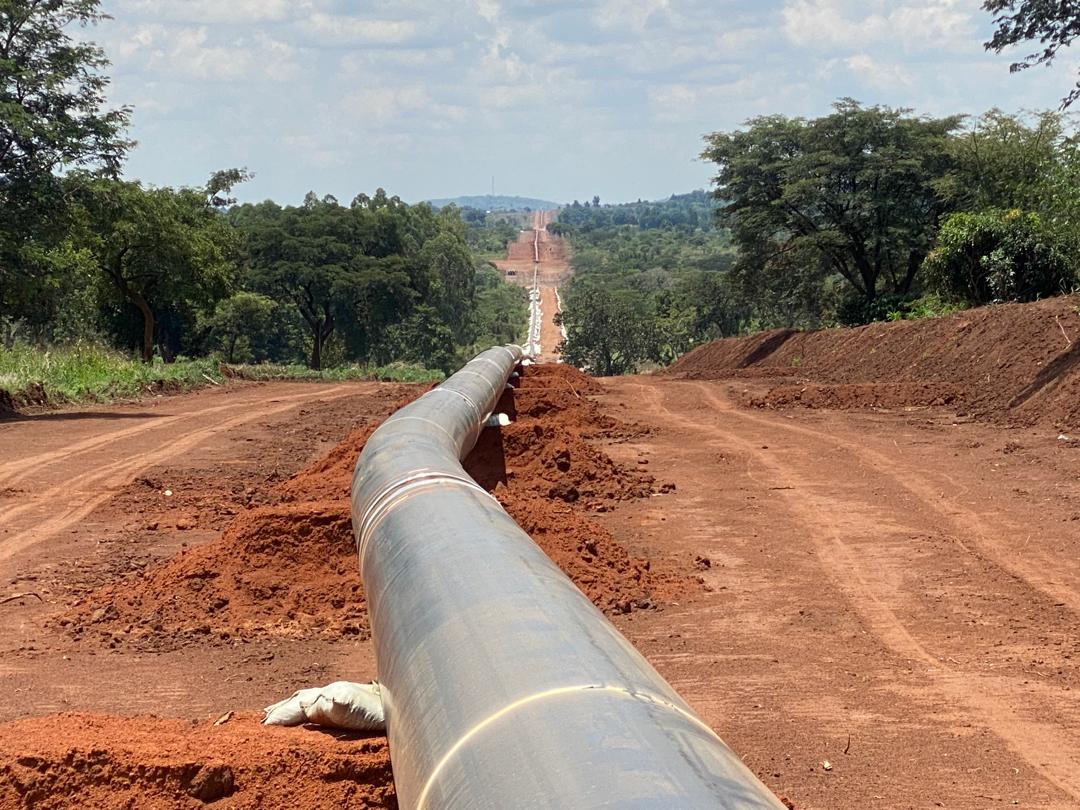
The project had already surpassed 79 percent completion rate at the beginning of 2026 , with construction progressing across Uganda and Tanzania. More than 8,000 Ugandans and Tanzanians are currently employed on the project, supported by approximately 400,000 manhours of training.
Recent updates from the Petroleum Authority of Uganda indicate that overall progress across the country’s oil developments remains on track.
As of January this year, the Tilenga Project had reached over 62 percent completion, the Kingfisher Project stood at 76 percent, while the EACOP pipeline had advanced to 79 percent completion. All three projects remain aligned and are expected to deliver first oil in the second half of 2026.
 New Reporting Standards Sink Finca into UGX665 million Loss from UGX 4.9 billion Profit
Once completed, the 1,443-kilometre pipeline will transport crude oil from Kabaale in Hoima, Uganda, to the Chongoleani Peninsula near Tanga in Tanzania for export to international markets.
The infrastructure will have the capacity to move up to 246,000 barrels of crude oil per day and will include six pumping stations, two pressure reduction stations and a marine export terminal in Tanzania.
Beyond oil and gas
Beyond oil and gas, Stanbic Bank continues to channel financing into other critical sectors of the economy. Through the Buy Uganda, Build Uganda initiative, the bank has supported local manufacturing with over UGX 700 billion in financing, targeting agro-processing, packaging, manufacturing inputs and essential consumer goods to strengthen domestic production.
In the science and technology sector, Stanbic has extended more than UGX 130 billion to a WHO-certified pharmaceutical manufacturer to support the construction of a second production facility, aimed at expanding national capacity. The bank has also played a leading role in the energy sector, committing over UGX 425 billion as Lead Arranger and Bookrunner on a transaction executed on behalf of the Ministry of Finance to support the management of a critical national asset.
Sectoral credit allocation reflects a diversified lending strategy, with manufacturing receiving UGX 632 billion, trade UGX 598 billion, infrastructure UGX 595 billion and agriculture UGX 425 billion. At the same time, the bank has increased its support for local businesses, with procurement spend rising from UGX 177 billion in 2024 to UGX 193 billion in 2025.
Household lending has also grown significantly, increasing from UGX 1.338 trillion in 2024 to UGX 1.525 trillion in 2025, signalling rising demand for credit and the bank’s continued push toward financial inclusion.
Stanbic’s participation in EACOP financing highlights the evolving role of regional banks in underwriting complex, capital-intensive projects, positioning them as key enablers of Uganda’s long-term economic transformation.