
The story of Yunga is personal to Anatoli Kirigwajjo. Anatoli comes from Kyotera, a district close to the Uganda-Tanzania border. Like so many other Ugandans, he made the trip there to celebrate Christmas leaving his house in Nsambya unattended to. As fate would have it, thieves broke into it.
“I was enjoying my well-deserved holiday with family when my neighbour called. He told me my house had been swept clean.” Anatoli tells me in a sombre mood. “I froze for a while, and everyone was sad for me. But I kept on asking myself what I would have done to prevent this.” As he tried to rebuild his life, another break-in happened at the same house. At this moment he knew it was time to leave.
Anatoli’s sad run-in with thieves is not an isolated case. As per the Uganda Police Force Crime Report of 2022, house break-ins were one of the most common crimes committed alongside theft, domestic violence, narcotics, land grabbing and child-related offences. The total number of break-ins reached an astonishing count of 13,826 reported cases in 2022 alone.
With his software background, he decided to do something about the problem. “I built an app that connects any person to a nearby police station.” But this idea failed terribly, and also, it didn’t cater for those break-ins when the house occupants were not in.
Anatoli’s path got better when he met Nasser Kawesa and Kasoma Fredrick, his co-founders. Nasser had worked at DeLorenzo, an Italian electronics company where he mastered building hardware ad took the lead on the hardware side while Fredrick took the lead on the software that ran the device.
In 2019, they decided to build a hardware device that would connect one neighbour to another, then the neighbourhood to the nearest police station. The hardware device is mounted to a wall just like a Yaka metre.

The Yunga security device is mounted on a wall just like this one at Cynibel Supermarket in Kiwatule.
Once an intruder breaks into the house, it triggers an alarm which alerts the neighbouring houses and also sends real-time alerts to the police. This is because the device comes with motion sensors that detect movements around the house. The home owner selects a time from which the motion sensors and alarms can be active for example from midnight upto 6 in the morning. During that time, the alarm will go off if any movements are detected outside. The original plan of Yunga was to have all the neighbours’ houses equipped with the Yunga device (based on the nyumba-kumi community security model), but they do install the device in houses that may not be part of a community.
Building a hardware startup in Uganda is not easy, because of the upfront financing that is needed. Anatoli raised shs 3 million from family and friends to work on the first version of the device. They got a lifeline when they raised €35,000 from the Hague Institute for Innovation of Law (HIIL). But this funding was released in tranches, pending milestones. The first tranche was used to do a pilot in Ntinda-Kigowa.
“When we went to Ntinda-Kigowa, we did a pilot by just giving out the devices. Our funders asked us to test the business model too, instead of just giving the devices away. Our story went viral after being featured on NTV, and we leveraged this to get pre-orders from the requests that we got. With the pre-orders locked down, we managed to trigger the rest of the funding.”
Since then, Yunga has grown. The startup now operates in multiple residential areas in Kampala, Wakiso and Mukono. So far, they have over 1,000 households that have bought and actively use the device. They have been able to stop over 100 break-ins since inception, and have racked up a partnership with multiple police stations.
One of the Yunga customers is Nabukeera Florence who stays in Masajja near Namasuba in Wakiso and has been using Yunga for the last two years. In a phone call, Florence told me that she joined Yunga two years ago after suffering a spate of house breaks. But that is no longer the case.
 After 29 Years in Court, Government Ordered to Pay UGX 512.9 Million in Kamuli Land Dispute
“No thief can enter our fence and the alarms do not go off. So In case of a break-in, we easily wake up due to the alarms. Also, the same alarm wakes up our neighbours, and it is normal for them to call and inquire if we are okay when the alarm goes off. Once the thieves hear the alarm, they usually take off. ”

A Yunga client shows off the Yunga alarm system device in their home.
Yunga is, however, a for-profit startup, and it makes money from selling the devices and charges a monthly subscription fee to keep one connected to its network.
One thing that Anatoli credits for his startup’s success is word of mouth. “Communities call us. In fact, we received about 500 calls after our pilot. Even when we failed to deliver, some communities stuck with us. And when a person goes to a home and sees our device, they reach out to us to get our services. But it is high time we take on an aggressive marketing style as well, and that is why we are raising $250,000.”
The startup has also grown due to its uniqueness when compared to other competitors in the market. The Yunga device costs shs 700,000 of which 15% (shs 105,000) is the installation fee. The device also comes with two motion sensors. “If you go to our competitors for a similar product, you will have to spend at least shs 3 Million.” But it isn’t just the price that makes Yunga very attractive to users.
“Our alarm system is community enabled. If one community member with the device is attacked, their alarm will ring, but so will the alarms of the other community members with the device. Our device will also display the name of the community member who has been attacked so that they can be helped. Furthermore, we give our users the chance to add emergency contacts in the Yunga App and in case of an attack, the emergency contacts will be notified automatically by phone calls and text messages even if they don’t have the Yunga device.
Apart from aggressive marketing, Yunga will use the $250,000 to build a B2B model as well. “We recognize how much B2C has worked for us. But we are now targeting B2B too. The B2B in our case are the real estate developers. We want to install Yunga devices while they are constructing the houses to have the security needs of the estate taken care of. We have already reached out to a few developers for partnerships, and hope to conclude a few soon.” Anatoli says bullishly.

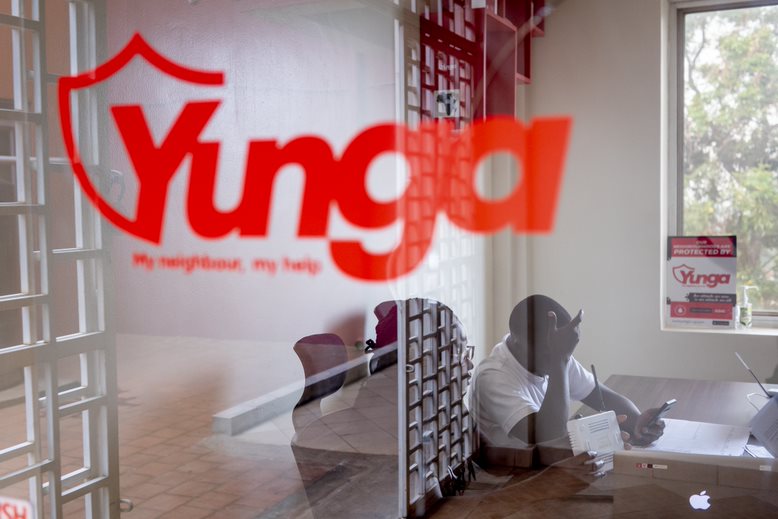
The Yunga team in their office at Mt. Olive Mall in Kiwatule.
Despite the growth Yunga has seen, they have faced challenges in building a hardware startup. They had to raise a lot of capital because of the need to spend on Research and development (R & D). “Building a hardware startup needs you to invest in building a gadget, and making it work perfectly, takes time. During the process of perfecting it, you are spending a lot of money because you have to even import some parts from places like Kenya and China. But building the device ourselves helped us save some money.”
Yunga has some ambitious targets for the next 24 months. “Our objective is to connect over 12,000 households to our protection belt within 24 months. This achievement will not only generate substantial profits but also enable us to expand into other key markets across Africa like Kenya and Tanzania where house break-ins are also rampant”.


