
By Silvia Nyambura
Uganda has seen a sweeping internet revolution over the last decade, mainly driven by mobile internet. According to a recent UCC report total estimated internet users increased by 52% to record 12,986,216 in financial year 2014/2015 compared to 8,531,081 in the previous financial year. As such, internet penetration increased from 37.3% driven by faster than average growth in mobile internet subscription.
Despite these impressive growth figures, there are still huge sections of the population and critical health and education infrastructures that either do not have access to internet at all or sufficient speeds. Gaps in internet access
Another UCC Report released in October 2015 called ‘A Study into Communication Services and Infrastructure across the Country’, reveals there a total of 3,949 base stations offering a mixture of 2G, 3G and 4G internet. All the base stations offer 2G network but even then, this covers only 49% of Uganda’s geographical area or 81% of the population.
Only 1,605 base stations, 42% are 3G enabled covering a mere 7% of the geographical area and 27% of the population. Only 114 stations (3%) are 4G enabled. The report also indicates that Uganda has 4,662kms total fibre length installed, but most of this is route duplication by other networks, reducing to just over 2,100 km. Kampala is only served by 282km of fibre.
 Nicholas Mukasa Appointed Bank of Namibia Deputy Governor
57 districts have no fibre access whatsoever on their land (57%), while 1031 sub-counties (76%) have no fibre access. Out of the 612 sub-counties with 3G coverage, 384 of them do not have any fibre to support data back-haul, implying limited access speeds.
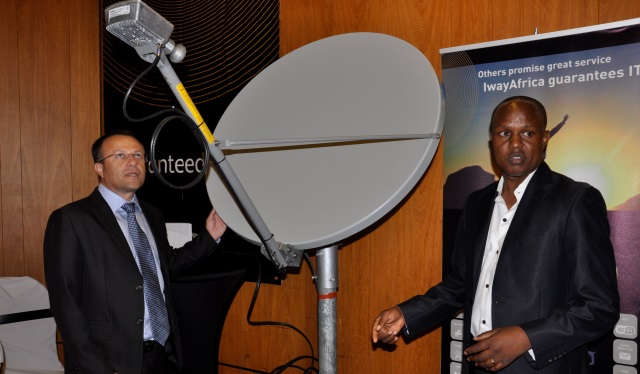
According to Internet Service Provider (ISP) iWayAfrica’s CEO Godfrey Serwamukoko, satellite internet (VSAT) provides the easiest way of commercially reaching these underserved populations.
“Given the commercial limitations of extending fibre and 3G/4G services to some of these remote areas, satellite technology is the only realistic solution to these areas that are underserved by terrestrial infrastructure. Although satellite connectivity has always been in the country, there has always been a cost-of-entry barrier. This has put it out of reach of many organizations and residential customers. The uniqueness of this technology is that it is completely ubiquitous regardless of location. It is complimentary to fiber and other technologies, convenient and is getting even more affordable,
