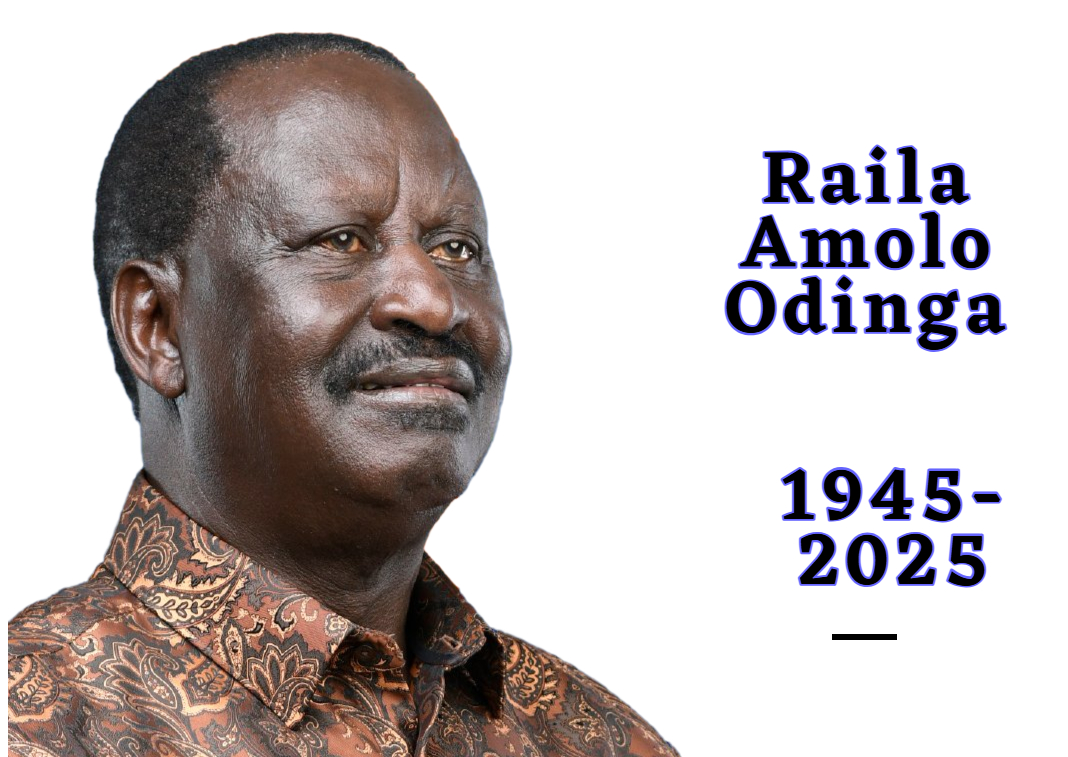
For a man who graced Kenyan politics for over half a century, Raila Amolo Odinga, who died today aged 80 in India, was seemingly destined for greatness.
It’s a destiny born of his father, Jaramogi Oginga Odinga, Kenya’s first vice president and a staunch leftist who courted communists, and controversy in equal measure.
Yet, as fate would have it, Raila’s lifelong pursuit of the presidency, a crown he sought with unyielding passion, remained the one dream that eluded him.
His was a life painted in triumph and tragedy, resilience and rebellion, compromise and confrontation, and the saga of a man who personified Kenya’s uneasy dance with democracy.
A son of the struggle
Born on January 7, 1945, in Maseno, Western Kenya, Raila inherited not only his father’s fiery political temperament but also his intellectual rigor.
After earning a master’s degree in mechanical engineering from East Germany in 1970, he returned home to lecture at the University of Nairobi.
But the young Odinga’s heart beat not only for machines but pulsed with the rhythms of revolution.
His foray into business through East African Spectre Ltd. gave him the grounding of a modern entrepreneur, but his gaze was set on bigger battles focusing on political freedom and justice.
Alliances and betrayals
Raila’s political career reads like a modern epic of ambition and reinvention. From FORD-Kenya under his father’s shadow to the National Development Party, then KANU, LDP, NARC, and finally ODM.
In an article, ‘From a Tiger to a Cat: How and Why Raila Odinga betrayed the Liberation Cause 35 Years Later’, Dr. Precious Wapukha, a lecturer of History and political science in the department of social sciences at Kibabii University, Kenya, describes Raila’s move through Kenya’s political constellations as a brilliant, unpredictable, and uncontainable politician.
His early political life was marked by resilience. In 1982, accused of complicity in a failed coup against President Daniel arap Moi, he was detained without trial for six long years.
Prison became his crucible. When he emerged, Raila was no longer just Jaramogi’s son, he was a name that stirred crowds and unsettled regimes.
He fled to Norway in 1991 during a fresh crackdown but returned to Kenya reawakening to multiparty democracy.
It was a time when the streets of Nairobi and Kisumu echoed with chants for change, and Raila stood at the front lines as a younger, hungrier, more defiant man.
In the 1990s, as democracy spread across Africa in the wake of the Soviet Union’s collapse, Kenya found its own revolutionary rhythm. Raila became the face of that rhythm: charismatic, relentless, uncompromising.
The art of the deal
Raila’s political life has always been a blend of conviction and calculation. After losing the 1997 presidential election under his National Development Party (NDP), he shocked many by aligning with President Moi in 2001.
The two men sealed their alliance with a handshake that earned Raila the Energy ministry, marking his first taste of establishment power.
It was a short-lived truce. When Moi chose Uhuru Kenyatta as his successor, Raila rebelled, leading a splinter group that eventually merged with Mwai Kibaki’s camp to form the National Rainbow Coalition (NARC).
The 2002 election swept Kibaki to power and ended 24 years of KANU rule. Raila’s chant “Kibaki Tosha!” became political folklore.
But the fairy tale quickly soured. The Memorandum of Understanding between Kibaki’s NAK and Raila’s LDP, which promised shared power and a new prime ministerial post, was never honored.
Kibaki’s first cabinet appointments favored his own camp. What followed was one of the most dramatic breakups in Kenya’s political history.
The rift climaxed with the 2005 constitutional referendum, when Raila led the victorious “No” campaign against a government-backed draft seen as entrenching presidential powers.
The “Orange” became his new symbol. It was the seed of the Orange Democratic Movement (ODM) that would redefine opposition politics in Kenya.
Between power and principle
Then came the fateful 2007 elections. It was Raila’s to win until it wasn’t. The disputed results plunged the country into chaos, leaving more than a thousand dead and half a million displaced. Under intense international pressure, Kofi Annan brokered a coalition government. Raila became Kenya’s first Prime Minister in 2008 under the “Nusu Mkate” arrangement with a government of shared power, not shared trust.
It was a delicate peace, built on fatigue more than friendship. Yet, Raila used that moment to push for reforms that would culminate in the 2010 Constitution.
It was one of the most progressive charters in Africa, enshrining devolution and checks on presidential authority. That same constitution, ironically, would later limit his chances at the presidency.
The Eternal Candidate
 World Bank bans PwC Africa, Rwanda and Kenya affiliates from Bank Group-financed projects over fraudulent practices
Raila’s pursuit of State House is one of the longest running dramas in African politics, full of near-wins, heartbreaks, and reinventions.
In 2013, he lost to Uhuru Kenyatta and chose the courts over chaos, signaling a maturity that even his critics admired.
In 2017, he came even closer. The Supreme Court’s nullification of the election results was a personal vindication. But his boycott of the repeat poll turned a historic legal victory into an anticlimax.
He would later swear himself in as “The People’s President” on 30 January 2018. It was a bold, symbolic act that nearly pushed the country to the brink. And then, in a twist worthy of Kenyan politics, came the handshake.
The handshake that changed everything
On 9 March 2018, Raila and Uhuru Kenyatta stood on the steps of Harambee House, smiling for the cameras, shaking hands, and pledging to heal the nation. For many, it was the beginning of a new political chapter. For others, it was the closing of one that saw opposition die a natural death.
The “Handshake” birthed the Building Bridges Initiative (BBI), a bold attempt to restructure Kenya’s governance and promote inclusivity.
The report, launched in 2019, promised hope, but its execution was opaque. The courts later declared it unconstitutional in 2022, marking another ambitious idea that fell short.
Dr. Precious Wapukha describes that moment as “the point when Raila stopped roaring and started reasoning, a statesman’s instinct, but also a reformer’s retreat.”
Losing the youth
The 2022 elections were Raila’s fifth and perhaps final shot at the presidency.
Backed by Uhuru Kenyatta under the Azimio la Umoja coalition, and joined by Martha Karua as running mate, he ran a polished campaign. But William Ruto’s message of “hustler nation” struck a deeper chord. Raila lost again, by the narrowest of margins.
Still, it was 2024 that truly tested his legacy. As young Kenyans, popularly known as the “Gen Z”, poured into the streets to protest the Finance Bill and rising taxes, they looked to the veteran opposition leader for leadership. Instead, they saw silence.
“Baba kaa nyumbani,” they told him, “Father, stay at home.”
The phrase went viral. To them, Raila had become part of the establishment, a man of handshakes, not headwinds.
Reports that he was in talks with President Ruto about a “broad-based government” only deepened the perception that the tiger had grown comfortable by the fire.
Dr. Wapukha puts it bluntly: “Raila helped teach Kenyans how to fight for freedom. Now the youth are teaching him that freedom must keep evolving.”
The Long Goodbye
Age and time had mellowed Raila. His attention and last days was drawn to the continental stage, particularly the African Union Chairpersonship, a position he had quietly courted with the backing of the Kenyan government.
For a man who once symbolized defiance, this new chapter felt almost poetic, the firebrand turned elder statesman, the street fighter turned diplomat. But the transformation had not gone unnoticed.
Among his admirers, he remained Baba, the father of Kenya’s opposition, the man who stood up to dictatorship and paid the price. Among his critics, he was the insider he once opposed, a “liberator-turned-lobbyist.”
Yet both views are true. Raila’s legacy was complicated because Kenya itself was complicated.
But behind the rallies and rhetoric stood a family steeped in politics and principle. His wife, Ida Odinga, stood by him through exile and imprisonment. His children carried the Odinga legacy into business, academia, and activism.
The legacy of a reluctant king
Raila Odinga may never have sat in State House as president, but in many ways, he ruled the Kenyan imagination. He shaped the vocabulary of resistance, expanded the possibilities of democracy, and taught a nation that losing an election is not the same as losing relevance.
In the end, history may remember him as the uncrowned king of Kenyan democracy — the man who challenged five presidents, inspired generations, and refused to bow to the machinery of power.
At the time of his death, he no longer roared like the tiger of old, but his pawprints remain on every major reform of modern Kenya.
His passing marks not just the end of an era, but the silencing of a voice that spoke truth to power for more than half a century.
Whether history remembers him as a statesman or a survivor, one truth will endure: Raila Odinga made Kenya argue, dream, and hope, and that, in politics, is the highest kind of victory.