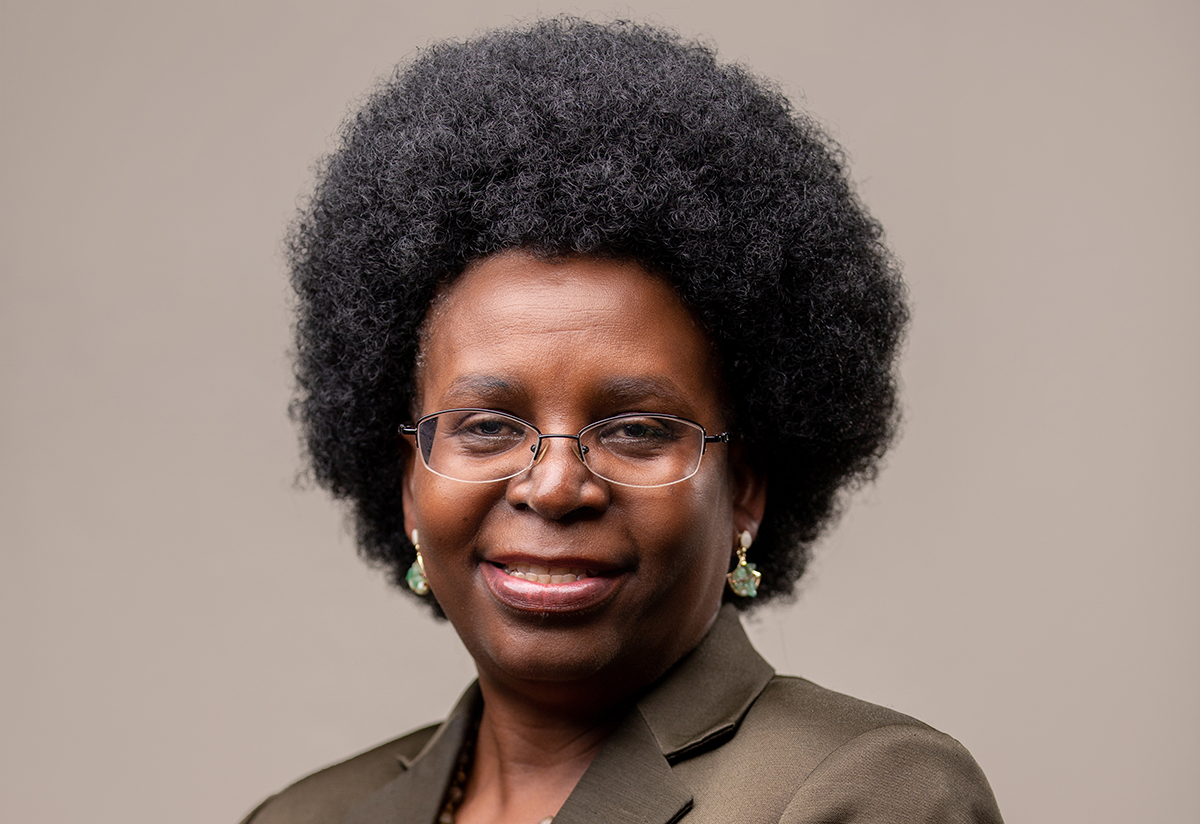
As an entry, please tell us about yourself. We have heard a lot about you over the last two years because of your frontline work on COVID-19 as the leader of “the Scientists” who locked us down for two years, and now you are also in charge of big projects like the Kiira EV cars. How did Dr. Monica Musenero Musanza get here?
I started my work in 1992 after graduating from Makerere University as a lecturer. I taught many subjects including Bio-Chemistry, Pharmacology, Microbiology and Physiology, and supervised many students.
I then went to Cornel Iniversity in the USA where I studied a Master’s Degree in Microbiology. I spent six (6) years in the USA; first studying and then working in the university. It was at Cornel University that I got introduced to vaccine molecular research project there focused on creating vaccines.
When I came back to Uganda and went back to my work at Makerere we were determined to build something better and bigger, using the experience that I had then. I spent several years in Makerere together with my colleagues to build the capacity for us to do research so that we can develop the right tools.
In 2003, I decided to take another Master’s in Public Health. I joined the Makerere School of Public Health where I trained and specialized in epidermic control. My work then shifted quite a lot to the Ministry of Health where I worked until I was the Assistant Commissioner in charge of Epidemiology and Surveillance. Before that, I had occupied various positions as Epidemiologist and Principal Epidemiologist.
In short, you have been in the field of public health and epidemiology working for the government all your life. Hasn’t that constrained you a little bit?
That isn’t entirely accurate – after my time at the Ministry of Health I joined an International NGO called African Field Epidemiology Network (AFENET) because of the experience I had gained. I made sure to work in African countries because they are really tormented with epidemics. The work of this organization was mostly to build capacity of many different African countries. I was supporting and coordinating 15 countries, working with them to develop training programs as well as supporting them in responding to epidemics. I spent 75% of my time building capacity in different countries on the continent.
I also worked many times as a special advisor to the World Health Organization; travelling to Geneva to work on policies. The longest contract I ran was in West Africa during the Ebola outbreak there. I was requested to go and support the response. But I was not very keen because I was not feeling healthy. When I arrived in Freetown and started to engage and saw the trouble this country was in because of Ebola, I just stayed there.
Even when my contract ended, I stayed back because I could see the lack of capacity in the country. Nobody was responsible for me, which was dangerous with such a dangerous disease.
But looking at the children there suffering and seeing households just disappearing, I could not bring myself to leave. The World Health Organization eventually took me.
I am proud of my work in Sierra Leone. When I got back the government even gave me an award, and so did the European Union.
More recently, in 2018, the Ebola epidemic outbreak in Congo forced me to go and support the response in Kinshasha. I spent a short time and returned home only for the WHO to send me to Rwanda to help more. With all this experience I was automatically put to work when COVID-19 broke out – and I was willing to serve, as always.
Of course people tease me when they talk about “the scientists”, but we worked as one team. The Task Force did the best that we could and I trust that we made Uganda proud for how well we stood out on the world stage. Some countries with even smaller populations than ours lost more people to COVID-19 and are still suffering. We are resilient and are now recovering.
You appear to have dedicated your entire life to this one field of health. Why?
My passion for epidemics control has resulted in many other benefits for the country, even of an economic nature. Many of you may not even notice some of the changes around us. For instance, we used to have a lot of cholera outbreak in Katanga when I was in the Ministry of Health. We had to think of creative ways to control the disease and focused more on the people than the environment. The residents of Katanga realized that even though their environment wasn’t going to change they could change their behavior and live better without any funding from government.
I got hypochlorite from the WHO and I would go every evening to Katanga to talk to women to chlorinate their water. I would then visit clinics there and talk to nurses and we would make a stock solution in jerrycans, then put them in Rwenzori Water bottles to give to the people. We started to reduce cholera in that place.
We also changed West Nile – where there used to be frequent plague epidemics that would make mostly the children suffer. At AFENET, I brought together teams of people from the Ministries of Agriculture and Health, Makerere University, and research agencies.
One was an entomologist (insect specialist) and we worked together in Arua, Nebbi and Zombo to clear out that epidemic.
I also remember the typhoid outbreak in Kampala in 2015 that was decimating taxi drivers, conductors and hawkers downtown. People didn’t recognize it but my second day in office on returning from West Africa, I detected a problem and brought together people from Makerere School of Public Health, Ministry of Health and KCCA. The rest is history – and it excites me because we are saving lives. None of it is about money or recognition. We must focus on service to our people.

But during the COVID-19 pandemic, we have seen even developed countries being selfish with their vaccines and things like surgical masks, and also charging a lot of money for COVID-19 vaccines and treatments. Here in Uganda we have also seen massive budgets being discussed for the two years of the pandemic. Isn’t vaccine development also about money?
 Shashi Dhar Drives Bank of Baroda Uganda Profit to UGX 156.8 Billion After Three Years of Strong Growth
It is not about money. Vaccine development is also about service. We have to focus our efforts on saving people’s lives and decreasing the impact of a disease like Covid-19 on the economy, as happened during the pandemic phase itself.
But while we do so we must understand that the development of vaccines is one of the most high technological advancements that a country can take on today. Many countries in Africa hid away because it appeared to be complicated and expensive. Also, some scientists lacked confidence and official support to take it on.
Vaccine research is different from vaccine manufacturing. Vaccine manufacturing is only a component in the vaccine development process. In full you have to think of the the ideation, then the research and then development. You identify the germ (virus or bacteria) and then use the science to deal with it.
In Uganda we put together a very high-level team of various scientists because we all have our different specifications. The process ends up in a vaccine candidate which is taken through pre-clinical studies, to test if the vaccine is safe, or capable of inducing an immune response in a live animal.
We also check, if we put the vaccine in a petrie dish, what it does to the virus, and then if it was able to induce that immune response or if it actually kills the virus. After that, we have to prove, using laboratory mice, if the vaccine is efficacious and actually reduces disease?
Uganda has built up the research capacity and we are going on with the pilot plant. Some of the work we are doing will overlap because of the needs we have and once we are ready we will be doing clinical trials.
Some people will ask why we are bothering to create more vaccines yet the world already has many of them, but it is clear that countries that conduct their research and develop their own technology are developed and you yourself mentioned the experience we went through as the developing world.
When you do your own research, you develop your technology and you can therefore determine when you are to use it without having to beg or be put in a queue you cannot control.
From all the projections, we are doing the right thing as a country and all Ugandans should be proud. We can easily adjust our vaccine once we are ready because we have seen new variants coming and we know how fast things change with Covid-19.
This capacity we have developed is going to be used for making many other vaccines since in Africa we are just waking up. 1% of the Covid-19 vaccines used on the continent were manufactured on the continent and even then it was just that final stage which is known as fill-and-finish.
Uganda is the only country that has started its own vaccine research and development in Africa. We want to have intellectual property and to make Uganda a hub for vaccines. We must make our young people, our children, realise that they can also do such things.
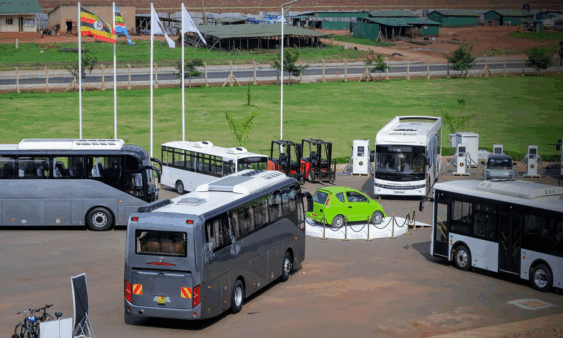
Does the same apply for an ambitious project like the Kiira EV Motor vehicle one? As Cabinet Minister, were you surprised to find yourself in charge of such a project?
When the President read the list of ministers in 2021 he announced that Dr. Monica Musenero Musanza was the Minister of Science and Innovation at Office of the President, serviced by the State House Comptroller. The way he announced it said a lot; it was the first indication to me and maybe those that I was working with on the vaccine project, because I was simply leading the project and also senior presidential advisor.
I later got to learn from the hand over notes prepared by my predecessor that the President had earlier had intentions of transferring the Ministry as he eventually did. He wasn’t just appointing me to take over the ministry, he was appointing me to the Office of the President to take over the portfolio of science and innovation.
In essence, that was a big change because the Ministry as it existed before was no more; we were starting something new and indeed our handover was by the Prime Minister to State House
There was even a bit of ping pong between Parliament and the Executive that delayed a lot of work until in December 2021 funds were released – we even paid salaries almost on Christmas Eve!
But still – work had to be done and we focused. We are technical people and we are capacity builders, so we had no choice but to keep thinking big and being ambitious. The Kiira EV project is certainly ambitious and we will see more such projects run and executed by the great minds of great Ugandans from many places.
Let us all believe and put ourselves to work to achieve these dreams!