
What is the current state of business at Post Bank?
Postbank Uganda (PBU) is a socially-oriented bank fully owned by the Government of Uganda. PBU was incorporated under the companies ACT in 1998. The Bank’s mission is to offer affordable financial services that drive financial inclusion for social-economic development.
The bank has a network of 43 branches (an additional 4 ready branches that are awaiting approval by BOU will take the number to 47) and 14 mobile banking vans (Bank On Wheels).
As part of its efforts towards financial inclusion, PBU has a focus on Agriculture and Micro, Small and Medium-sized Enterprises (MSMEs) as it is estimated that 60% of Ugandans are involved in the agriculture sector. Equally, a large majority of Ugandans are involved in entrepreneurship activity as a means of survival.
It is important to remember that the agriculture is not just about farmers tilling the land, fishing or rearing animals, but the agro sector has a large ecosystem that includes – suppliers and manufacturers of farm inputs, transport, storage, vendors in markets, agro-processing, traders, etc.… Most Ugandans are involved in these activities in one way or another or they have family members or associates involved.
By PBU focusing on Agriculture and MSME, we believe we are at the core of Uganda’s economic growth especially through food security, job creation and entrepreneurship.
It is now one year since you were appointed Managing Director. What have you been up to?
My top priority as I joined, was to strengthen the bank’s foundation so that it can optimize its potential and ably compete with the aggressive privately owned financial institutions.
We carried out an institutional review which informed the decision to change the structure of the bank. We are at the tail end of filling the positions in the new structure, as to reposition ourselves for the transformation ahead. This is part of our journey of transforming PBU from a credit institution to a fully-fledged commercial bank.
We have been working on improving our customer experience to reduce on the long queues in our banking hall through a number of initiatives including;
- Revamping our self-service channels; mobile application, USSD code *263# and internet banking. We shall soon be launching a campaign to educate our customers to take advantage of these channels for a number of services including mobile money, payment of utilities, account balances, etc…
- The bank is in the process of replacing the old worn-out ATMs;
- There were legacy issues around issuing of ATM cards which we have addressed. In some of the branches the cards are instant and customers can obtain a card in 20 minutes!
- We have reviewed the customer onboarding process to make the process shorter and reduce on the amount of paper work
- We are also finalizing process flows for employee loans (these include civil servants, men in uniform, private companies) so that applications can be processed within 48 hours

We embarked on upgrading our core banking system from the decade-old system to Finacle version 10 which will be completed mid next year. We started the process of KYC update for all our customers- given the numbers, the exercise may run until mid-next year
We have added 4 branches (Rushere, Butogota, Mukono and Kamdini) that are awaiting approval by BOU. Upon approval, these communities will enjoy the full services of PBU which ties into our strategic objective of being a market leader in financial inclusion.
When you say you want to be a market leader in financial inclusion- a different kind of ambition from most banks; what does this exactly mean and why is it important for you as Post Bank?
For every economy to achieve growth, a significant part of its especially adult population must be financially included. You cannot leave them behind.
However, financial inclusion, in many cases is not as rewarding; profitably. It takes time, so a lot of institutions shy away from financial inclusion and prefer to deal with the more established customers. As Post Bank, we see our cardinal role as being, supporting government in terms of transforming the lives and livelihoods of Ugandans and we believe this can happen through financial inclusion. Once you onboard a lot of the financially excluded people into the formal financial sector, you can exponentially grow their participation in the economy. Financial inclusion involves a lot of things- you start by educating people about savings, and how to borrow and boost their businesses; and how to move up the chain in terms of financial services. They can start off in a microfinance or in a group e.g. a group of market vendors borrowing to improve their stalls. Once the stall becomes active, you are able to make more savings and possibly are now ready to open a shop. At this point you don’t have to borrow as a group- you can go on your own to the bank, borrow then eventually invest in assets which will enable you to borrow even more and diversify into other businesses.
If you can onboard as many people on such a journey, it makes a very big impact; that’s how countries grow- one business at a time.
In your analysis- is Post Bank living up to its full potential/the purpose for which it was created?
PBU has done well, there are just a handful of banks than can boast of serving 1 million Ugandans. However, the bank can do a lot more in availing more Ugandans with affordable financial services, boosting the agriculture sector and taking a leadership role in government business especially payments.
 Africa Takes The Stage: From Raw Supply To Brand Ownership
What we have been doing is building the foundation- a solid foundation, because if you have a very solid foundation, you can do so many things including competitiveness and growth.

Even if we are fully government-owned, we have to be very competitive- when it comes to service, the customers of Post Bank should have an experience, just like they enjoy at any of the big multinational banks or any of the other private banks. The experience should be the same, right from onboarding, service, products, solutions etc. It should be the same or even better. That is part of our transformation journey- we want to create a first-class customer experience. This is because much as we are a government bank, we are operating in an arena that is full of very aggressive private banks. We have to adopt that level of aggression, if we are to optimize our potential- it is good for business, but it is also good for our customers, shareholders and partners.
What else do you think needs to be fixed/or rather what will you be fixing for Post Bank to achieve this full potential?
I do believe we have quite some work to do regarding reinforcing the Post Bank brand. In my view, building a brand is all about everything we do and how we do it. That ranges from branch ambience and the exceptional service delivered therein as well as the reliability and quality of service on our digital channels. For example, when customers come to open an account, it should be simple and swift and they should be able to move out with their ATM card. Today, the industry is moving towards self-service- you would like as many of your customers to be able to serve themselves.
A lot of investments that we shall be making in the coming months will be in technology. We are bringing in new ATMs- most of our ATMs are old- more than 7 years. We are upgrading our switch to enable it to handle remotely, multiple services and solutions that today bring people to the banking hall. Next year I believe, the queues will be gone- unless the number of customers also multiply. We are also in the process of procuring 800 Point of Sale terminals for agents so as to also grow our agency network.
In summary, there are quite a number of issues we are in the process of fixing for the bank to optimize its potential; but the following are priority;
- Technology
- PBU channels are being enhanced to ensure seamless service to customers and robust operational risk management;
- We are acquiring an automated solution to drive mass payments countrywide- PBU is a service provider for SAGE (government payments to the elderly) and donors supporting the refugee communities;
- More automated solutions are in the works to allow convenient customer onboarding and mass customer acquisition as well as enabling virtual interaction amongst group members for purposes of microfinance lending and financial literacy;
- We are growing the number of our agent outlets
- Partnerships: Other than government, PBU has partnerships including the Uganda Development Bank and several donors. There is need to increase the engagement levels with partners, both in scale and impact.
- Risk and Governance: The journey has already started with the changes in both the Board of Directors and senior management. We are strengthening our risk management framework to prepare the bank for growth and transition to tier 1;
- Customer experience: Develop a 24/7 contact centre that is multilingual to ensure customers can be served at any given time.
There seems to be a narrative that brick and mortar banking is getting out of fashion yet you are investing in more branches. What’s the justification?
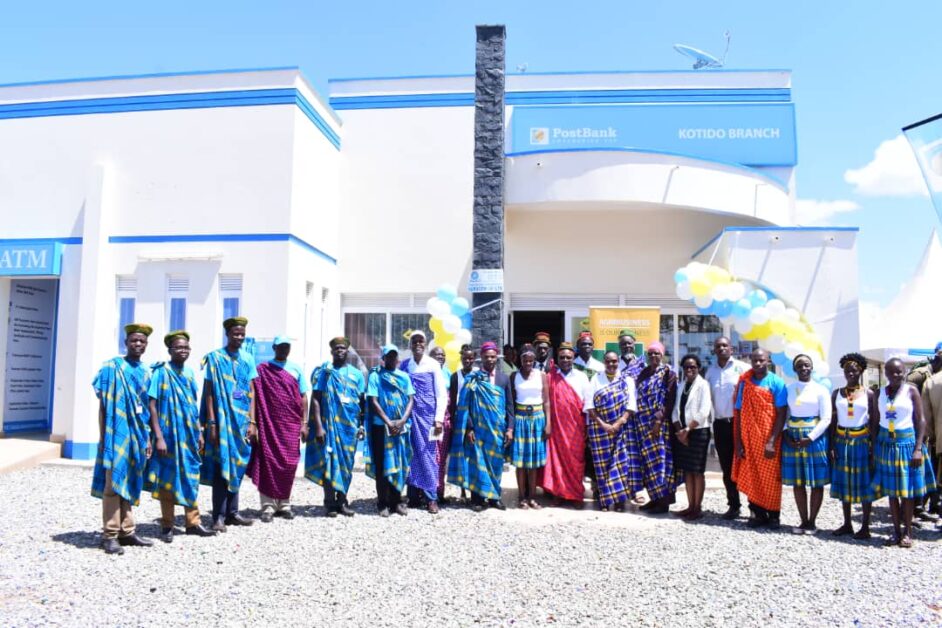
In this business, you have to segment your customers. There are some banks in this market, that unlike Post Bank, don’t have a customer in Amolatar, Kotido or Kamwenge, who is this farmer from the village and doesn’t have access to these gadgets driving digital banking. All they have is maybe a small feature phone and they can possibly access and use the USSD code. They can’t go online to apply for a loan. So, this calls for a mix of brick and mortar branches as well as digital banking. We must find the perfect mix to win. We must invest in technology to make sure that a number of services can be accessed by the customer remotely, well knowing that there will always be instances where physical branches are important. If you look at our focus, where our customers are primarily into agriculture, micro and MSME banking, which are the heartbeat of the economy, we will always have physical branches for the foreseeable future.
That said, the role of the branch is also going to evolve. In the past, branches used to be dominated by over-the-counter transactions- mainly cash deposits and withdrawals. Going forward these are things that will be done by agents. Branches will now be for consultations, borrowing, advisory services etc. Cash transactions will be taken over by agents, point of sale terminals and ATM recyclers (ATMS that can take deposits and credit client accounts instantly). If the agent is out of float, they can go and do an instant deposit on a recycling ATMS and their accounts will be deposited instantly. So we will still have branches, but the role of a branch is quickly shifting away from cash.
Having been at Post Bank for a year and understanding the brand properly, what reason would you give to anyone to convince them to come and bank with Post Bank?
Reason number one is that we are owned by Government- that is security/safety to start with. Secondly, we have a huge network of 43 branches and 4 more in the pipeline pending approval. We have got 14 mobile vans- a branch on wheels- that go to the deepest unserved areas all over Uganda and can lend and take deposits. I bet we are among the top 5 financial institutions in both foot print and number of customers served. This added to our technology investments that I have mentioned, very soon, we will be as good as any commercial bank.
It is also important to note that we are well capitalized with a strong asset base. In 2019, our assets grew by 23 per cent from UGX398 billion in 2018 to UGX491 billion. Our asset base is larger than that of 12 of the 26 tier 1 commercial banks. This growth was driven by largely a growing loan portfolio- UGX267.1 billion in 2019 itself driven by healthy deposits growth- UGX348 billion in 2019. If we were to benchmark with the tier 1 commercial banks, that would make us the 12th largest by lending and 15th by deposits.

Perhaps even more importantly, Post Bank has been able to bank most of the unbanked segments profitably. In 2019, we made a profit of UGX8.4 billion; only 11 commercial banks were more profitable than Post Bank, making us the 12th most profitable bank if you like, beating 14 other commercial banks.
We are also leaders in agriculture lending, having extended 8,300 agriculture loans to 56,000 borrowers. Agriculture lending accounts for about 25% of our entire lending portfolio. Last year, we were named the best Financial Institution in advancing agricultural financing in the country under the Bank of Uganda Agricultural Credit facility (ACF) program. We were recognized for having the highest outreach to small borrowers, having the highest National coverage, having the highest absorption rates and for having the highest number of loans applications submitted to Bank of Uganda as at 31st March 2019.
Where do we see Post Bank in the next 5-10 years?
A tier 1 fully-fledged digital commercial bank at the heart of the country’s economic growth by economically transforming the lives of millions of Ugandans and businesses, in partnership with the government.