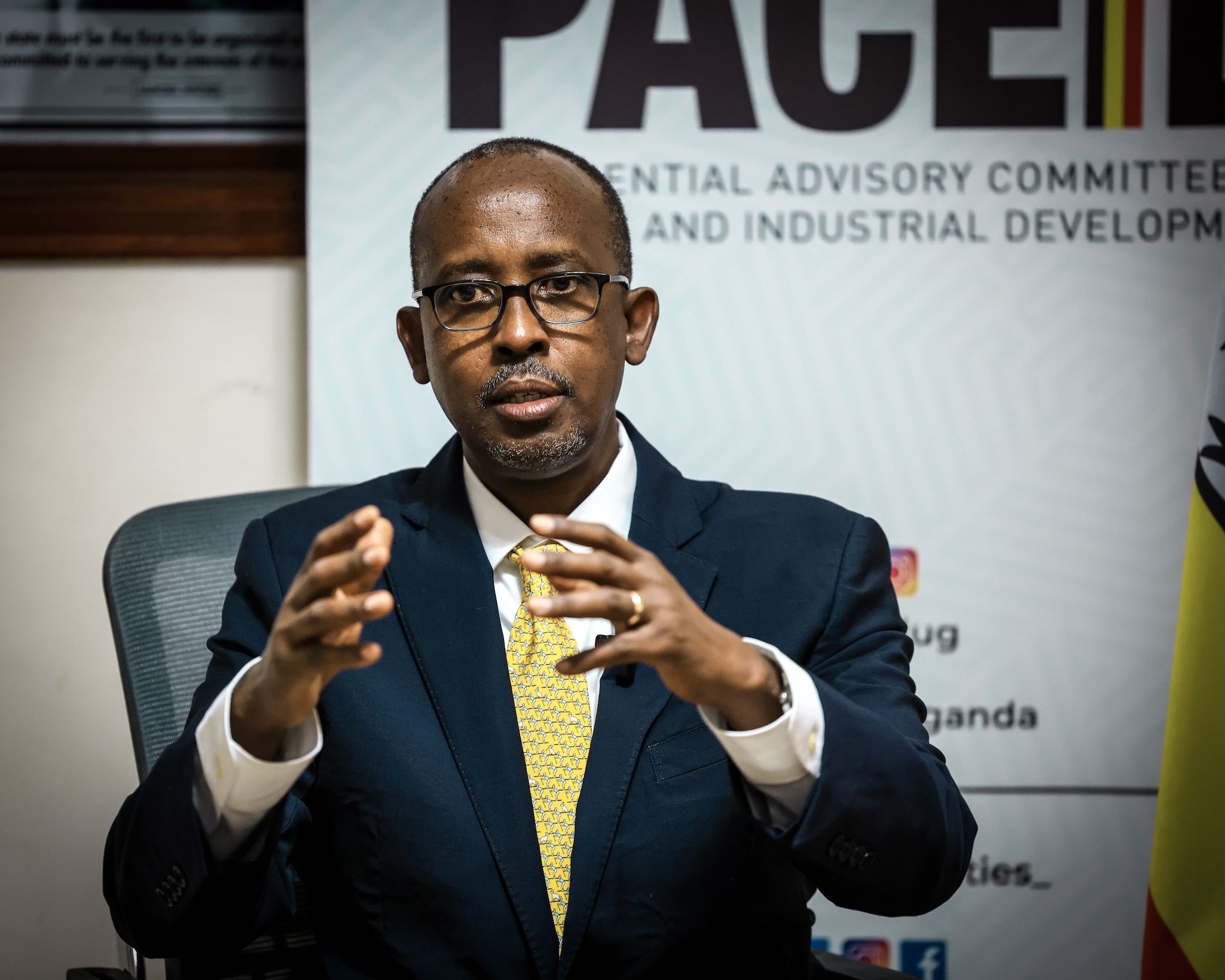
As you approach four years as Chairperson of PACEID, what was the single biggest problem you were determined to solve in Uganda’s export and industrial story when you took on the role?
This work didn’t begin with an appointment to a position because I wasn’t looking for a title. It began in 2018 when I carried a truckload of dairy products and drove through three borders. I lost the products, time and money and had nowhere to turn to, yet this is a government I thought I knew a little better and could find solutions. I thought about hundreds of other SMEs that suffer this and have no recourse to justice, and have no voice. Right then, I began thinking about a solution.
When the President appointed me a senior advisor, as he has done with a number of others, I turned that role into helping firms succeed in difficult regional and international markets. We sought to solve problems of blind trade or the habit of entering markets without adequate research and preparation. We aimed at fixing products’ compliance standards, we wanted to negotiate the cost of logistics for firms where possible, and we wanted to find low-cost money for firms that secure export orders yet have no working capital. Those were problems we determined to resolve from the start.
At the start, some observers questioned whether PACEID would duplicate the work of institutions like UEPB, UTB and sector bodies. Four years later, what would you say has been PACEID’s clearest unique contribution?
The German/American physicist, Albert Einstein, once said, “As far as the laws of mathematics refer to reality, they are not certain; and as far as they are certain, they do not refer to reality”. He meant that models, mandates, theories or maps are clean and abstract, but the reality of any given situation can be messy, requiring a unique understanding. I know that mandates are great, but something greater is finding solutions that give practical therapy to exporting firms and create jobs.
Mandates are maps, but the territory is different. Our intervention has been to shine a spotlight on a sector that is often buried in red tape and/or ignored. We complement traditional institutions and make faster decisions for export firms that pass through our hands. Because of this approach, we have opened new markets like the Balkans and improved segments in old markets like the US cities of Detroit, Atlanta and Chicago or Canada’s Vancouver. We will soon commission a location in London, UK, and once Kinshasa opens up, you will see new signals there for our products. We have helped the country sell value-added products, negotiated better terms for companies and dealt with bad publicity affecting our products in foreign markets. But all this is still too little. Uganda has much more mileage to cover if we reduce jurisdictional fights over mandates and coordinate on actions to enter markets and support firms.
What does success look like for you personally, four years in, and has that definition changed from what you imagined in 2022?
No. It has not. Our aim remains 1000 exporting firms. We now have 200 on the database, but have supported less than 60. It seems slow, but each firm, each market, each problem is unique, and we seek understanding rather than a sprint. Solving problems of a firm as well as a society is a marathon task. You could say, ” Why don’t you support only ten to do the job of 1000. I have heard that, but I don’t believe that an economy with small start-ups should start with those who are already able. After all, when the small ones stabilise, they also supply the big ones that already export. You must balance both the capacity of the big with the great potential of the small, which can pull in more products. Our initial product focus was wide, ranging from grains to fruits and vegetables to meats to dairy to tourism and many more. We are now narrowing down to what we can achieve with fewer products. It helps us to work around aggregation and create a bridge between demand and supply.
Uganda’s total export earnings have risen sharply—from about US$ 4.28 billion in 2022 to about US$ 13.43 billion in 2025 (preliminary). When you look at this shift, what stands out most about the nature and drivers of this growth?
I am happy with our period of work; export increases, in a way, justify our effort. We began on March 16, 2022, and numbers haven’t looked back moving north! I thank the President for his tremendous listening capacity to all ideas on the economy and for supporting us. I thank God and our team of young people for the opportunity to be of value to our country. Many people focus on consumptive parts of the economy (more administrative jobs, more allowances); we focus on the sales parts of the economy, along with manufacturing, in the sectors we are in.
Our manufacturing output has increased, somewhere around 25% of value added in East Africa, even if it is still only 16% contribution to our GDP. There have been significant increases in both production and diversification from traditional export categories to more. For example, five years ago, we were not exporting Cocoa, let alone shelf-ready chocolate, to the tune of USD600m, as we do today. Neither was the current avocado oil and fruit extraction and processing as it is today. One avocado processing factory we are working with today has a capacity of 300 metric tons a day, requiring a daily supply of 600 metric tons. Where are the suppliers? Very few. This company alone needs 15000 acres of avocado land to scale. Where is it, and how fast can you get it? The same applies to fish, fish feeds, milk, etc. So, the drivers are increased production, substantial awareness created in key markets in Europe, the USA, the Middle East, the Balkans and parts of Africa and some of the support we have given to exporting firms across sectors and regions of the country.
Between 2022 and 2025, exports have more than tripled in value. In your assessment, which part of this growth reflects structural improvements in Uganda’s export capacity—and which part is more cyclical, price-driven, or shaped by trading routes?
In an economy dominated by commodities, it is safe to say that much of the growth is cyclical. Fiscal policies in consuming countries like the tariff announcements by the USA recently, temporarily shove the competition out of the way, and our numbers go up, and so does the effect of weather and other elements. Structural improvement in an economy is buttressed by cheap electricity, better road network, fast and accessible broadband, water and rail transport, robust health and education infrastructure that gives quality labour the confidence to relocate to your country. All these give firms the ability to compete, yet these are not yet optimal in Uganda to say there is a huge structural change. The signals, though, are promising. If we are able to assemble televisions, fridges, vehicles and improve the quality of fast-moving consumer goods as we do today, the economy is truly adjusting to a better level, albeit slowly.
Gold alone reached about US$ 6.47 billion in 2025, nearly half of total exports. Help us understand this gold revolution: where is this gold coming from, what are the key drivers behind the surge, and is this now a value-addition story driven by refining capacity—or primarily a regional trading and transit hub story?
The gold surge in Uganda, as well as much of the world, is a response to the uncertainty with superpower rivalry and heightened tension on account of geo-security. It is a safe asset to store value. Much of the gold sold in Uganda comes from the region and beyond, even as far as Ghana. Our contribution is minimal. We haven’t put all our mining capacity to this threshold to generate the numbers we have. We are a transit centre because of the reforms we carried out in the economy years ago. For example, we liberalised the capital account, removing all restrictions on all forms of capital coming in or leaving Uganda. Because of this, many investors find Uganda very liberal, secure and welcoming to trade commodities like gold.
We also recently added seven refineries that handle up to 99.4 per cent metal purity. We could do more with gold, but we are limited by capital and a small domestic and regional market in moving to the next level. The next level is the production of gold rings, mixing the metal with other alloys or in pharmaceuticals to get a better return. That would give Uganda a real gold souk in the region. We will get there with this mineral and others with time. The Baganda say “nezikokolima ggali maggyi”, meaning even ‘the rooster you have was once an egg’.
Who Benefits from Gold: Critically, how much of the value from this gold boom is accruing to Ugandans—across miners, refiners, transporters, traders, financial intermediaries and the wider ecosystem?
Ugandans benefit, but in a limited way. When we were exporting USD2.4bn of the product three years ago, our margin was just above USD100m retained. I am not sure how much we retain today. It is small compared to the sales. But this is not a problem in the short run because this money comes through Uganda and bolsters our national accounts, as you can see. We simply need to develop the value chain better so that the ecosystem you mention benefits.
 Nicholas Mukasa Appointed Bank of Namibia Deputy Governor
When you assess PACEID’s impact, what indicators matter most—export value, market access, policy reforms, standards compliance, export financing, firm capability, or something else?
All the indicators you mention matter. To move the economy from commodity sales to manufacturing, value addition, as well as continually improving market access and cheap finance, matter. You cannot build firm capability if enterprises aren’t living long enough to transit to two generations in a sector or several sectors they are specialising in. And if you do not develop and comply with the standards applied by your peers, you are as good as one who fetches water in a clay pot only to break it in the doorway! You must combine these elements to deliver growth and have a lasting impact.
If you were asked to point to two or three outcomes where you are confident PACEID made a decisive difference, what would those be—and why?
First, in the last year, we have pulled in more than USD30m in support to export firms with orders now generating more than USD9m weekly. This is a critical fuel of cheap finance to get SMEs into foreign markets. There are more than 49 companies in coffee, dairy, beef, fruits and vegetables, sesame, nuts, cocoa, vanilla, tourism, grains, timber, chillies, and even the export of Uganda gins. By the start of 2026, 20 more firms will be under consideration for export orders handling. Several of these firms were on the sickbed on account of corporate governance issues and/or expensive loans from commercial banks. You cannot use short-term funding for long-term structural problems of exports. These firms are now stabilising and growing using export orders.
Secondly, we have taken several countries and opened trade locations to give our country visibility in the market. In Serbia, we are entering our fifth trade location. This market was not on Uganda’s radar for 63 years, yet we have had a trade agreement with them this long. The issue is not even Serbia; it is the gateway from Serbia to the Balkans and Europe we are looking for.
Thirdly, next month, we are bringing a bill to the cabinet to establish Uganda’s first food safety Ombudsman. This is to protect our citizens and also cure the bad reputation of our food and country as a sourcing centre. This is because of the multiple sources of certification that are suboptimal in the matter of pesticide control, animal drugs and plant health measures.
PACEID has consistently emphasised value addition and non-traditional exports. Which sectors did you deliberately prioritise, and which ones do you feel are now on a different trajectory because of PACEID’s interventions? Are there priority sectors where results have been slower, and what explains that?
Coffee, dairy, fruits and vegetables, grains, tea (even if we have generated much heat and less light on tea because the sector has been neglected for a long time), sesame, and fish have had our attention. Beef, tourism, and infrastructure, we have struggled. Much of the struggle is to do with failure to pull in the same direction with all our partner institutions. The delays are crippling, and the lack of care and urgency is very troubling. But we didn’t get in here with blinders on our eyes. We are learning how to navigate and still push the initiatives we bring, even if we see resistance in some quarters; much of this resistance is really driven by the politics of selfishness and arrogance borne of ignorance.
PACEID has invested time in opening and deepening international relationships. How do you decide which markets deserve focus, and how should we interpret cases where a country or region has received significant engagement but does not yet clearly show up in Uganda’s export destination data?
We conduct a basic ‘dip study’ survey ahead of entry to each market. The UNDP in 2023 helped us with research in seven markets in Africa, and it is some of these that we are working in. We also ask and appoint trade representatives who guide us on entry and walk us through tastes and preferences on the market, the level of taxes, culture and non-tariff trade barriers. We don’t have money for marketing and promotion, and so we have to use all non-traditional and creative means to achieve our objective. This takes a lot of time and relationships. Where you see nontraditional export destinations, that is to say, we found a soft spot, and we are using it to open a new area. Data is still our weakness at PACEID because we rely on other institutions of government and our trade representatives for help. We are now building a platform to allow us a window into what we do so that we can analyse results and plan better.
As a farmer and entrepreneur—and speaking on behalf of producers and exporters—if you were addressing the next Cabinet, the 12th Parliament, or key policymakers on the export component of the 10X strategy, what five non-negotiables would you insist on for Uganda to succeed?
First, to export more than 50 percent of our GDP outside oil and gas, which is what will begin to shift the country’s fortunes, we must invest much of our money in efficient and modern ports on lakes Victoria and Albert, improve our airports and have well run mini ones near game parks, build a modern road and rail network to the sea, lower the cost of electricity to 2 cents. Then we can begin to compete and end the logistics nightmare of our exporters. We must spend money on these things, spend it transparently, and eliminate corruption in procurement.
Second, we must stop breaking the country into small political pieces and instead do this for manufacturing hubs, food and product aggregation centres. Ugandans like to build political ecosystems instead of ecosystems for electronics, food and manufacturing. A USD30,000 tea cottage factory in Zombo, for example, for speciality teas that fetch USD50 a kilo, is much better than a new constituency or sub-county with councillors looking for jobs. The small factory raises the production capabilities of many young people and women and creates real jobs.
Third, this means that Uganda can compete in everything. We have to build where we have strength and use technology to improve labour skills and make them productive. We are everywhere but nowhere strong on agriculture, mining, or services as a base for export strengths. This is why we ask for a minimum of four aggregation centres and focus on a few products, and drive them to their maximum potential factor utilisation.
Fourth, the quality of our education de-emphasises science and entrepreneurship and instead pushes people into a narrowing public sector. I am happy about the change of curriculum for schools recently because I have been graduating thousands of people in villages who, through their own talent, are building SMES. It’s a good start for Uganda, but it’s not sufficient to give Uganda a competitive edge. It has to be deliberately emphasised so our young people can create their own jobs. This will eventually change the culture, character and behaviour of our labour force.
And fifth, making government officials work for the private sector and the citizens. There are so many inefficient offices obstructing growth rather than aiding it. If it takes ten years to build a power dam or five years to enter a free zone facility, who wants to invest in a country with these inefficiencies? This is not about money. This is often ‘politicising’ the work on the economy instead of bringing fresh thinking on how to leap forward. We must keep an attractive and efficient public service to compete.