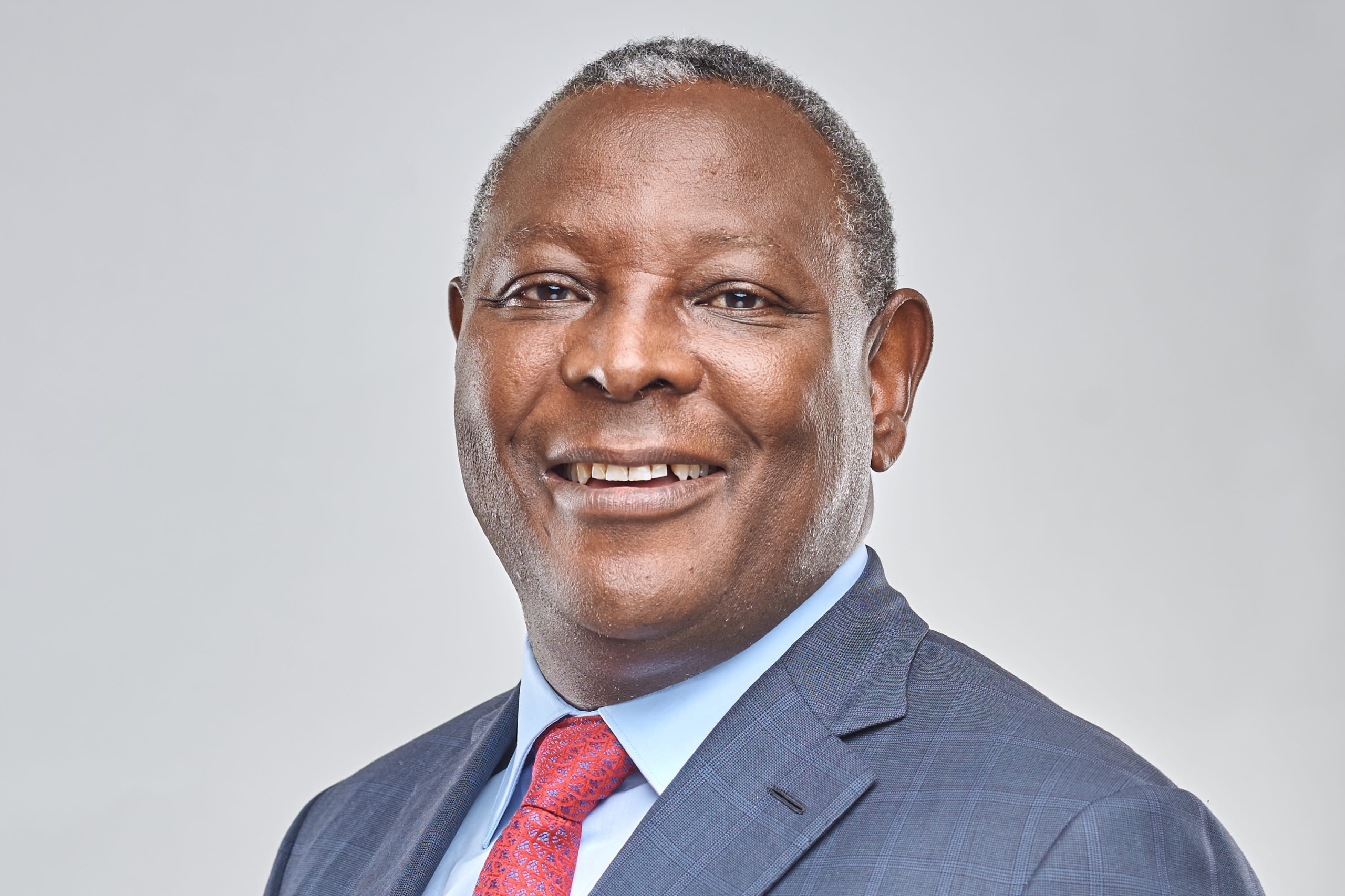
In a sweeping call for economic recalibration across the continent, Equity Group Managing Director and CEO, Dr. James Mwangi, has urged African governments to “let the private sector take on development projects,” arguing that sustainable growth will increasingly depend on private-sector investment rather than public expenditure.
Speaking at the B20 Summit Fireside Chat in Johannesburg, Mwangi outlined Equity Group’s Pan-African ambitions—including expansion into 15 countries by 2030—and affirmed that all the Group’s subsidiaries are now “fairly profitable,” positioning the lender for its next phase of continental growth.
Mwangi’s insights came during a high-level conversation on Bridging Priorities: Cooperation, Innovation, and Growth, where he discussed financial inclusion, AI-driven transformation, cross-border banking, and the rise of private capital in infrastructure financing.
CEO East Africa Magazine’s Paul Murungi, who covered the Fireside Chat, reproduces below the full interview moderated by Jennifer Zabasajja, Bloomberg Television’s Chief Africa Correspondent and News Anchor.
There has been quite a bit of talk about reorienting the financial ecosystem to better adhere to the realities in different geographies. When we think about Africa and the development needs here, what progress have you witnessed in some of this reorienting that we need to see for development?
The financial system on the African continent has been going through transformation and change, reorienting itself to the realities. The first one is inclusion, and I think that has been the biggest challenge.
Banks are asking, How do we get to ensure nobody is left behind? Financial access is relevant to everybody on the continent. And that has involved quite a lot of changing the business models, moving from high margin to low margin, high volume business models.
We have also seen the African financial system embrace technology to be able to manage the costs because of shrinking margins. The last one is interoperability; banks initially had closed systems, but we are seeing a lot of cooperation, and people are opening up systems.
The recent one is the adoption of AI algorithms so that we can be able to understand our customers better at the personal level than segment level.
In what ways are you noticing that as the leader or the CEO of a bank? How is AI and the uptick in adoption of that enhancing some of this connection and cooperation that you’re alluding to?
The biggest enhancement is in efficiency and decision-making. Most of our jobs that used to be human-driven at the back office are essentially being automated using AI.
The second is that staff are increasingly more productive than ever before. But it’s a buildup of algorithms in decision-making, particularly in credit scoring, where the biggest impact is being felt.
By using data analysis, you’re able to get a clear picture of a customer’s needs much better than before.
When we look at this theme and topic for our session, ‘Bridging Priorities’. Every private institution or public institution, to a certain extent, has varying priorities. How do you see some of the innovations and the cooperation enhancing the priorities of the continent? Maybe we can start with East Africa because that’s where you operate.
We’ve seen the priority of embracing technology as a big one, particularly in dealing with cybercrime, and it is helping a lot.
We’ve also observed that the East African banks have started to become regional banks, and now it is a kind of cross-border business. Partnerships and collaborations are more of a priority to be able to do business.
You go to a new market, and you have to leverage the infrastructure that has already been built and share the cost. So ultimately, that is bringing quite a lot of efficiencies.
The rush to embrace mobile banking in East Africa has really become a priority because the region has been heavily disrupted by the telecoms and the fintechs, particularly in transaction banking.
There’s more encouragement and a push for private sector engagement to fill a lot of those gaps, at least if we talk about infrastructure financing. Is there still some work that needs to be done in order to better engage the private sector and tap into that capital in order to, again, accelerate some of the growth that we need to see?
We have seen the private sector starting to become significant in most of the markets, and as a result, the private sector becomes the national go-to in complementing the government, particularly in financing infrastructure. Pension funds are becoming huge players in infrastructure financing because they have appropriate funding.
Banks are directly investing in infrastructure projects, and there’s quite a lot of private sector taking on development projects that traditionally were government-reserved, such as power generation, transmission, toll roads and private-public partnerships have become commonplace in projects.
Is your expectation that that will continue throughout the continent, more tapping of the private sector in order to fund some of these projects that maybe governments don’t have the capacity to do so in this current environment?
Looking at the state of our economies, particularly the debt-to-GDP ratio, the amount of tax revenue that goes to debt payment and taking lessons from the developed world, which I hope is the same path we will follow. We see that governments in developed countries are more involved in policy setting, not in investment decisions. That is really the private sector reserve!
So we think that will be the direction that African governments will take, and let the space be afforded by the private sector while they bring in policy frameworks that enable that to happen.
 Standard Chartered Kenya Targets Nakumatt Properties in $14.3 Million Debt Recovery Battle
What progress have you had in pushing for that, especially here as we convene for the B20 and the G20?
I think there is a significant debate around the world about private sector-led development financing. I’ve seen it taking momentum, and it’s being adopted by multilateral institutions.
Essentially, it is reaching the doors of governments and being embraced because governments are looking for alternatives since they don’t have headroom in terms of budget financing. The private sector then becomes an alternative.
If we look at it historically, the private sector has always funded government through a mechanism of treasury securities, but now, instead of buying treasury bonds, why don’t you give the projects to the private sector and they are funded as such? That is the direction that I’m seeing change because the first one creates debt, and the other creates investments.
In some way, it relinquishes control from the governments to a certain extent to the private sector. But as you mentioned, maybe this is where government steps in on policy instead…
Governments believe they have better planning and engineering capabilities, but the truth is, governments always outsource to the private sector to construct.
So why don’t you outsource the entire project from design, finance, and operations?
Perhaps we see more development as a result, or at least quicker, expedited development.
I think what we will see more of is competition because now the private sector will be competing for those projects. So we’ll see more efficiency, cost effectiveness, and better pricing for infrastructure.
Equity Bank is the biggest bank in East Africa. You’re expanding, and you’re looking at other markets, and the DRC is one that you’ve continued to grow in, and you’re the second biggest bank in the DRC. Talk about your growth strategy and the progress that you’ve seen, and maybe some of the challenges?
Equity Group Holdings has an aspiration of being a Pan-African bank. The aspiration is to be in 15 countries by 2030, so there’s quite a lot of coverage to be made, so we are exploring markets.
If you look at our financials for the third quarter, all the subsidiaries we have are now fairly profitable. You could say they are mature in terms of return. So it is time for us to pick new investments and work on them for the next five years, to 2030.
Of course, we are on record as having said that we’re exploring Ethiopia. We have had a rep office for the last six years. We’re also persuaded to go closer towards the south because there are huge opportunities beyond Tanzania, which is our southernmost country.
Is Ethiopia likely the next market we’ll see Equity moving to? Or is there still some time off until you can?
The government has opened the license opportunity. We have a presence there already as a rep office. The national expectation is that the license will graduate to a full license. So you can say we have expressed interest by having that rep office there for the last six years.
If you think about Pan-African and you follow the trade, is it eventually getting to the Gulf? I mean, how are you thinking about some of these other corridors in terms of your growth strategy?
The corridor that we have exploited the most is the northern corridor that links Kenya, South Sudan, Ethiopia, Uganda, Rwanda and Eastern DRC. The second biggest corridor we have is the DRC to the Indian Ocean, which then goes through Tanzania to Mozambique and Angola, particularly with the new investment on that corridor. So we see that as the next big thing because you are facilitating trade.
And if you look, as you later said, the DRC has now become a $5 billion balance sheet. That balance sheet shows that there are a lot of economic activities that need to be facilitated across the export ports.
So there’s quite a bit of growth that we can still see from your presence in DRC in the near term?
Looking at that region entirely, it has become the fastest-growing region in the world, averaging a 6-7% GDP growth rate. So we are seeing a huge wave that is supporting trade. If you look at DRC’s contribution to strategic minerals, that gives us a huge headroom in terms of trade opportunities.
So when we look at the construction of the Lobito corridor and the connection to the port of Dar es Salaam, then that’s where a huge opportunity lies.
We see that as an area that can lead Africa in industrialisation because it’s very rich in agricultural produce, and it’s very strong in mineral resources, and the rapid growth has a huge attraction to global capital.