A February 11 letter from President Museveni to Prime Minister Robinah Nabbanja raises debatable questions about the mega international airport at Nyakyisharara government aerodrome near Mbarara, which, if implemented, will have the longest runways in the world.
In the letter, the President directs, through Ms Nabbanja, all concerned government departments, including the Ministry of Works, Lands, and Finance, to support a company identified as Base Seven Company to implement what he describes as a mega transport project with a nucleus at Nyakyisharara.
What the letter proposes
According to the letter, Nyakyisharara would serve as the nucleus of a mega international airport. The President justifies the project on geopolitical grounds, positioning Uganda as a strategic refuelling hub between Latin America, especially Brazil, and China.
He argues that current routes between South America and China, which pass over the Atlantic, Europe, and Asia, are irrational and uneconomic, taking between 34 and 42 hours.
Museveni states that a Brazil–Nyakyisharara–China route would significantly reduce travel time, estimating that it would take nine hours from South America to Nyakyisharara and eleven hours from Nyakyisharara to China, bringing total flying time to 20 hours.
The letter explains that the project would be privately financed by the company, which would recover its investment by charging airport users and developing hotel facilities.
It would operate under a Build, Operate, and Transfer arrangement, eventually transferring ownership to the government after an agreed period.
The financiers, identified as Hunnan and Black Rock, would nominate the operator.
The runway question
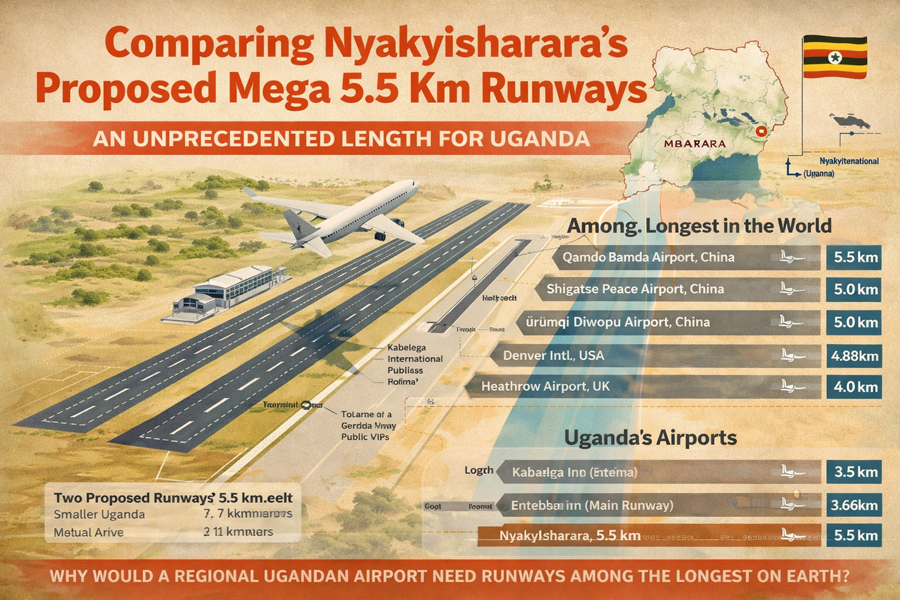
The most striking detail in the letter concerns the proposed runway lengths. The project envisions two runways measuring 5.5 kilometres, along with a reserve VIP runway measuring 3.7 kilometres. The entire development would cover 21 square kilometres.
The 5.5-kilometre runways would rank among the very longest in the world.
Qamdo Bamda Airport in China has a runway measuring 5.5 kilometres, while Shigatse Peace Airport and Ürümqi Diwopu Airport also have runways measuring approximately 5 kilometres.
Denver International Airport in the US operates a runway measuring approximately 4.88 kilometres, and Heathrow Airport in the UK operates runways measuring just under 4 kilometres.
Most major international hubs operate runways between 3 and 4 kilometres.
Aircraft such as the Airbus A380, Boeing 747-8, and Boeing 777-300ER typically require between 3 and 3.8 kilometres, depending on load and elevation.
Runways exceeding 5 kilometres are rare and are usually located at very high altitudes, where thinner air requires longer takeoff distances.
The proposed 5.5-kilometre runway would be dramatically longer than those at Uganda’s current main gateway, Entebbe International Airport.
 Crisis Beneath the Pumps: Kenya’s Unfolding Fuel Scandal and the Fall of Top Energy Chiefs - Why it Matters to Uganda
Entebbe’s primary runway measures approximately 3.66 kilometres, even after recent upgrades. That runway handles wide-body aircraft and long-haul intercontinental flights.
Kabalega International Airport in Hoima, developed to support the oil and gas sector and international traffic, has a runway measuring approximately 3.5 kilometres.
That design was considered sufficient to accommodate large commercial and cargo aircraft serving petroleum operations and international routes.
By comparison, Nyakyisharara’s proposed 5.5-kilometre runway would be nearly 1.84 kilometres longer than Entebbe’s and about 2.0 kilometres longer than Hoima’s.
In percentage terms, Nyakyisharara’s runways would be more than 50% than Entebbe’s primary runway.
Nyakyisharara sits at roughly 1.4 kilometres above sea level. While this elevation does require somewhat longer takeoff distances than airports at sea level, it does not approach the extreme altitudes of certain Asian plateau airports where 5-kilometre-plus runways are necessary.
Strategic vision or over-specification?
The President frames the airport as a response to shifting global trade patterns between Brazil and China, arguing that Uganda’s location offers a more rational mid-point refuelling hub.
However, aviation route planning is shaped by great-circle distances, fuel efficiency, bilateral air service agreements, passenger and cargo demand, and commercial viability.
It remains unclear whether airlines would choose southwestern Uganda as a preferred refuelling stop or whether projected traffic volumes justify the infrastructure of this magnitude.
Land and infrastructure impact
The project would occupy 21 square kilometres, utilising government aerodrome land and additional land to be purchased from surrounding owners.
The letter also indicates that the Ibanda–Mbarara public road would be shifted east of Nyakyisharara.
If constructed as proposed, Nyakyisharara would not only rival but surpass Uganda’s existing and emerging international airports in runway scale.
A 5.5-kilometre runway is not merely long; it is among the longest ever built globally. For Uganda, it would represent infrastructure significantly larger than both Entebbe and Hoima in runway ambition.
The central policy question is whether Uganda is positioning itself for a transformative aviation role in a reshaped global economy, or whether it risks constructing infrastructure that far exceeds foreseeable aviation demand.