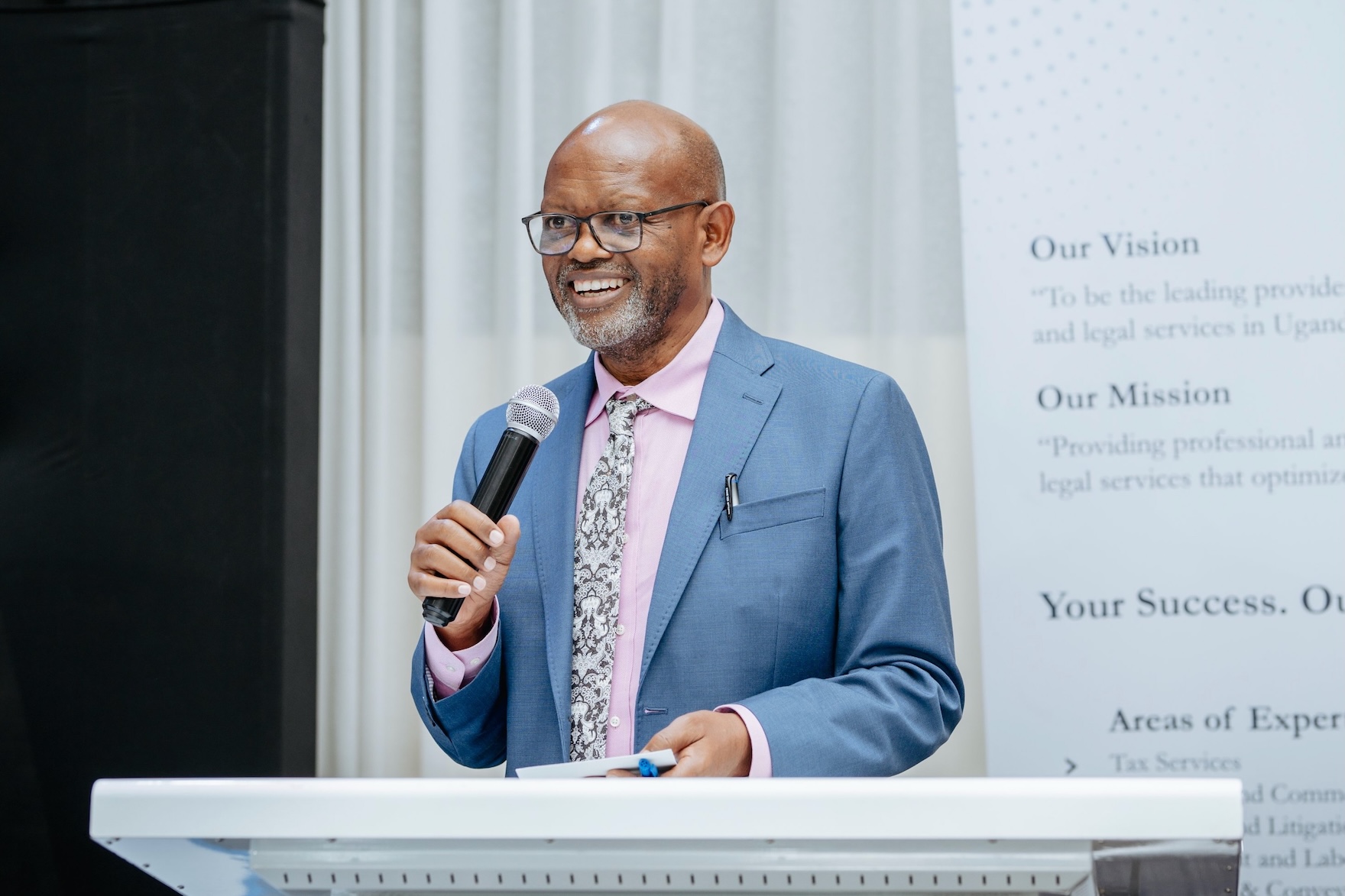
Tell us a bit about the firm, Birungyi, Barata & Advocates. To the lay person, it is a prominent tax law firm…
Well, we are a law firm, but we are also a tax consultancy firm. We have been around for about 22 years, and I am the Managing Partner. I co-founded the firm with my partner, Mr. Enoch Barata, and together we lead a team of 4 partners, other advocates, lawyers and other professionals. Tax is our primary area of practice, accounting for about 65% of what we do. We are also involved in commercial, land transactions, labour, and intellectual property law.
How has your background impacted who you are now? Can you tell us about your early childhood? Where were you born and raised? Some of our earliest memories growing up?
I was born in Kabale in 1961. I experienced bereavement at an early age. My father, AW Rugirehe, died in a mysterious fire when I was only three years old. My stepfather, Charles Kasaza, was disappeared in 1972 by men in Uniform. He was never traced. My mother, Evelyn, struggled greatly but did remarkably well raising us in the difficult Amin regime.
I attended Kigezi High School (a primary school) from 1967 to 1973. I later joined St Mary’s College, Kisubi, for my O-Level education and subsequently returned to Kigezi High School for my A-Levels. In 1980, I joined Makerere University, where the LLB course ran for three years. In 1984, while at the Law Development Centre, I got a job with the Ministry of Finance with the income tax department and consequently quit LDC. The Income Tax Department of the Ministry of Finance, Planning and Economic Development became part of the Uganda Revenue Authority, and I served there until 2003. Thereafter, I transitioned into private legal practice and established Birungyi Barata & Associates, where I have remained in practice ever since.
Were there strong influences from your parents or extended family regarding education or career aspirations?
No, I wouldn’t say that, having explained that my father died young. My mother was a teacher, and while she influenced me in other ways, this did not extend to my choice of career. I would have preferred to be a scientist, but I found the arts far less of a struggle. I ultimately chose law as it was the most respectable among the arts subjects.
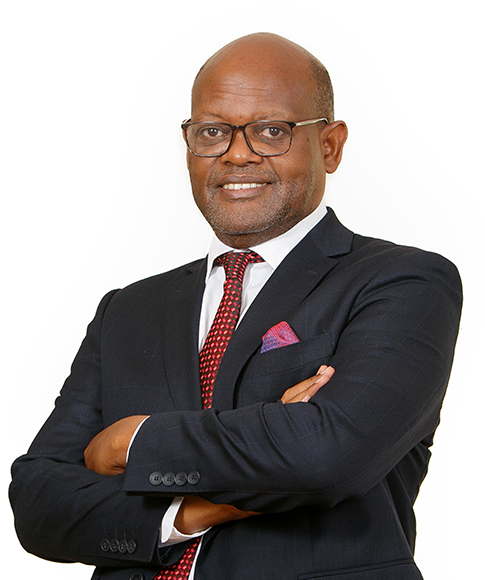
What is your personal specialisation?
My background is in tax, and as the Managing Partner of the firm, I have heavily influenced its direction in that regard. We have other experts whose strengths and qualifications ensure that the firm remains well-balanced and adequately diverse.
After university, and after law school, did you go for further education?
Yes, I did, post-graduate courses in law, tax administration, and management.
Tell us about the early days leading to setting up the firm.
In 1983, the Ministry advertised for positions, just as we were about to start LDC. We did the interviews and then joined LDC. While at LDC, there was a strike, and during the strike, the Ministry of Finance reminded me that I had passed Public Service interviews and had been offered employment. This was a fantastic opportunity, in 1984, an employer with the capacity to pay my salary on time, so I took it before completing LDC. I subsequently embarked on the income tax training at the Institute of Public Administration, now known as the Uganda Management Institute.
In 1989, the Ministry of Finance held another round of interviews, which I passed well enough to be promoted to Principal Assessor of Taxes and to head Masaka Tax District at a relatively young age. I later headed the Jinja tax district, rose to become an Assistant Commissioner and then Deputy Commissioner.
Some of my memorable achievements include playing a significant role in the drafting of the Income Tax Act, the VAT Act, the Tax Appeals Tribunal Act, as well as negotiating the Double Tax Treaties between Uganda and India, and Mauritius. At that stage, I felt a strong urge to be independent and practice tax law from the other side.
You did eventually get to finish LDC?
Yes. Later on, in my career, when I felt that I had done enough for URA, I had to return to LDC and finish what I had abandoned many years back.
What principles guided you as you put together the building blocks for the law firm?
To do my best. Just to do my best. I knew that technically I was as competent as anyone could be in tax, and that there were a lot of tax disputes. I knew that if I could put together a good team and handle my people well, it would flourish. There was a clear market demand, and I had the capacity and resources to meet it.
What key personnel were on board with the firm in the beginning?
When I was at LDC, I met my partner, Enoch Barata. When I later made the decision to start a firm, I had a discussion with him – he was practising at another law firm. We developed the framework, and we have remained together as partners since its inception.
How would you describe the practice of law in Uganda when you started, versus today?
The legal practice in Uganda is made up of a few big firms that can hold their own internationally, alongside many smaller practices, usually with no more than four advocates.
How does the legal sector compare to the global one?
Well, by ‘global’, I guess you mean the developed Western economies. Comparisons are rarely drawn between Uganda and Bolivia, Vietnam or Lesotho. We have been conditioned to take that question to mean the USA, the UK and other economies. Anyway, we do benchmark a lot against the OECD countries, and in that case, our practice is really small. In the developed West, a law firm with fewer than 50 partners is considered small. A firm with an annual turnover of less than 20m USD is very small. Using that analogy, I suspect all law firms in Uganda are small. But that is expected because, by world standards, Uganda is a small economy. It is admittedly a small pond, but we have some really big fish, and they seem to be flourishing.
Which brings me to the subject of case backlog in Uganda, and proposals on how this can be resolved.
Let’s assume, for argument’s sake, that the official backlog of around 16,000 cases at the High Court, Court of Appeal, and Supreme Court is accurate. Suppose we have 80 judges to resolve these cases within a year, and that each year brings in an additional 1,000 new cases. We also need to consider that, at the Court of Appeal and Supreme Court, most cases are heard by at least three judges.
Related
 High Court Allows Rocket Health Share Transfer Meeting to Proceed Without Dr. Davis Musinguzi
 If each case requires three physical appearances by the parties and takes roughly five days for a judge to deliver a decision, the math suggests that clearing the existing backlog would take at least 1,000 days, almost three years. This, essentially, is the challenge our judges and the system face.
How do we approach a solution? Consider an analogy with the medical profession. Uganda has about 5,000 practising doctors handling roughly 20,000 patients daily. The reason we cannot have 5,000 judges does not lie in a shortage of capable individuals. The problem lies in the pay and privileges currently accorded to judges. The government cannot afford to provide 5,000 judges with the same remuneration, benefits, four-wheel vehicles, and security entourages that judges currently receive. Nor can it provide doctors with similar privileges. The result is that the problem is largely ignored, punctuated only by occasional public grievances.
My proposal is simple: demystify the role of the judge. The system needs more judges, at least another 2,000, but this can only happen if judges are not treated as demi-gods. Even increasing the number of judges to 1,000 would not entirely eliminate the backlog, but it would provide much-needed flexibility in the system.
I must admit, I cannot foresee my proposal being implemented, nor can I imagine the backlog disappearing entirely. But it is a start in an achievable first step toward addressing a persistent and growing problem.
(Laughing) It is a novel and practical solution.
What are your views on governance and regulatory frameworks in Uganda? How do you think we can improve them?
I think there are many things we need to reform in the legal framework. We need to have practical and simple solutions for simple disputes and administration. We should shift from the system that was steeped in complicated language, strange attire, intimidating judges, rituals, decorum and snobbery.
Our governance and regulatory frameworks should be practical and applicable.
From the system of having a Law development Centre in the current state, to the process of enrolling lawyers so as to allow them to practice as advocates and renewing practising certificates on an annual basis, to everyday procedures such as bail applications and the antiquated processes for registering trusts, urgent reforms are needed across the system.
What is the role of lawyers in public service beyond litigation and transactions?
Lawyers are required to provide pro bono services, which is rather contradictory, because if it is compulsory, then it cannot be pro bono. However, as human beings, after some level of affluence, people are expected to give back to society. Some do so and seek recognition in return, and some do it quietly. So, it is not so much a lawyer thing as it is a human thing.
Are there particular landmark cases or transactions you look back on with pride?
I would not want to single out any individual case; we have handled cases that have impacted and changed the law in favor of taxpayers. For example, there was the issue of double taxation under domestic VAT, which affected domestic importers who were effectively paying VAT twice. We successfully challenged this, and the practice was corrected.
Overall, we have contributed to more than 200 decisions that have benefited various clients in litigation, thereby adding significantly to the body of tax jurisprudence in this country.
For you personally, what defines success at this stage of your life?
I think in my view, one of the things I can say that since this law firm started 22 years ago, there is not a single month where we did not pay staff on time the amount contracted for. There is no month we did not pay our taxes on time. That seems like a low threshold but it does not come easy.
You seem very energized and passionate. What inspires you in the morning, gets you out of bed to face a working week?
There’s always room to do better. Whatever you have done is behind you. I participate actively in the International Bar Association, where you meet people from law firms managing funds upwards of 5 billion dollars. They are humble people, they work diligently, and deliver– when you look at them, you realise that there is nothing to keep you in bed. There are still further heights to reach.
How do you maintain work-life balance in such a demanding profession?
My work–life balance is simple. It has transitioned over the years. There were times for social causes, but right now I am in that sphere of life where I value more time alone – reflection and reading, more time alone. I have put the golf course behind me.
What advice would you offer to a young law student today who dreams of becoming a great corporate lawyer?
I don’t agree with many who say that the new batch of lawyers is ‘not good enough’. I have come across many young lawyers who are doing well. They will become very good corporate lawyers, not necessarily by learning from us, the older generation. It is true that without the manual typewriter we may not have developed to the smartphone but it is also true that the developer of the smartphone did not have to learn how to use Kodak camera. The new generation of lawyers will do best when it looks forward and not backwards.
Finally, what message do you have for Uganda’s business community about the importance of sound legal practice and governance in national development?
My message to the business community is that they need to ensure that they seek sound professional advice from experts in law, accounting, insurance and tax and learn to pay for it.