In the last 35 years, Uganda’s economy has been growing at the rate of 6.2% per annum. It now stands at US$40.5 billion if you use the exchange rate method and US$116 billion, if you use the PPP method.
With the activation of the oil sector, which has been dormant since 2006 when we discovered the petroleum and if you add the expected average growth rate of 6% per annum post covid-19, the combination will expand the economy to an estimated US$67 billion by 2026 using the exchange rate method and US$193 billion, using the PPP method; meaning that the economy will be growing at the rate of between 9-10% in the initial years of oil production.
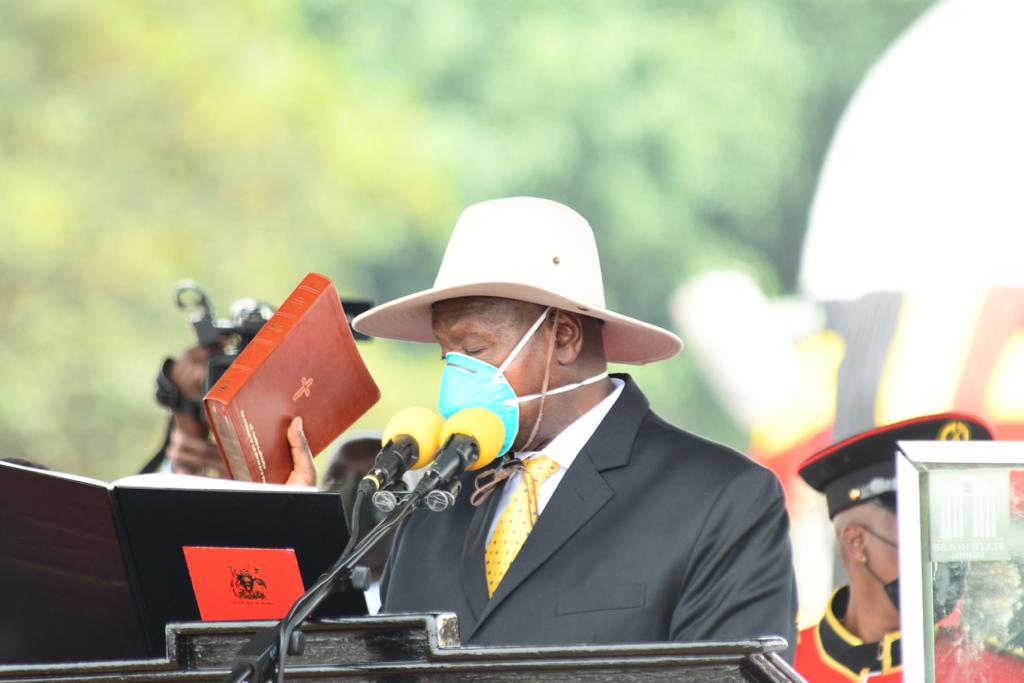
In his acceptance speech yesterday, newly sworn-in Ugandan President, Yoweri Kaguta Museveni said this rate of growth, although reasonable, is not what he wants.
“With the rise of the literacy rate from 43% in 1986 to now 76.53%, we can achieve much-faster rates of growth and I will see to that. We have achieved rapid rates of growth in some sectors. These isolated positive rapid rates of growth can be generalized throughout the whole economy,” he said.
The president said that the NRM has been able to wake up sections of the population of Uganda. Reminding Ugandans that in 1986, Uganda was a land of shortages ─ no sugar, no soap, no paraffin, no textiles, no sodas, no salt, no beer, no petrol, etc.
“With the limited waking up of some sections of the population, Uganda now is a country of surpluses: maize, where we produce 5 million tonnes per year, but consume only 1 million tonnes within Uganda; milk where we produce 2.6 billion liters, but consume only 800 million litres; bananas; beef; sugar where we produce 600,000 tonnes but consume only 380,000 tonnes; cement; steel bars (mitayiimbwa); tyres and tubes for motorcycles; textiles; ceramic tiles; coffee – 7million bags; tea – 60million kgs,” he stated.
In order, to solve the problem of the new happy phenomenon of surpluses in Uganda, the President said “we need to deal, along with our brothers and sisters in Africa, with 3 issues: regional and continental integration to unite the regional and continental markets to support production of goods and services better; higher purchasing power in Uganda so that the Ugandans can buy more; and good quality products at comparative costs that can be accepted in national, regional, continental and international markets.”
 OPINION: 623 Cases, UGX 2 Trillion at Stake: Why Uganda Must Rethink How Banking Disputes Are Resolved
He also said that, in order to intensify the struggle for social-economic transformation, Uganda shall aggressively and without compromise, deal with some obstacles.
“There was some resistance by some parasite groups to our policies of creating and properly using the wealth funds (OWC, Youth, Women, Emyooga, etc.); implementing free education in Government Primary and Secondary Schools; providing free vaccines and therapeutic drugs in Government health centres,” he stated.
adding that; “protecting bibanja (tenants) owners on the iniquitous mailo land system; ensuring that the feeder roads are in good condition following the provision of good road equipment to all the districts; fighting corruption of Government officials including magistrates and the Policemen; and dealing decisively with the cattle thieves and those who steal crops from the gardens.”
He stated that the wealth funds will be concentrated at the Parish (Muruka), in the Parish Model, except for the myooga (specializations) funds that will remain at the constituency.
The President-elect also said that with free education, after due considerations, there will be no head-teacher, that will be tolerated if he/she re-imposes school charges. Dealing with corruption and stealing drugs, part of the solution, will be e-Government. All Government transactions will be computer-based; no more human to human contact. This will be easier to monitor even for remote supervisions.