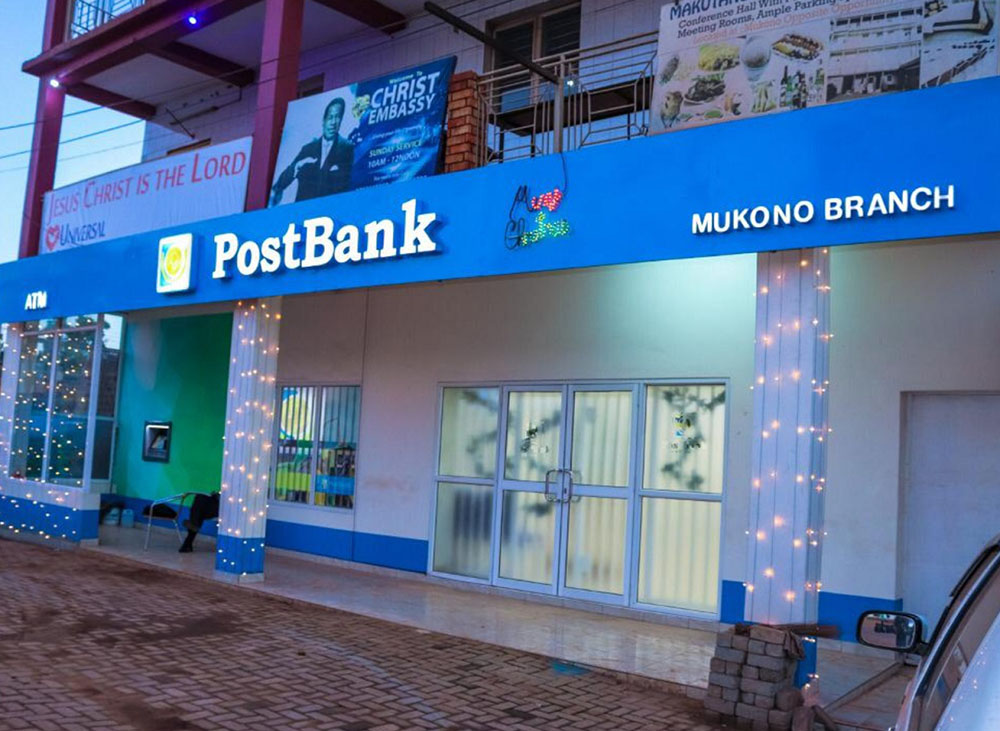
PostBank Uganda’s bid to become a tier-one bank got another boost, following an above-industry 2020 growth.
Results published last week show, PostBank, the 100% government-owned financial institution, crossed the UGX500 billion assets rubicon, reaching UGX675 billion— a 38% increase, from the UGX490.6 billion registered in 2019.
At UGX675 billion, PostBank, although a tier-two institution is already larger than nearly half of all tier-one commercial banks in the country.
This unprecedented growth, in what has been the toughest year in Uganda’s recent banking history, was majorly driven by a 25% increase in lending- from UGX 267.1 billion to UGX335 billion- a growth of UGX67.6 billion. The bank also increased its placements with other banking institutions- from UGX113.9 billion to UGX180.4 billion.
As a result, interest income on the deposits and placements with other banks went up by 79%, from UGX5.8 billion to UGX10.4 billion. Interest earnings on customer lending went up 7% from UGX72.2 billion to UGX77.4 billion. Significant improvement in these two major revenue lines, led total income to grow by over UGX10 billion, from UGX109.6 billion in 2019 to UGX119.5 billion- a 9% increment.
Buttressing this assets and income growth is equally a healthy growth in deposits—by 29% from UGX347.6 billion to UGX449 billion.
Although on the whole, total costs went up by UGX7.4 billion, from UGX97 billion to UGX104.3 billion, PostBank kept a tight leash on operating and personnel costs, which, combined, forms 70% of the entire cost base.
Operating expenses largely remained the same- UGX31.6 billion in 2020 versus UGX31.5 billion while personnel costs went down from UGX42.5 billion to UGX41.8 billion – a reduction of over UGX750 million. This is despite opening 4 new branches in 2020 as well as external recruitments of several middle and senior managers and investing in a number of technology platforms.

The rise in expenses was almost single-handedly occasioned by an unavoidable rise in interest expenses for deposits and other borrowings, which grew by 52% from UGX12 billion to UGX18.3 billion as the bank picked up more deposits from the market. The bank also had to provision for bad debts, to give Covid-19 hit customers some breathing space. As a result impairment charges went up by 253% from UGX1.8 billion to UGX6.3 billion.
A delicate balance between costs and income subsequently saw a 20.2% rise in profits from UGX8.4 billion in 2019 to UGX10.1 billion.
The bank also remains adequately capitalised, well within the Bank of Uganda’s new regulatory requirements.
In the face of Covid-19, the Bank of Uganda in December 2020 instituted new regulatory buffers, in what the central bank said was to enhance the resilience to shocks. In the regulations, core capital to risk-weighted assets was increased from 10% to 12.5% while total capital to risk-weighted assets was increased to 14.5% from 12%.
PostBank’s core capital to risk-weighted assets and total capital to risk-weighted assets stood at 21% and 22% respectively.
Commenting about the results, Julius Kakeeto, the Bank’s Managing Director said that most of the growth was driven by “improvement in customer service, the efficiency of operations and the roll-out of alternate delivery channels.”
He also said that the sturdy 2020 growth in most of the key parameters, further emboldened the bank’s commitment to “continue its support to the Micro, Small and Medium Enterprises (MSME) and the agriculture sector of the economy which are vital to economically transforming lives and livelihoods of Ugandans but are largely “financially excluded by the commercial-driven private sector players.”
Towards being a tier-one bank
Related
 MTN vs Airtel: Balance Sheet Strength Meets Earnings Momentum in the Race to Win the Telecom Market
The 2020 results are Julius Kakeeto’s first full-year results since he joined the bank in October 2019 and has since set upon a journey to restructure the bank.
PostBank is 100% owned by the Government of Uganda. The bank currently has 55 Points of Reference (PORs), composed of 43 branches, 6 mini-branches and 6 contact centres. These are complemented by 14 mobile banking vans and 60 ATMs, serving almost 1 million customers, of whom 57,000 are active borrowers.
9,400 of these borrowers are in the agriculture sector, making the bank the largest lender (by the number of borrowers) to agriculture.
Over the last year, Kakeeto has led the bank through a restructuring exercise that has seen the bank restructure its entire organizational structure, dropping some roles, merging others and creating new ones altogether.
In a recent interview with CEO East Africa magazine, Julius Kakeeto said that the tier two financial institution had attracted “a lot of seasoned and experienced people.”
“If you look at the profile of our senior management team, it is as good as most commercial banks. It is a very capable and competitive team,” he said.
Over and above himself, six (6) other Exco members, were also hired from other tier-one banks.
They include Andrew Kabeera who joined the bank in July 2020 as the new Executive Director and Chief Operating Officer. He was tapped from dfcu Bank, where he was the Chief Operating Officer and Chief Change and Innovation Officer.
Martin Mugisha, the new Chief Credit Officer joined the bank in January 2021 from Ecobank Uganda where he was the Head of Credit Risk since February 2014. Peter Ssenyange, the new Chief Finance Officer, was until June 2020, the CFO for United Bank for Africa for 4 years while Andrew Agaba joined PostBank in April 2020 as the Chief Business Officer from Housing Finance Bank, where he worked as Head of Mortgage and Personal Banking.
But PostBank also retained some good old hands especially in talent management and legal – however, they too, had to defend their roles against tough internal and external competition.
Judy Namanda Kikonyogo was promoted from the Head HR to Chief HR & Admin Officer while Justine Tumuheki Wabwire, a seasoned lawyer with over 20 years experience in legal, regulatory, and corporate governance; 10 of those at PostBank, was promoted from Company Secretary to become the Chief Legal Officer and Company Secretary.
Kakeeto also said the bank had revamped most of its distribution channels such as payment cards, SMS banking and internet banking and had as a result reduced over the counter transactions to 60% from 90% a year ago. To serve the corporate and upmarket segment, the bank in April this year also opened a branch at Forest Mall. Within the Forest Mall branch, there is a Summit Banking suite for high-net-worth individuals.
He said that all these changes are aimed at creating more efficiency for the business and more convenience for the customer.
“The bank has made significant growth. If you look at our balance sheet growth in 2020, with this new momentum, new energy- we have grown faster than the three preceding years in aggregate. Our deposits and loans growth is equal to or more than what we grew, between 2017 to 2019,” he told this writer then.
“This gives us a solid foundation to build on and take the bank to the next level. Our transformation journey is just starting,” said Kakeeto, adding: “The changes and growth have been quite fast-paced.