
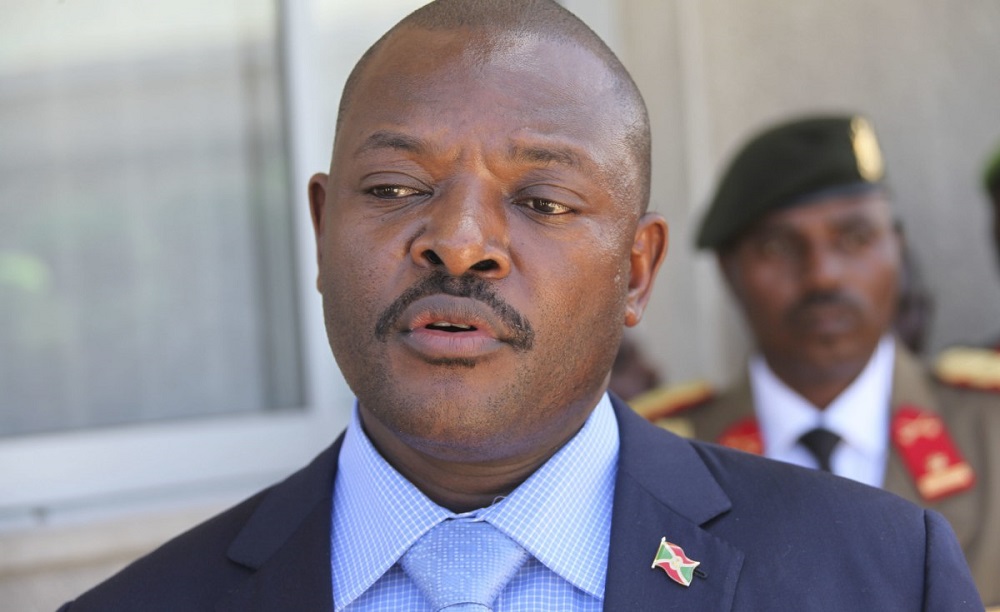
Burundi’s President Pierre Nkurunziza, has died, the Burundi government has confirmed. He has succumbed to a heart attack. He was aged 55.
He dies a few days after, the 20th May 2020 general elections that elected General Evariste Ndayishimiye of the ruling CNDD–FDD as president with 71% of the vote. In the National Assembly elections, the CNDD–FDD won 72 of the 100 elected seats.
Just last week, the Burundian constitutional court on upheld the presidential election of retired general Evariste Ndayishimiye which have been challenged by Agathon Rwasa, an opposition politician.
Nkurunziza was due to step down on August 20 when Ndayishimiye will begin his seven-year term on August 20.
He has been in power in Burundi since 2005. Before being elected into power, he was the Chairman of the National Council for the Defense of Democracy-Forces for the Defense of Democracy (CNDD-FDD), the ruling party, until he was elected as President of Burundi.
The life and times of Pierre Nkurunziza
Pierre Nkurunziza born 18 December 1963. He was raised in the province of Ngozi in northern Burundi. His father, Eustache Ngabisha, was a Catholic Hutu connected with the royal family. His mother was a Protestant Tutsi assistant nurse. Ngabisha was enlisted to the ranks of the pro-independence UPRONA party and elected to the Parliament of Burundi in 1965, later becoming governor of two provinces before being killed in 1972 during the Burundian Genocide of 1972 when ethnic violence claimed the lives of between 80,000 and 210,000 Burundians.
Nkurunziza attended primary school in Ngozi and pursued secondary education at Athénée in Gitega. He later attended the Institut d’Education Physique et des Sports (IEPS) at the University of Burundi in the late 1980s and graduated in 1990 after obtaining his degree in sports education. Before the civil war broke out, he became a sports professor at Lycée de Muramvya in 1991 while still studying psychology and pedagogy. Nkurunziza became a teacher and assistant lecturer at the University of Burundi in 1992. He also began to teach courses at the Institut Supérieur Des Cadres Militaires (ISCAM).
In 1995, he was threatened and joined the CNDD-FDD when hundreds of Hutu students were killed or forced to flee. After rising through the ranks, Nkurunziza was appointed deputy secretary-general of the CNDD-FDD in 1998. In the late 1990s, he was condemned to death by court and trial in absentia. In 2001, he was elected chairman. There was a split in the group in late 2001. He was re-elected chairman in August 2004.
During the Burundian Civil War, Nkurunziza is said to have survived a near death experience. He was wounded several times in the war and was given the nickname “Pita”. Beginning in late 2003 and after the ceasefire agreement, he was appointed Minister for Good Governance in the transitional government of President Domitien Ndayizeye.
Following a series of CNDD-FDD victories in elections held during June and July 2005, Nkurunziza was nominated as the party’s presidential candidate. He was elected president by members of parliament (acting as an electoral college) with a vote of 151 to 162 on 19 August 2005 and took office on 26 August 2005.
He was re-elected in 2010 with more than 91% of the vote amidst an opposition boycott and sworn in for his second term on August 26, 2010.
In 2015, Nkurunziza was controversially nominated by his party for a third term in office. Supporters and opponents of Nkurunziza disagreed as to whether it was legal for him to run again, and protests followed. More than two months of anti-Nkurunziza protests, which were often violently repressed, left at least 100 dead. On 13 May 2015, a coup attempt against Nkurunziza occurred while he was out of the country; the coup leader, Godefroid Niyombare, claimed to have ousted Nkurunziza, but Nkurunziza loyalists disputed the claim. Facing resistance from Nkurunziza loyalists, the coup collapsed and forces loyal to Nkurunziza appeared to be back in full control by 15 May. Independent media was shut down and many opponents fled, joining an exodus of more than 400,000 Burundians.
 Strong Vote of Confidence: Mbire Reappointed MTN Uganda Chairman
Amidst an opposition boycott, Nkurunziza was reelected to a third term in the July 2015 presidential election. On 7 June 2018, Nkurunziza announced that he would not seek another term when his current term ends in 2020.
In March 2014, Nkurunziza banned jogging, due to “fears it was being used as a cover for subversion.” According to the BBC, “The tradition of Saturday morning runs started during Burundi’s long years of ethnic conflict”, as residents in the city of Bujumbura, where the surrounding hills were home to armed militants before 2005, “would try to vent their fear and frustration and claustrophobia, by running, often in a group.” The same month, 21 supporters of the opposition Movement for Solidarity and Democracy (MSD) Party were sentenced to life in prison for using “jogging” as a way to organize “an illegal demonstration that turned violent.”
In April 2015 Nkurunziza announced that he would seek a third term in office. The opposition said that Nkurunziza’s bid to extend his term was in defiance of the constitution, as it bars the president from running for a third term. Nkurunziza’s allies said his first term did not count as he was elected by parliament, not directly by the people. On April 26 police clashed with demonstrators protesting Nkurunziza’s announcement that he would seek a third term. At least six people were killed in the first two days of protests. The government shut down multiple radio stations and arrested a prominent civil society leader, Pierre-Claver Mbonimpa. UN General Secretary Ban Ki-moon said in a statement that he had despatched his special envoy for the region, Said Djinnit, to Burundi for talks with Nkurunziza. African Union commission head Nkosazana Dlamini-Zuma said she welcomed a decision by Burundi’s Senate to ask the Constitutional Court to rule whether Nkurunziza could stand for reelection. More than 24,000 people fled Burundi in April, as tensions mounted ahead of presidential elections in June, the UN refugee agency said.
On May 13, 2015, Burundi Army General Godefroid Niyombareh declared a coup via radio while Nkurunziza was abroad attending a summit in Tanzania with other African leaders. Niyombareh had been dismissed from his post as head of intelligence in February 2015. Despite reports that gunshots had been heard and people were celebrating in the streets of the capital, government officials dismissed the threat and claimed to remain in control. Nkurunziza tried to return to Burundi promptly, but was unable to land at the Bujumbura airport because it had been taken over by rebel soldiers. Nevertheless, loyalist forces managed to retain control of the state radio and television broadcaster, the key means of communicating with the broader population, fending off attacks by rebel soldiers on 14 May. Later the same day, Nkurunziza announced that he had returned to Burundi, although his specific location was not given for security reasons. He congratulated “the army and the police for their patriotism” and “above all the Burundian people for their patience”.
The controversial presidential elections were held on 21 July 2015. The electoral commission under pressure announced on 24 July 2015 that Nkurunziza had won the election with 69.41% of the vote with low voter turnout, the participation rate under 30%. Agathon Rwasa placed second and credited with 18.99% despite calling for a boycott.
Nkurunziza was sworn in for his third term on 20 August 2015. Speaking on the occasion, he described his re-election as “a victory of all Burundians”. He vowed that if his enemies continued to pursue violence, they would be beaten with the aid of God and “scattered like flour thrown into the air”. By December 2015 over 300 people had been killed; about 215,000 others had fled the country.
2018 constitutional referendum
In March 2018, Nkurunziza was named “eternal supreme guide” by the ruling party, CNDD-FDD, in the run-up to a constitutional referendum on 17 May that year. The referendum’s proposed constitutional changes would allow Nkurunziza to stay in office until 2034. The referendum was widely criticized by Burundi’s opposition, the UK, the United States and Catholic bishops. On 21 May the new constitution was approved, allowing Nkurunziza to extend his term limits starting in 2020. On 7 June 2018, Nkurunziza announced that he will step down after the 2020 elections.
Nkurunzia: Hero or villain?
Nkurunziza was one of seven siblings. Two of his siblings were killed after civil war erupted in 1993, and three others died while fighting in the CNDD-FDD. Only one of his siblings, a sister, is alive today. He married his wife in 1994 and is the father of two sons. Nkurunziza described himself as a born again Christian, though his rule has involved severely restricting religious freedoms for evangelical Christians and other groups.
Nkurunziza enjoyed playing football and cycling. He began playing football at the age of five, and played in a team at secondary school and his university. As a University Physical Education teacher, Nkurunziza used his football talents as a coach of “Union Sporting”, a first division club side. As President, he has re-called some of his former players to form a new team of veterans, “Helleluia FC”. In 2004, when he was a State Minister, Nkurunziza created a “Soccer Academy” which is home to nearly 300 kids learning skills in various training centres across the country. Nkurunziza has his own football team, Haleluya FC, which he has traveled Burundi with.
In May 2015, Africa Confidential reported that Nkurunziza was said to be preoccupied by his football club, had difficulty concentrating for long periods, and believed that he was chosen by God to rule Burundi. In the national press, his mental health is publicly questioned. Nkurunziza has been accused of persistent extrajudicial executions, arbitrary arrests and detentions, enforced disappearances, torture and cruel, inhuman or degrading treatment and sexual violence in Burundi since April 2015 by the Imbonerakure.
In September 2019, a UN committee concluded that President Pierre Nkurunziza is personally accountable for serious violations.