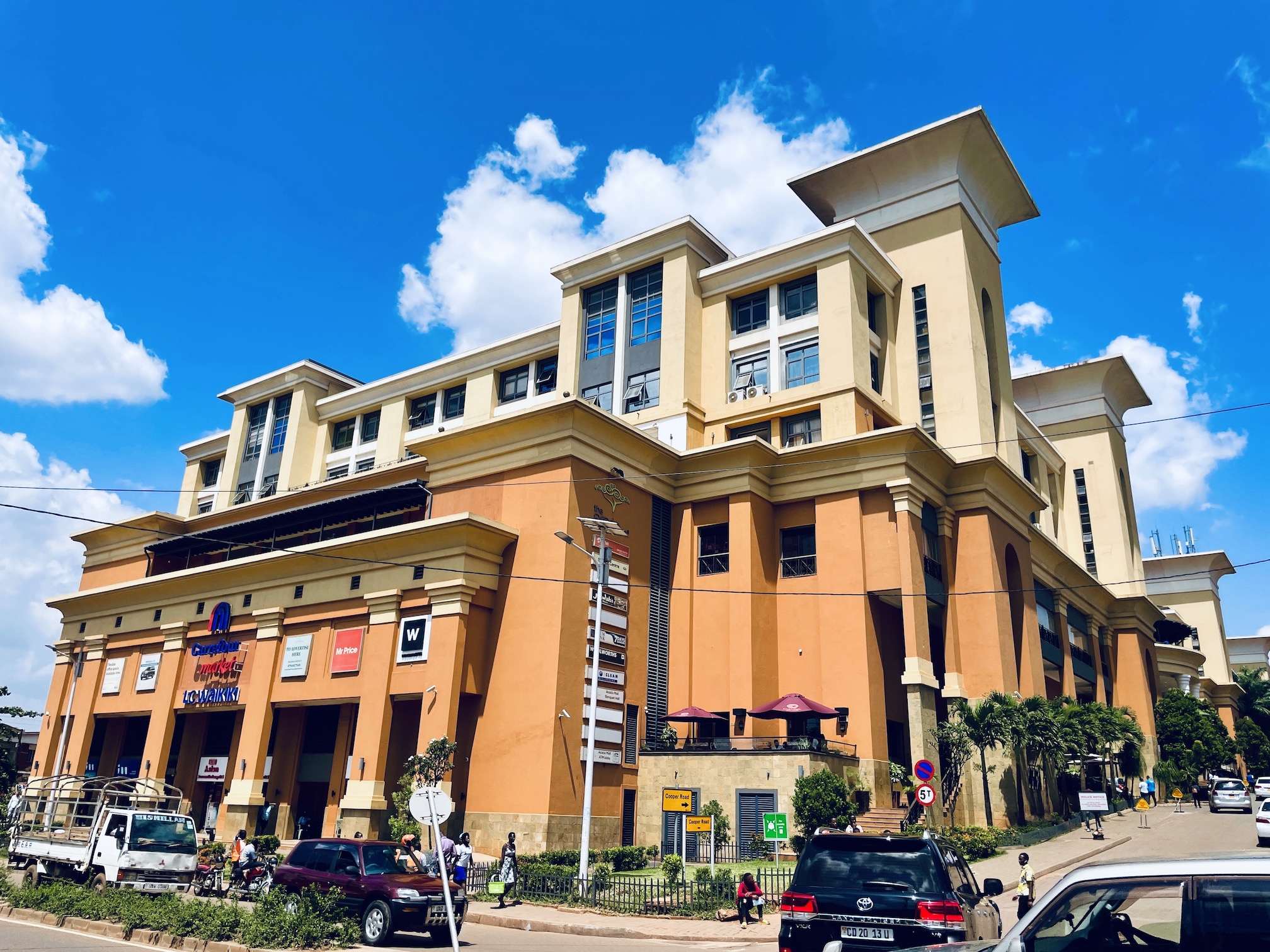
Acacia Mall one of Uganda’s prestigious and much sought-after malls has been sold. Alykhan Karmali’s Gulfstream Investments (U) Ltd, an investment vehicle through which he owned property, according to very knowledgeable sources, a while ago sold all its interests in Acacia Mall to Lexington Properties and is reportedly focusing on investing in the more lucrative and investor-friendly Dubai real estate market.
Lexington Properties is a subsidiary company of the Sarrai Group- a conglomerate of diverse inter-related agro-manufacturing, cement, and foam mattresses as well as properties across East and Southern Africa.
According to industry sources, Alykhan Karmali didn’t necessarily sell for lack of tenants. At the time he sold, Acacia Mall’s occupancy levels were at about 90%.
And he is not the only real estate investor divesting their interests. Industry sources also intimated to CEO East Africa Magazine that other big-time investors in commercial real estate, such as DG Properties, a subsidiary of Indian billionaire businessman, Hasmukh Dawda of the House of Dawda Group and Property Services Limited of billionaire businessman, Pradip Karia are quitting town for Dubai, Nairobi and other markets- “slowly but surely”.
Industry experts that CEO East Africa Magazine spoke to, boiled down the problem to declining profit margins, caused by a tough macroeconomic environment, Covid-19 compounded by an unfriendly regulatory and tax environment, which “make it difficult to meaningfully and sustainably invest in Ugandan real estate”.
“The Covid-19 pandemic, multiple changes in the tax laws, the uncertainties surrounding Uganda’s land tenure system and the related land grab epidemic, especially in rural areas of the central region of Uganda have had a number of real estate investors start to reconsider whether it is worthwhile to leave all their eggs in one basket (Uganda). There have been reports of investors delaying investment, abandoning projects and altogether pulling out of the Ugandan real estate market and trying their luck elsewhere,” says Mugisha Linda Mbabazize, a tax, land transactions and commercial lawyer with Birungyi Barata & Associates.
Birungyi Barata & Associates is one of Uganda’s leading tax law firms. The firm also offers investment as well as real estate advisory services among other corporate and commercial legal services.
Ms. Mbabazize adds that Uganda is already disadvantaged with low stability of the economy, limited access to capital, high-interest rates, and low purchasing power, all of which lead to low effective demand and subsequently lower rental yield for investors and therefore any other regulatory and public policy bottlenecks make an already bad situation worse.
“Consequently, an investor obtains a lower rental yield owing to the low effective demand coupled with high default rates by tenants. As such, investors are attracted to economies such as UAE, South Africa and Kenya where they are guaranteed higher returns and security on their investments, which may explain why some investors are running away to these markets,” she says.
She adds that demand-side constraints aside, on the supply side, “risks associated with land acquisition in Uganda” such as protracted legal battles fought in a bid to resolve endless land wrangles, are creating uncertainty amongst investors and prolonging the time needed to complete projects.
Investor money follows friendly laws, policies and processes
The just-released Knight Frank Uganda H2 2022 Kampala Market Performance Review report for example noted that the pace of real estate construction in Kampala had slowed down, due to what it said were “supply bottlenecks”, resulting in longer than anticipated construction periods. The report noted that project construction periods, which typically averaged two years in 2019, presently averaged between three to four years.

“The demand problem in Uganda is demonstrated by lack of effective demand while the supply problem is illustrated by the risks associated with the acquisition of property and both of these fall within the domain of government policy,” she says.
“Government policy includes the laws, regulations and policies of a country and it follows that investors will be attracted to countries that have investor-friendly laws, policies and processes, especially regarding taxation and immigration,” explains Mbabazize.
She, for example, says that Uganda and Kenya have similar tax and fiscal incentives such as wear and tear incentives, and industrial building deductions e.g., 10% for hotels and 25% for residential buildings in planned developed areas; and investors in both countries must pay income tax, rental tax, corporate tax, capital gains tax and VAT depending on the development, the UAE had a much more generous tax regime.
“In contrast, an investor in the UAE is currently not required to pay income, rental or capital gains tax. Additionally, UAE has also made amendments to their immigration laws, which enable foreigners that acquire property to obtain long-term visas and this has attracted foreign investment. The more favourable laws and policies in the other economies are prompting investors with the capital to leave the Ugandan real estate market for greener pastures. The high returns and security of investment, the ease of doing business and the better tax and economic policies in these countries especially in the UAE surpass Uganda’s advantage of a cheaper cost of construction and acquisition of real property,” she said.
“In conclusion, investors in real estate are reconsidering Uganda as an investment destination because the poor state of its economy is aggravated by high-interest rates, worsening inflation, and the low purchasing power of its population. Government policies such as tax incentives and allocation of land for investment are not adequate to attract investors because they are undermined by poor policy implementation and ethical issues such as corruption,” adds Mbabazize.
Need for responsive, proactive, objective, practical and considerate policy implementation
Judy Rugasira, the Managing Director of Knight Frank Uganda, the leading property advisory and management firm agrees with Mbabazize on the need for Uganda to “seriously rethink” its policy and regulatory environment as well as tax regime, to make it investor friendly.
 Stanbic Accelerates Uganda’s Digital Future with “Kikole Ku Speedii” Campaign
“There are a number of things that they are not really thinking through. If they did, it would make our lives easier and make the lives of the real estate sector easier, because, on one hand, the government is trying to grow tax revenue and on the other hand, they’re frustrating the people that would be the taxpayers, and in the end, frustrating the sector as a whole,” she told media breakfast to release the Knight Frank Uganda H2 2022 Kampala Market Performance Review report.

She for example said that on the issue of rental income tax and the allowable expenses, it would be very helpfully practical to consider interest rates, as an allowable expense under finance costs.
“In a market already suffering from high-interest rates and a sector with one of the highest Non-Performing Loans, I think it will make a huge difference to property investments. When prospective and existing investors do the maths, it is beginning to become debatable as to whether investing in Uganda is really a good investment to be getting involved in right now, given all these issues and the taxation regimes that are being levied on real estate,” she said.
The Knight Frank report noted that the industry was still resiliently beginning to recover from the effects of the Covid-19 pandemic but was yet to restore to full pre-pandemic levels.
In the report released on January 13th 2023, covering the six months to December 2022, Knight Frank, observed that “2022 was a year of resilience, circumspection, and optimism” and that despite slow economic recovery dogged by local and international challenges, such as inflation, the Ukraine war and lag effects of Covid-19, there was some remarkable rebound in the real estate sector.
“Across the different real estate sub-sectors, the post-pandemic recovery was optimistic, with demand and supply indicators pointing to positive growth on a year-on-year comparison,” the report said.
“Everybody in the sector- developers, tenants and their customers- is trying to readjust to the new realities. What the sector needs is not only investor-friendly policies on paper, but we also need responsive, proactive, objective, practical and considerate officers on the ground implementing these policies,” she said.
Citing an example of the Uganda National Bureau of Standards (UNBS), Judy says the agency is too fraught with frustrating red tape, that is slowing down prospective tenants and in turn affecting the real estate sector.
“If customers or tenants of real estate developers can’t do business smoothly, by extension the owners of the building too are hurt. If retailer X wants to roll out 4-5 outlets in a year, in 5 malls and they are being frustrated by UNBS or any other regulatory agency and they can’t get their goods onto the shelves in time, that increases startup losses, slows down expansion speed, reduces occupancy revels, slows down jobs creation and by extension reduces tax revenue. It also eventually kills the reputation of Uganda as an investment destination, especially at a time when global investors are too cautious on venturing out to the developing world,” she says.
She gives an example of where UNBS of putting excessive-quality testing requirements on goods that are sold the world over and have passed other internationally accepted quality standards such as the Conformité Européenne (CE) certification is a regulatory standard that verifies certain products are safe for sale and use in the European Economic Area (EEA) as well as the South African National Standards (SANS).
“UNBS insists on independent laboratory tests to meet UNBS’ own standards. Internal control procedures such as ISO Accreditation are also not accepted. This is duplicating costs for importers and creating time delays and incurring storage costs offshore whilst waiting for testing and accreditation to ship the product. Moreover, UNBS does not have most of the testing facilities locally so importers are required to do tests offshore- usually in Dubai or South Africa and it doesn’t cost less than USD10,000 per container. Why can’t such not be done in Uganda and Uganda earn the revenue?,” she wonders.
“Even if you 10 containers of the same goods, e.g shirts by the same maker and of the same colour, UNBS requires you to test each container. Why?,” she narrates the importers’ ordeals.
In one case, one manufacturer of an internationally reputable shoe brand, sold in in over 100 countries turning over USD2 billion dollars in trade was frustrated out of the country, affecting their investment and job creation.
Judy, wonders why laboratory testing of a sample product from each container is required, irrespective of the product being the same product from the same source of origin and having been tested and approved under other internationally accepted quality standards.
In another case, an international hotel brand had its branded soap, which is used and accepted in over 4,000 hotels worldwide rejected by UNBS.
“How is this possible? What is so unique about our standards, if this is not merely frustrating investors, probably for other hidden motives?”
“The frustrations for retailers are becoming difficult to stomach and a lot of them are deciding that it is too much trouble to do business in Uganda. They are choosing other countries where the ease of doing business is much better. If such challenges could be eased, I am sure we would see more retailers getting into the country,” she concludes.