The pre-Covid19 lockdown news that Hassan Basajjabalaba, the former chairman of ruling party NRM Entrepreneurs’ League and frontman for a string of briefcase companies, has been ordered by court to refund hundreds of billions of shillings which he was paid as ‘compensation by government’ was not only profoundly disappointing but also sadly predictable.
It depicts the failure of our judiciary, civil society and the media to maintain alertness, honesty, and impartiality in the fight against grand corruption.
There is so much wrong with the verdict of the constitutional court delivered on 24th March 2020 that it is hard to know where to start.
But since CEO East Africa is a business news site, I gather its readers are probably more interested in ‘following the money’ than grappling with the nuances of constitutional interpretation. Hence let’s follow the money.
Basajjabalaba and his shady portfolio of briefcase companies – Haba Group (U) Ltd, Victoria International Trading Co Ltd, Sheila Investments Ltd, Yudaya International Ltd, and First Merchant International Trading Co Ltd – were not paid any money at all as ‘compensation by government’.
Between 2010 and 2011, Basajjabalaba pushed hard for his ‘Haba Group of Companies’ to be paid nearly UGX 170 billion as ‘compensation by government’ after the salutary cancellation of the group’s ‘bogus’ tenders awarded by the defunct Kampala City Council to develop and manage four city markets and the Constitution Square.
He lobbied State House, forged a court order, and incentivized many friends in high places to push a supplementary budget quickly through parliament on his behalf, but at every turn, the rapacious businessman failed to reach the national treasury counter.
Many patriotic citizens and public servants, including former Attorney General Peter Nyombi (RIP), former URA Commissioner General Allen Kagina, former High Court Registrar John Eudes Keitirima, Auditor General Paul Muwanga, and Ministry of Finance Permanent Secretary and Secretary to the Treasury Keith Muhakanizi, steadfastly blew the whistle on Basajjabalaba’s shenanigans. They refused to capitulate to his crooked charms and wicked threats.
Their joint efforts in blocking Basajjabalaba & Company from accessing public funds are gratefully acknowledged on page 68 of Justice Kenneth Kakuru’s seminal judgment as follows: ‘Once again the conspirators got stuck. They got stuck because no payment in the nature of compensation can be made by government without a clearance of the auditor general in the form of ‘a letter of no objection’: see American Procurement v Attorney General, Civil Appeal No 35 of 2009.’
On 26th July 2011, the Auditor General announced the results of a forensic audit he had carried out at the request of the Secretary to the Treasury: ‘Government did not owe Basajjabalaba and his Haba Group of Companies any money’. Interestingly, they ‘owed Government a net amount of UGX 994,039,186/=’.
Enter the foreign bankers
Unfortunately, before the publication of the Auditor General’s report, four commercial banks predominantly controlled by foreigners had taken the bait and offered to help Haba Group and its conspirators in the hitherto ‘bogus’ bid for ‘compensation by the government

.At various intervals between June 2010 and June 2011, Haba Group (U) Ltd applied for and received a series of short-term loans from the private sector as follows: USD 1m from Bank of Baroda (U) Ltd to recapitalize a tea factory project in Bushenyi; USD 10m from Orient Bank Ltd to finance the construction of 4,000 houses and apartments in Kampala; USD 10m from Tropical Bank Ltd to finance the completion of ongoing real estate projects; and USD 19.5m from United Bank for Africa (U) Ltd to purchase hospital laboratory equipment, steel, cement, aluminum and other construction material for Kampala International University and Haba Group respectively.
The banks did not carry out the usual ‘due diligence’ inquiries before approving the aforesaid loans. They did not bother to ascertain whether the applicant had any land, approved architectural plans, feasibility studies, business plans, or other evidence that it would use the money for the stated purpose.
At each occasion, Bank of Uganda (BoU) Governor Prof Emmanuel Tumusiime-Mutebile issued ‘a letter of comfort’ as a guarantee that BoU would repay each bank’s loan plus interest and attendant costs from ‘receivables’ (i.e. taxpayers’ money) to which the Haba Group eagerly looked forward as ‘compensation by government’.
As it turned out, the government did not owe these crooks any money. They defaulted on each loan, but no effort was taken by their bankers to recover the loans by foreclosure in any civil suit or otherwise. Instead, each bank simply invoked its BoU guarantee(s) and was swiftly repaid out of public funds.
Clearly, therefore, it is the four commercial banks that sought and received taxpayers’ money from BoU. Their client, Haba Group (U) Ltd and its known agents and associates, had tried and failed to access taxpayers’ money. That is why they resorted to borrowing from the private sector, albeit with a wink and a smile.
Convenient scapegoat
In accepting the Governor’s utterly worthless assurances (‘the wink’) that loans given to Haba Group (U) Ltd would be guaranteed by the taxpayer (‘the smile’), Orient Bank, Tropical Bank, UBA Bank and Bank of Baroda willfully contravened Articles 159(2) and 159(7)(a) of the Constitution which expressly prohibit any facility for borrowing, guaranteeing or raising a loan on behalf of any person or authority using taxpayers’ money except as authorised by or under an Act of Parliament.
 Tax on Used Clothes to Increase to 30%
And so here’s the thing. The court ruling was very good for the delinquent bankers and the Governor. It shielded both from the consequences of their ‘unconstitutional’ conduct. But it was very, very bad for the Ugandan taxpayers whose official legal representative (the Attorney General) has been tasked to recover the lost billions from a man of straw and five briefcase companies. In short, this is a Pyrrhic victory for the taxpayer! (Editor: Pyrrhic victory is victory won at too great a cost to have been worthwhile for the victor.)
It is enormously convenient to magnetize public indignation for looting the national treasury on the semi-literate, serially indicted Al-Hajji Hassan Basajjabalaba – possibly the most-hated and most-haunted businessman in Uganda today – or his disreputable Haba Group of Companies that is already blacklisted by the authorities for corruption, land grabbing and tax evasion.
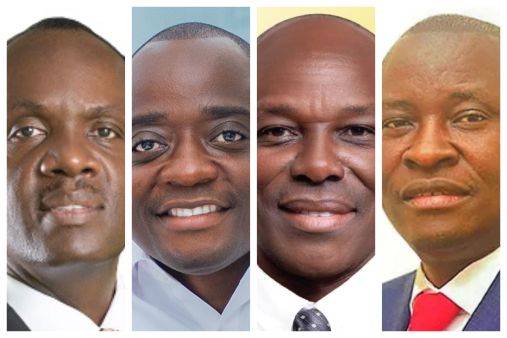
However, the Haba mafia did not act alone and could not have acted alone – which begs the question why the majority of the court (i.e. Justices Geoffrey Kiryabwire, Elizabeth Musoke, Cheborion Barishaki and Stephen Musota) refused to investigate the constitutionality of the conduct of Haba Group bankers (Orient Bank, Tropical Bank, UBA Bank and Bank of Baroda) or that of the Governor and two former ministers Syda Bumba (Finance) and Prof Khiddu Makubuya (Attorney General) whose fingerprints were all over the vault.
Inevitable appeal
In his detailed minority judgment, Justice Kenneth Kakuru exposes ‘fraud’ and a host of troubling connections between the four commercial banks and two politicians who acted as Haba Group lobbyists.
The no-nonsense judge minces no words. He fingers the politicians as ‘masterminds behind this fraud’ and the commercial banks as ‘part of the oil lubricating the wheels of corruption. [Their] role was to assist [Basajjabalaba] to defraud taxpayers’ money.’
In the end, Justice Kakuru would have nullified all the questioned loans and guarantees as he found them to be ‘fake’ and ‘unconstitutional’, and the purposes for which they were obtained a mere ‘hoax’.
However, I respectfully opine that it was erroneous for the learned justice of appeal not to accompany the nullification order with a directive that the commercial banks should immediately refund any and all public funds which they jointly or severally received from BoU through ‘fraudulent’ and ‘unconstitutional’ schemes instigated by their customer.
A refund by the commercial banks is consistent with the following salutary conclusion by Justice Kakuru: ‘The colossal sums of money set out in this judgment would never have been lost without the involvement of [UBA Bank, Orient Bank, Bank of Baroda, and Tropical Bank]. They are the ones individually and collectively that provided [Basajjabalaba] with the key to the national treasury. They provided him with the password to the safe. Without them, this money would never have been lost. They are to blame for the loss of over UGX 142,698,096,338/= of taxpayers’ money. This money ought to be recovered and paid back to the treasury.’
It should, therefore, be the delinquent commercial banks, not the Ugandan taxpayer ‘through the Attorney General’, to recover the ‘fake’ and ‘unconstitutional’ loans from the shadowy Haba Group.
As the bankers willfully contravened the Constitution so as to profit at the expense of the taxpayer, Justice Kakuru would have imposed on each banker a fine of USD 10m in keeping with the global trend of inflicting significantly large fines and penalties on financial institutions that are found to have engaged in improper conduct such as fraud and violation of anti-corruption laws.
Unfortunately, the majority disagreed with Justice Kakuru’s analysis, conclusions and orders.
Justice Barishaki and Justice Musota would have dismissed the petition on a technicality. In their Lordships’ view, the complex financial transactions extensively probed by both Justice Kakuru and Justice Musoke did not raise a question for constitutional interpretation.
Whereas Justice Musoke declared that there was non-compliance with Articles 159(2) and 159(7)(a) of the Constitution in the process through which the questioned loans and guarantees were created, she did not give a full interpretation of the implication of this finding.
Meanwhile Justice Kiryabwire did not explicitly probe the constitutionality of the loans and guarantees. Having declared as unconstitutional the property leases for which Haba Group received ‘compensation by government’, the former head of the commercial court regarded this question as superfluous.
Consequently, the bankers got off scot-free. Pertinent treaties such as the UN Convention against Corruption and AU Convention on Preventing and Combating Corruption were ignored. Novel and important concepts such as the inviolability of consolidated fund protection clauses and ‘odious debt’ were also swept under the proverbial carpet. An appeal to the Supreme Court is therefore inevitable.
Isaac Ssemakadde (Twitter: @IsaacSsemakadde) is the chief counsel of Legal Brains Trust, Kampala. He specialises in commercial law, consumer law, strategic litigation, research, and human rights. He was recently voted by Uganda Law Society as ‘the most outstanding advocate in the field of public interest litigation’. He successfully represented the petitioner in Constitutional Petition No 4 of 2012 Legal Brains Trust v Hassan Basajjabalaba & 19 others, including the four commercial banks mentioned in this article.