By Kenneth Robert Kitariko
I need to confess something!
I chair two boards. And I chair the audit, risk, and governance committee on a third. So, when I tell you that board service now feels like a full-time job, I am speaking from the deep end of the pool.
Board service used to feel like a privilege. It still is, don’t get me wrong. But it also now feels, if I am being brutally honest, like a job. A real job. The kind that has you checking email at 10:30 pm on a Tuesday night and blocking out whole weekends to prep. The kind where your brain never fully switches off because there is always another board packet to read, another risk register to review, another governance question to consider.
And let me be clear, it is not the number of boards. I know directors who sit on four or five and seem to carry it lightly. Most would agree that four is cutting it close. There is a limit to how much granular oversight any human being can sustain. The issue is not the count. It is the nature of the work itself.
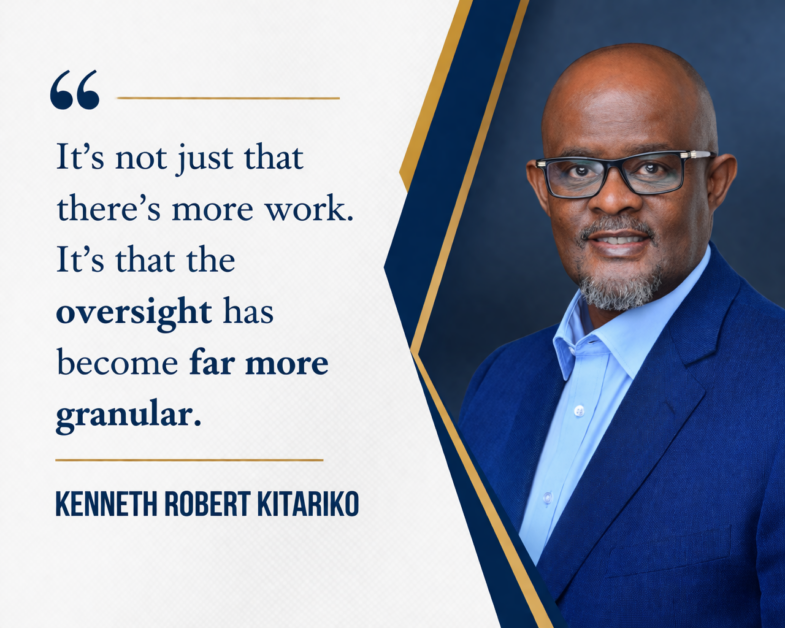
Over dinner with a director last week, he said something that felt familiar. He said, “It’s not just that there’s more work. It’s that the oversight has become far more granular.”
Yes. That is exactly it!
What he was describing, I have come to realise, is not just a matter of style or preference. It is now embedded in the formal expectations of governance itself. King IV, which has shaped our thinking across much of Africa, makes this explicit. The board’s role is to “lead ethically and effectively.” That means exercising oversight with a level of depth and engagement that would have been unthinkable under the old model. The days of a board that merely nods at strategy and waits for the next meeting are over, not because directors have changed, but because the standards have.
The Old Boardroom Was a Different Country
If you had walked into a boardroom twenty or thirty years ago, the air was heavier. There was a formality to it, a hierarchy that you felt the moment you walked through the door. And at the head of the table, literally and figuratively, sat the chairperson. They were not just the leader of the meeting. They were, in many cases, feared and revered in equal measure.
I remember watching them work, back in my early days. They commanded the room without raising their voice. A single glance could silence a conversation. A quiet word after the meeting could shape your entire future on that board. They were the gatekeepers, the final arbiters, the figures whose approval you sought and whose displeasure you dreaded. New directors, and sometimes not-so-new directors, spent years learning to read the room, watching the chair’s expression, waiting for the moment when it was safe to speak.
And management? They came prepared for a performance. The relationship was transactional, sometimes adversarial. The board judged, and management performed. That was the deal.
That world is mostly gone now, and thank goodness for it in many ways.
The boards I sit on today, including the ones I am privileged to chair, operate like actual teams. The dynamic is collaborative. The chairperson is still a leader, but they lead through facilitation now, not fear. My job is to pull others into the conversation, to make sure the quiet voices get heard, to ensure that we are challenging each other constructively rather than performing for each other. The CEO wants us as thought partners, not antagonists. We are in it together.
But here is the part nobody tells you. Being a teammate, especially as chair, is exhausting in a way that being a distant judge never was. You cannot hide behind the title. You cannot rely on reverence to carry the meeting. You have to do the work. You have to prepare. You have to manage the dynamics, mediate the disagreements, and still hold the ultimate accountability when things go wrong.
And Then There Is the Other Side of the Table
There is something else I have noticed, though, and it is the thing we do not talk about enough. Management is struggling with this change of dynamic, too. And in some cases, they are genuinely irritated.
I have heard the private complaints. You probably have too. “The board wants to run the company.” “They hired me to make these decisions.” “I spend more time preparing for board meetings than I do running the business.” “Who do they think they are to question us?”
And look, sometimes they are right. Sometimes we do overstep. Sometimes, in our eagerness to be diligent, we become a burden rather than a partner.
But here is what I wish every CEO and every executive team truly understood.
For all the frustration this new era causes, for all the extra hours spent preparing materials, for all the uncomfortable questions in the boardroom, I have not once heard a management team say they wished for a less engaged board when a crisis hit.
And when things do go wrong, the spotlight is unforgiving. Regulators like the Bank of Uganda, the Insurance Regulatory Authority of Uganda and the Capital Markets Authority have made clear that they expect boards to demonstrate not just oversight but active, documented engagement. The question after a failure is no longer simply “What did management do?” It is “What did the board know, when did they know it, and what did they do about it?” I have sat on the other side of those regulatory inquiries, and I can tell you that a board that cannot show its work, that cannot produce the minutes and follow-ups, will most certainly find itself in very difficult conversations.
The codes are unambiguous. King IV calls for boards to “govern the ethics of the organisation” and to “ensure that the organisation is and is seen to be a responsible corporate citizen.” These are not passive mandates. They require boards to be in the details, not to manage, but to verify, to probe, and to satisfy themselves that the controls and culture are real.
So yes, management is struggling with this transition too. Yes, it asks more of them than the old model ever did. Yes, it can feel like the board is encroaching on their territory. But the alternative, a board that is passive, distant, and uninformed, is not better. It is a disaster waiting to happen.
The Elephant in the Room: Technology and Social Media
There is another force at work here, one that I have not yet mentioned, and it may be the most powerful of all. Technology has transformed everything.
When I first started in boardrooms, a crisis unfolded at the speed of print. You had time, time to gather information, time to consult, time to craft a response. Today, a crisis unfolds at the speed of a tweet. A single customer complaint can go viral before breakfast.
Social media has fundamentally altered the relationship between corporations and their stakeholders. Scholars now speak of “total governance,” a concept borrowed from “total football,” where players move fluidly between positions rather than staying in fixed roles. In the same way, stakeholders no longer stay in neat categories. The same person can be a shareholder through a mobile investing app, an employee sharing workplace concerns on LinkedIn, a customer organising a boycott on Twitter, and a community activist mobilising on WhatsApp. They occupy all these roles simultaneously, and they coordinate across them effortlessly.
What does this mean for those of us in the chair? It means that every decision we make, and every decision we fail to make, is subject to instantaneous scrutiny and amplification. A compliance failure is no longer just a regulatory matter. It is a reputational event that can ripple across stakeholders in hours.
 How Digital Empowerment is Shaping the Future of Ugandan Women
 And here, too, the governance frameworks have caught up. The new sustainability standards ISSB, IFRS S1 and S2 require boards to oversee not just financial reporting but climate-related risks and opportunities. These are not optional add-ons. They are becoming the law. For those of us in regulated financial services, the expectation is even more acute; the Bank of Uganda’s Corporate Governance Guidelines for Commercial Banks explicitly require boards to “oversee the management of all material risks,” including those emerging from technology, reputation, and sustainability.
When you are flying low like a fighter jet in combat, you cannot afford to miss a single threat. But you also cannot afford to fixate on one threat while another kills you from the side. The cognitive load is immense.
The Data Deluge and the Discipline of “So What?”
But perhaps the most profound transformation, the one that lands in my inbox every single day, is the explosion of data.
There is a trap here, and I have fallen into it more times than I care to admit.
The trap is that data is not the same as insight. More information does not automatically mean better understanding. Drowning in detail is not the same as providing effective oversight.
So I have started forcing myself to ask a simple question: so what? It sounds almost too simple, but it is surprisingly hard to stick to. The discipline of “so what?” is the discipline of relevance. It forces a brutal honesty about what actually matters. It separates the metrics that are genuinely material from the ones that are merely interesting. It protects the board’s time and attention from being scattered across a thousand trivial details.
This is the discipline I am trying to learn. Not rejecting data, but filtering it through the lens of action. Not ignoring details, but insisting that every detail earn its place at the table by answering the question: so what?
I have asked myself this a hundred times: why can’t we just go back to the way it was?
Part of the answer is that the regulators and the codes will not let us. And that, I have come to believe, is not a bad thing.
Part of it is speed, also. Things move so fast now. A problem that would have taken months to surface twenty years ago can blow up in a weekend. You cannot wait for the quarterly report to spot the fire. You have to be watching something closer to real time. As a chair, I feel that acutely. A risk that emerges on a Tuesday can be a crisis by Friday.
A major red flag is that the consequences can be personal; directors can be disqualified, held personally liable, or worse. The days of board service as a ceremonial honour are over. This is serious work, and the frameworks that govern us, King IV, the sustainability standards, the sectoral regulations reflect that seriousness.
Are We Better Off?
There is one more question, though. The one that sits beneath all of this. The one that shareholders, regulators, and stakeholders are entitled to ask.
After all this change, after all this granularity, after all this exhaustion, are the companies better off? Are the shareholders better off? Is governance actually better than it was in the era of the feared and revered chair?
I think the answer is yes. But it is a qualified yes.
The new model is messier. It is more exhausting. It asks more of everyone. But it also distributes the weight. It ensures that no single voice, however powerful, can dominate without being challenged. It forces engagement from everyone at the table. It makes it harder for problems to hide.
But we are only better off if we learn to manage the new reality. If we drown in the data, we are not better off. If we mistake activity for insight, we are not better off.
Learning to Live in the New Reality
So here we are. Stuck between two worlds. Expected to know the details but not drown in them. Expected to be teammates with management while respecting that they have their own jobs to do. Expected to understand technologies that are evolving faster than any of us can keep up. Expected to navigate a data deluge that would have been unimaginable a generation ago. Expected to fly low and fast through increasingly hostile terrain.
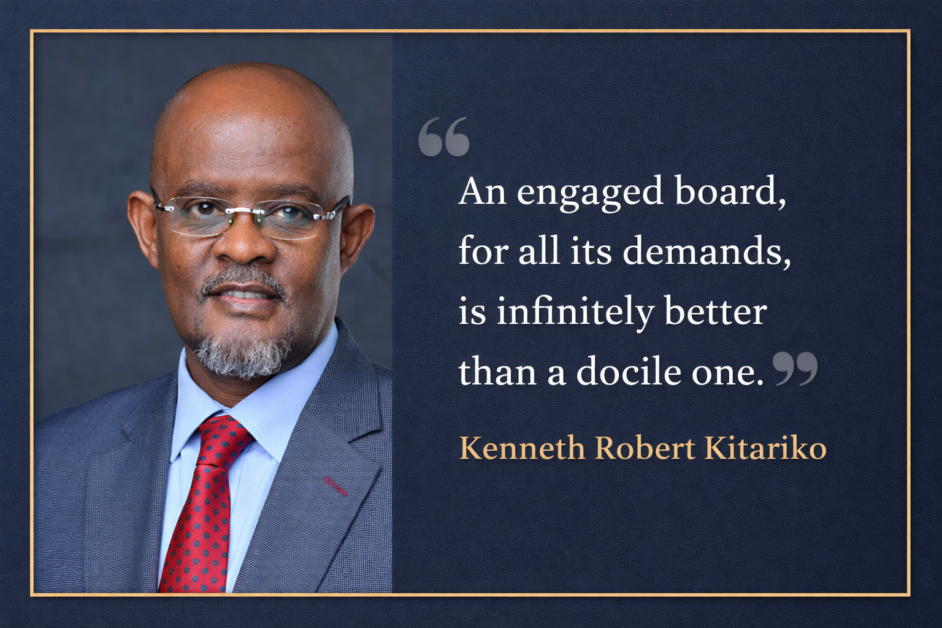
And through it all, expected to maintain a partnership with management that is honest about the friction but clear about the fundamental truth; an engaged board, for all its demands, is infinitely better than a docile one.
So Should It Feel Like a Full-Time Job?
The honest answer is both yes and no.
Yes, it should feel like a full-time job in terms of engagement. If you are only thinking about the company in the 48 hours before a board meeting, you are not doing the job.
But no, it should not feel like a full-time job in the operational sense. If you are so deep in the trenches that you cannot see the horizon, you are not providing oversight. You are doing management’s job.
The fact that it feels like a full-time job to so many of us right now might not mean we are doing it right. It might mean we are still learning.
The generation before us carried it differently. They had a lightness. They commanded respect without clutching at it.
We are still learning. But we are getting there. One board pack at a time. One “so what?” at a time.
And when we get it right, it does not feel like a full-time job. It feels like exactly what we signed up for.
It Is Different Now
The observation my friend made over dinner was right. It is not just more work. It is a different kind of work entirely.
We are asked, in short, to meet the demands of governance codes that require active, engaged oversight; I am not complaining. I keep coming back to that because it matters. The work is harder, yes. But it is also more interesting, more collaborative, and in some ways, more meaningful than it used to be.
So, I sit with the question. Is this a new normal? Or is this just my generation’s turn at the helm, feeling the weight that every generation before us felt, and mistaking it for something unprecedented?
I do not have the answer. I only know that the work is different now, and that we are all management and board, young and old, still figuring out how to do it well.
The old boardroom had its giants. We honour them by doing the work and by remembering, always, that the goal was never to make it easy on ourselves. The goal was to make it better for those we serve.
Kenneth Robert Kitariko is the Chairman of Old Mutual Life Assurance Uganda, Chairman of the National Lotteries, Gaming and Regulatory Board Uganda and the Chairman of the Audit, Risk and Governance Committee of Old Mutual Investment Group Uganda.