Despite a 13.1% increase in NSSF’s assets under management, from UGX 10.0 trillion to UGX 11.3 trillion as at 30th June 2019 and despite realized income growing by 20.4% from UGX 1.05 trillion in 2017/2018 to UGX 1.26 trillion in 2018/2019 due to increased gross Interest income from Treasury and Infrastructure bonds, NSSF has warned that it will pay a lower interest rate to its members for the Financial Year 2018/19 on account of a drop in its total income compared to the previous year.
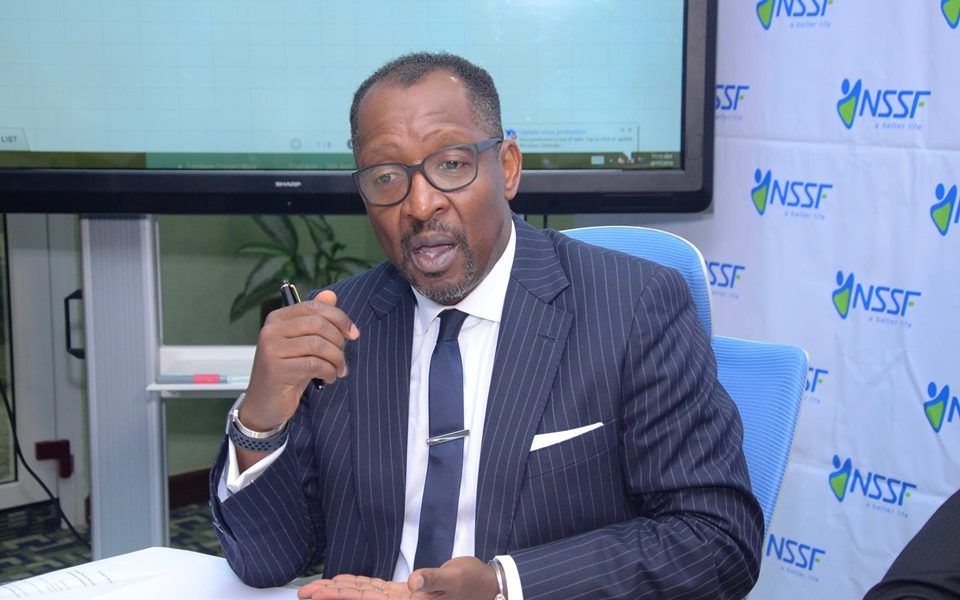
Addressing the media at NSSF’s headquarters, at Workers House, Kampala today , NSSF Managing Director Richard Byarugaba said that despite a rise in the Fund’s realised income above, overall income reduced by over UGX 402.8 billion due to a decline in regional equity prices, strengthening of the Ugandan Shilling against major and regional currencies as well as lower yields in government securities.
According to explanations provided by the Fund, the Nairobi Stock Exchange lost 14%, the Uganda local share index shaded 10% while that of Tanzania plummeted by over 21%. Consequently, the share prices in stocks held by NSSF closed below the prices registered at end of the previous financial year, which impacted the performance of NSSF’s equity portfolio.
Further there was general depreciation of the regional currencies against the Uganda Shilling. Both the Kenya and Tanzania currencies depreciated by 6.1% against the Uganda Shilling,” said Byarugaba.
For example, because of the shillings strengthening, the fund’s holdings in all foreign exchange markets and its equity positions accumulated to an unrealized exchange loss of UGX402 billion shillings as at June 30th 2019.
Byarugaba said that while interest rates remained relatively stable in FY 2018/19, long-term bond yields dropped, with the 15-year moving from 17.75% at the start of the year to 15.85% as at the end of June 2019- a decline of 10.7%.
“This was significant for the Fund, given that we hold over 70% of our total investment portfolio in long term bonds,” said Byarugaba.
The Fund as at June, 2019 held 79% of its investment portfolio in fixed income, 15% in equity and 6% in real estate and currencies.
Byarugaba said that given the Fund’s performance this year, the Fund will not match the 15% interest rate paid the previous Financial Year 2017/2018.
“The return we pay to members depends on the financial performance of the Fund. This means that in principle, the members share the profits but also the losses. As we await the declaration by the Minister of Finance, Planning & Economic Development, our members should expect a reduction in the interest rate this year compared to last year,” he said.
 Ruparelia Group Wins Key Entebbe Land Case, Clearing Path for the New Mega Speke Resort and Convention Centre, Entebbe
Since 2012/13 NSSF has consistently paid a double digit return to its members, in line with their promise to pay interest rate that is at least 2 percentage points above the 10 year average rate of inflation.
The Fund in 2012/13 declared 10% interest rate, 11.23% in 2013/14 and 11.50% in 2014/15. In 2015/16, the interest rate rose to 13%, then declined slightly to 12.30% in 2016/17 and 11.23% in 2017/18. In 2018/19 the fund paid a historic high of 15% in the Fund’s 34 years of existence.
Although Byarugaba did not mention the interest rate to be paid this year- as it can only be declared by the Minister, he said the promise to pay at least above the 2 percentage points above the 10 year average rate of inflation pledge will be “maintained this year.”
Byarugaba also assured members that the Fund is stable and financially sound, and continues to grow both in value and membership. The Fund’s assets under management increased by 13.1% from UGX 10.0 trillion to UGX 11.3 trillion at end of June 2019, mainly driven by increased contributions and interest income.
Annual contributions collections increased from UGX 1.0 trillion to UGX 1.2 trillion – a 15% growth and the amount of money paid in benefits increased by 25% from UGX 360 billion into UGX 450 billion.
Byarugaba also said that the cost of administration marginally improved from 1.30% to 1.28% while the average benefits turn-around-time in 2018/19 remained flat at 8 days.
“Our members should be confident about the health of the Fund in the short, medium and long term as the Fund remains financially stable and growing. We have the ability and means to withstand any shock in the economy, given our aggressive but prudent investment approach and our investment diversification strategy. Safety and Security of members’ funds will remain the guiding principle in our decision making,” he said.
ABOUT NSSF
The National Social Security Fund (NSSF) Uganda is a multi-trillion Fund mandated by Government through the NSSF Act, Cap 222 (Laws of Uganda) to provide social security services to employees in the private sector. The Fund manages assets worth over UGX 11.3 trillion invested in Fixed Income, Equities and Real Estate assets within the East Africa region. It is the largest Fund in East Africa by value, with an ambitious goal of growing assets under management to UGX20 trillion by 202