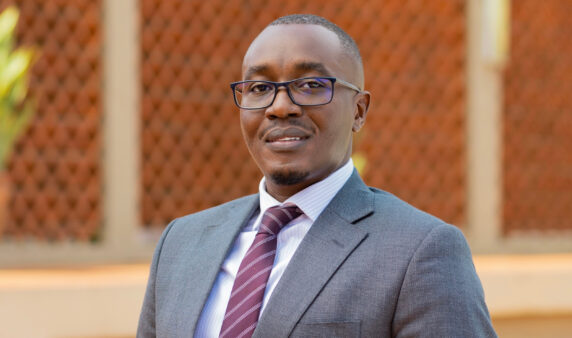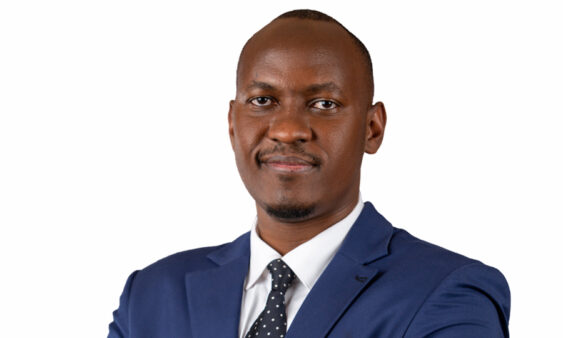
When Patrick Michael Ayota was appointed Acting Managing Director of the National Social Security Fund (NSSF) in December 2022, he stepped into an institution in the midst of a politically charged and uncertain transition. His predecessor, long-serving MD Richard Byarugaba, had just exited after his contract expired, leaving behind boardroom tensions and heightened public scrutiny over governance.
Ayota was no outsider to the Fund. Having served as Chief Financial Officer from July 2011 to October 2017 and as Deputy Managing Director from October 2017, he knew the operations, the numbers, and the stakeholder terrain inside out. His initial appointment was viewed as a stabilising move — a steady hand to calm the waters — until August 18, 2023, when the Minister of Gender, Labour, and Social Development confirmed him as substantive Managing Director for a five-year term.
Less than three years on, Ayota has turned that uncertain starting point into a period of sustained momentum. The Fund has recorded consecutive years of double-digit asset growth, achieved record revenues, and cut its cost-to-income ratio to the lowest level in five years. Customer satisfaction has inched higher, staff engagement has reached its strongest point in years, and the voluntary Smartlife Flexi savings product has attracted over UGX 27 billion in just its first 10 months — signalling renewed trust and confidence in the Fund’s stewardship.
Delivering Growth Across the Board
NSSF’s growth under Patrick Ayota has been both rapid and sustained — and it stands out even more when compared to the two years before he took the full helm.
In FY 2024/25, the National Social Security Fund’s Assets Under Management (AUM) reached UGX 26.0 trillion, up from UGX 22.13 trillion a year earlier — a robust 17.5% increase. This followed an even stronger 19.2% growth in 2022/23, nearly triple the pace recorded just two years before.
By comparison, before Patrick Ayota assumed the role of acting Managing Director midway through 2022/23, AUM growth had been more modest — 10.7% in 2020/21 and 7.5% in 2021/22 — underscoring the sharp acceleration in momentum under his leadership.
Earnings performance mirrors this acceleration, increasing by 11% from Ugx3.2 trillion for the Financial Year 2023/24 to UGX 3.52 trillion.
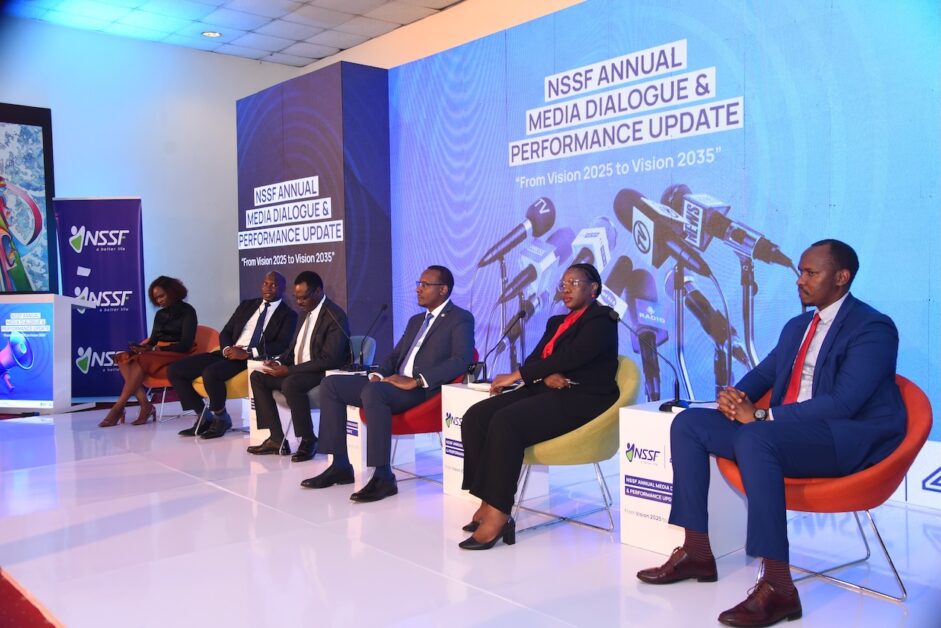
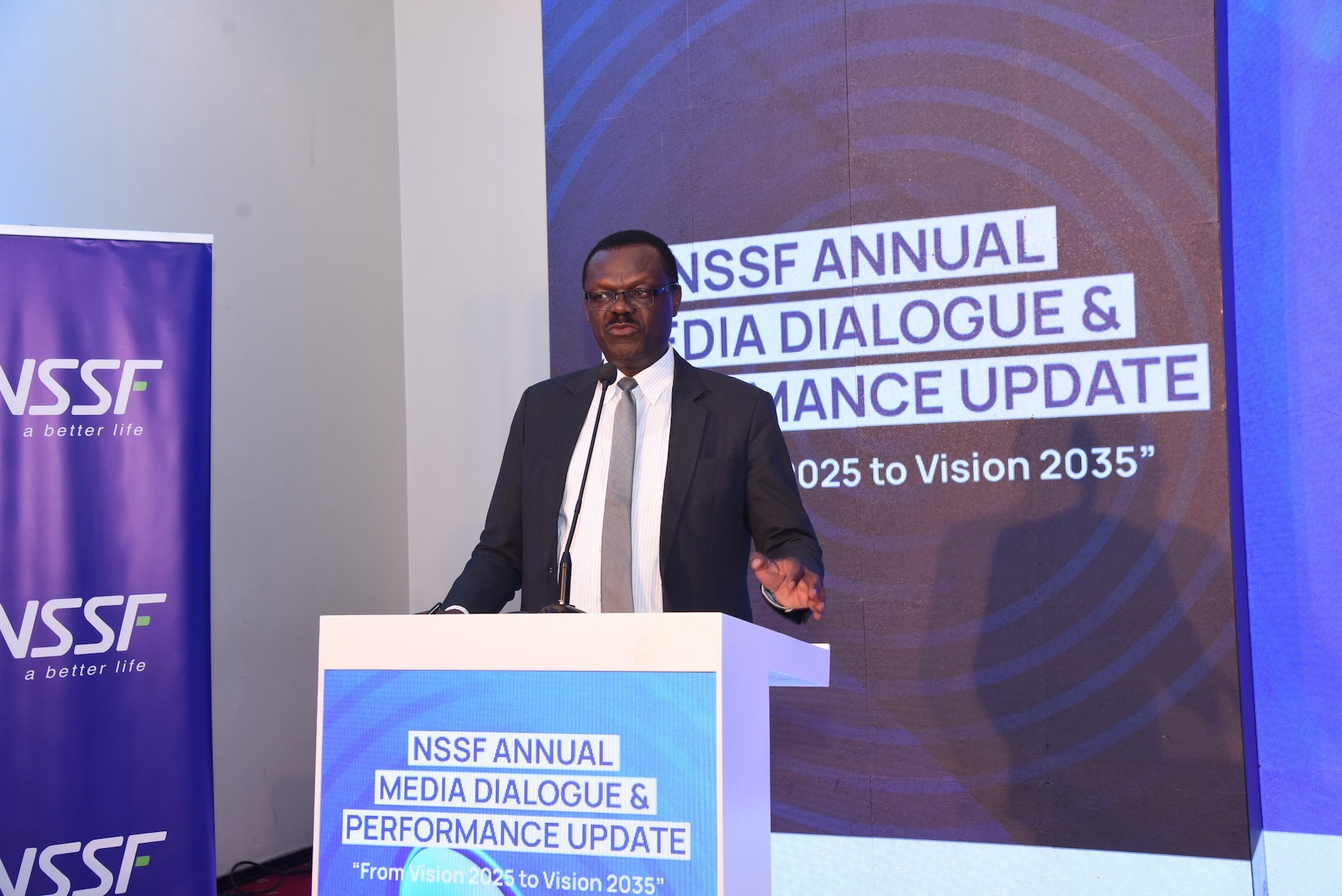
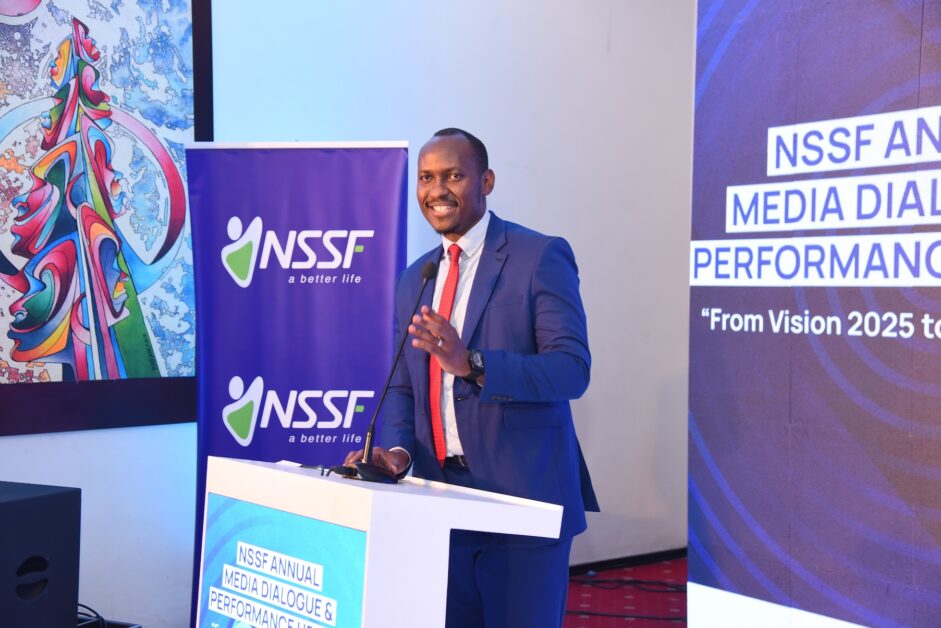
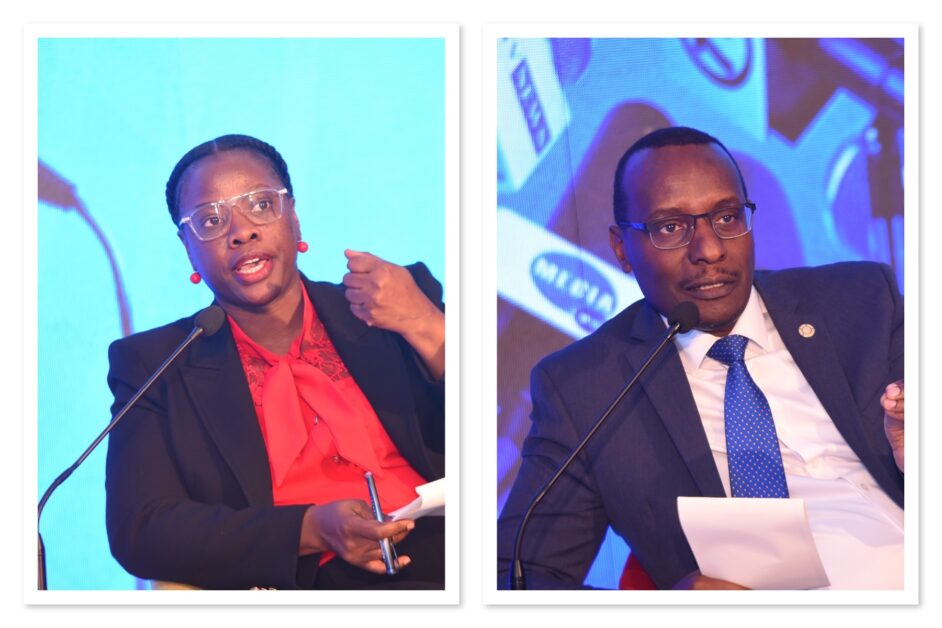
“For the second year running, we saw a significant increase in revenue in our real estate income, interest income, as well as dividend income,” Ayota told journalists at the Fund’s Annual Media Roundtable on 10th September 2025 at Kampala Serena Hotel, attributing the growth to better performance across the Fund’s asset classes.
In the years before Patrick Ayota took over, the Fund’s total revenue first contracted by 3.8% in the 2020/21 financial year before rebounding with a 23.9% increase in 2021/22. In FY 2024/25, the Fund’s earnings climbed by 11% to UGX 3.52 trillion — the highest in its history. This followed a record-breaking 45.5% surge in 2023/24 and a strong 23.9% rise in 2022/23, marking three consecutive years of robust revenue growth.
This was largely powered by strong returns across asset classes, especially interest income, which climbed from UGX 2.34 trillion to UGX 2.88 trillion.
Dividend income rose from UGX 175 billion to UGX 238.14 billion, and real estate income improved from UGX 13.24 billion to UGX 16.64 billion.
According to the Fund, dividend earnings include UGX 61.8 billion from MTN Uganda, UGX 36 billion from Airtel, UGX 21.5 billion from Equity Bank, and UGX 18.6 billion from CRDB Tanzania. Others are UGX 16 billion from KCB, UGX 15 billion from Safaricom, UGX 15 billion from Tanzania Breweries, UGX 13.7 billion from NMB Bank, and UGX 13 billion from Stanbic Bank, among others.
Member contributions also kept pace, growing from UGX 1.49 trillion in FY 2021/22 to UGX 1.72 trillion in FY 2022/23, UGX 1.93 trillion in FY 2023/24, and UGX 2.13 trillion in FY 2024/25 — sustaining double-digit annual growth in each of the last three years.
The benefits paid out to members also increased from UGX 1.12 trillion in the Financial Year 2023/24 to UGX 1.32 trillion in the Financial Year 2024/25. This was despite a decline in the number of claimants from 44,250 to 43,501.
Ayota also said that the Fund’s impressive performance shows financial stability, which sets up the Fund well as it begins implementation of its next 10-year strategic plan. The Plan, dubbed “Vision 2035”, centres around growing the Fund to UGX 50 trillion, increasing NSSF coverage to 50% of the working population, and achieving a customer satisfaction rate of 95%.
 Shashi Dhar Drives Bank of Baroda Uganda Profit to UGX 156.8 Billion After Three Years of Strong Growth
“Generally speaking, the investment environment in the last Financial Year was quite challenging. Despite a slight improvement in economic growth from 6.1% to 6.3%, and while inflation remained under control, we saw some volatility across the East African stock market. The Uganda shilling strengthened against the US dollar and the regional currencies. Against this background, our performance this year has been impressive and bodes well for our future,” Ayota said.
Improving Efficiency
In FY 2024/25, NSSF achieved its most efficient year in at least half a decade. The cost-to-income ratio dropped to 7.9%, down from 9.7% in FY 2023/24 and well below the 9.4% recorded in FY 2022/23 when Patrick Ayota was still acting MD. Two years earlier, before his leadership tenure began, the ratio had been 11.7% in FY 2021/22 — meaning the Fund has cut this measure by almost a third in just three years.
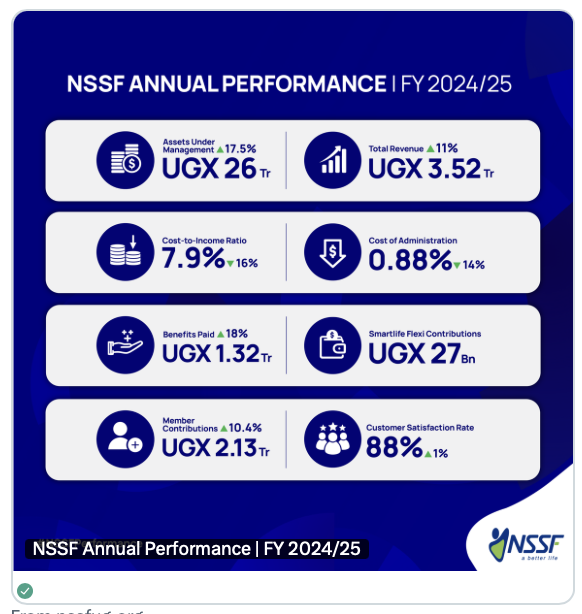
The cost of administration tells a similar story. In FY 2024/25, the Fund’s administrative expenses equated to just 0.88% of total assets, down from 1.02% in both FY 2023/24 and FY 2022/23, and from 1.18% in FY 2021/22. This steady decline reflects sustained discipline in managing operational overheads while growing the asset base.
By prioritising efficiency alongside growth, Ayota has freed up more resources for member returns, reinforcing the Fund’s value proposition without sacrificing service quality or stakeholder confidence.
Restoring Trust and Stakeholder Value
By the close of FY 2024/25, NSSF’s trust and engagement indicators were at some of their strongest levels in years. Customer satisfaction edged up to 88%, from 87% in FY 2023/24, continuing the high confidence trend of 88% in FY 2022/23. Staff engagement also improved to 91%, from 89% the year before and 86% in FY 2022/23, showing deeper internal alignment since Ayota took over.
One of the clearest signs of rising member confidence has been the rapid uptake of the Smartlife Flexi voluntary savings product. Introduced in November 2024, it attracted UGX 27 billion in contributions within just 10 months — a remarkable result for a new, non-mandatory product.
Delivering Real Value to Members
NSSF’s return promise — at least 2% above the 10-year average inflation rate — has been consistently met. While the exact FY 2024/25 interest rate will be declared later in September 2025, Ayota has already confirmed it will again exceed this benchmark. This continued delivery of real positive returns reinforces the Fund’s positioning as both safe and rewarding for members.
Navigating Compliance Challenges
The one dip in performance was in the compliance rate, which fell from 57% to 52% in FY 2024/25. However, this reflects a structural change in the law from 2022 that expanded mandatory NSSF contributions to all employers, including those with fewer workers. Many of these new contributors face cash flow constraints. Ayota’s strategy has been to focus on sensitisation and employer engagement — a long-term play aimed at broadening the contributor base for sustainable growth.
Positioning for Vision 2035
The 2024/25 financial year marks the beginning of an ambitious new chapter for the National Social Security Fund with the launch of Vision 2035. This 10-year plan sets out three bold objectives: to grow the Fund’s assets to UGX 50 trillion, extend coverage to at least half of Uganda’s working population, and raise customer satisfaction to 95%.
Patrick Ayota steps into this decade-long journey with solid momentum behind him. Over the past two years, the Fund has delivered consecutive double-digit growth in assets, revenues, and member contributions. It has achieved record earnings, expanded its investment returns across all major asset classes, and reduced its cost-to-income ratio to the lowest level in five years. At the same time, trust in the institution has strengthened, with customer satisfaction edging upward, staff engagement hitting 91%, and voluntary contributions through the new Smartlife Flexi product surging to UGX 27 billion in just 10 months.
These results are not the product of short-term gains. They reflect the steady systems strengthening Ayota began in December 2022 when he assumed the role of acting Managing Director and continued after his substantive appointment in August 2023. In less than three years, he has not only consolidated his grip on the Fund’s operations but also demonstrated that growth, efficiency, and trust can be advanced together. As NSSF embarks on Vision 2035, it does so with a leader who has already shown he can deliver on big targets — a track record that makes the Fund’s new ambitions both credible and achievable.