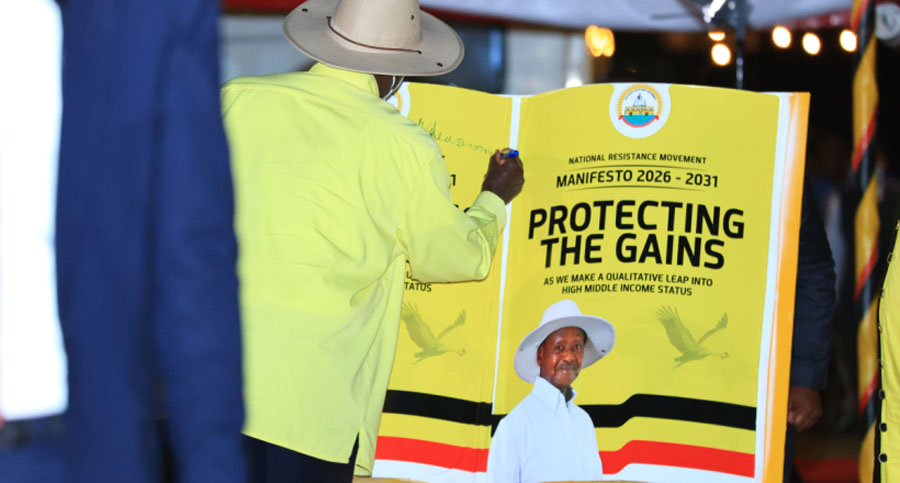
As Uganda heads into another electoral cycle, the National Resistance Movement (NRM) has unveiled its 2026–2031 Manifesto, branding it a programme for “consolidating socio-economic transformation.”
The document doubles as both a balance sheet of what the party says it has delivered since 1986 and a forward-looking plan for the next five years.
At its heart, the manifesto sets out a vision of industrial growth, agricultural modernisation, financial inclusion, and digital innovation.
It also places heavy emphasis on stability, infrastructure, and regional trade.
It frames these as foundations on which Uganda’s next phase of transformation will stand.
The economic broad vision
NRM says Uganda has moved from economic collapse in the 1980s to a country of steady growth, peace, and stability.
Average GDP growth, the party says, has hovered between 5 and 6% annually over the past two decades, amid global crises such as the Covid-19.
Looking ahead, the manifesto sets a goal of deepening modernization and expanding the money economy.
Industrialization, commercial agriculture, ICT, and private sector growth are highlighted as the engines that will propel Uganda into a more competitive regional hub.
Anchoring households in the money economy
Agriculture remains the backbone of Uganda’s economy, employing the majority of Ugandans.
The manifesto’s agricultural strategy revolves around moving farmers from subsistence to commercial production.
For the next five years, the NRM pledges to expand the Parish Development Model and scale up irrigation and mechanization.
It also pledges to strengthen commodity value chains in coffee, cotton, dairy, maize, tea, fruits, and fish.
In addition to investing in storage and post-harvest infrastructure.
The party points to what it describes as “transformational growth” already achieved in the sector.
Coffee production, it says, has risen from 2.5 million bags in the 1980s to over 8 million bags by 2023.
Dairy has expanded into a regional export, and horticultural, maize, and fish exports have also increased.

Building factories and parks
The manifesto places industrialization at the center of Uganda’s economic vision. The stated goal is to add value to agricultural produce while reducing dependence on imports.
The NRM promises more industrial parks and special economic zones.
It also promises support for local pharmaceutical and vaccine manufacturing, and financial incentives for small and medium-sized manufacturers.
It highlights existing growth in cement, steel, textiles, and beverages as progress.
Electricity supply, the party notes, has expanded from under 200 megawatts in 1986 to over 1,300 megawatts.
It is now able to power both households and industries.
Uganda as a hub
NRM is keen to cast Uganda as a regional trade and logistics hub, leveraging its central location in East and Central Africa.
The party commits to deepening access to markets through the East African Community and the African Continental Free Trade Area.
It also commits to reducing customs bottlenecks, expanding road, rail, air, and water corridors, and supporting exporters in coffee, dairy, fish, and horticulture.
The party lists as achievements more than 6,000 km of paved roads since 1986 and upgrades at Entebbe Airport.
Groundwork for the Standard Gauge Railway, and expanded exports to neighbors, including South Sudan, Kenya, and DR Congo, are also listed.
 Uganda Fuel Stocks to Last Until End of April, Government Assures Amid Global Oil Crisis
Banking on youthful innovation
With Uganda’s population skewing young, the manifesto frames ICT as a critical driver of the next economic phase.
For 2026–2031, the NRM promises to extend broadband nationwide, promote fintech and e-commerce for SMEs.
It also promises to expand innovation hubs and incubation centers, and digitize more government services to improve efficiency.
Among the achievements listed are the rise of mobile money and digital banking, ICT’s growing contribution to GDP, and the establishment of e-government services and tech hubs such as the Innovation Village.
Selling Uganda to the world
Tourism is flagged as a sector with untapped potential. The manifesto promises increased marketing of Uganda’s natural attractions, new investment in infrastructure around airports and parks, and stronger support for business process outsourcing and financial services.
Uganda, the NRM says, will also be promoted as a regional hub for conferences and events.
Stated achievements include tourism’s rise to become a top foreign exchange earner, infrastructure improvements around airports, and tourist corridors.
The party also lists expanded hotel capacity and the successful hosting of major regional and international summits as key achievements.
Access to capital
The manifesto positions affordable financing as essential to unlocking entrepreneurship.
It pledges to expand the Uganda Development Bank’s lending capacity, deepen capital markets, strengthen Emyooga and Saccos, and cut bureaucracy in business registration and licensing.
The party says it has already laid the foundation for this push, citing the capitalization of UDB, rollout of household-level financing under the Parish Development Model, and widespread financial inclusion driven by mobile money and digital banking.
The cross-cutting enabler
Infrastructure, the manifesto stresses, is the lifeblood of economic transformation.
The party promises more investment in the Standard Gauge Railway, major regional road corridors, electricity expansion, and improved access to clean water and internet connectivity.
Achievements listed include electricity generation growth from 200 megawatts in 1986 to over 1,300 megawatts by 2025.
It also lists upgrades at Entebbe Airport and investments in rural electrification and water supply schemes as critical achievements.

Framing the journey: 1986 to 2031
NRM’s manifesto is structured around a simple narrative: Uganda was once a failed state; now it is on the path to middle-income status.
The past is defined through stated achievements in peace, stability, and infrastructure, while the future is cast as a continuation of modernization through industry, agriculture, ICT, and trade.
The manifesto argues that the next step is to move more households into the money economy, expand industrialization, and channel Uganda’s youthful population into innovation and enterprise.
A stated vision of continuity
The NRM’s 2026–2031 manifesto presents itself as both a scorecard and a roadmap.
On one hand, it highlights roads, power plants, export growth, and expanded services.
On the other hand, it promises to deepen industrialization, commercialize agriculture, build the digital economy, and open more doors for private business.
For investors and businesses, the party promises a better operating environment, wider access to finance, and improved infrastructure.
For households, it focuses on moving Ugandans further away from subsistence through models like PDM.
The political debate over these pledges and achievements will unfold in the months ahead.
For now, the manifesto stands as the NRM’s official statement of economic intent for the next five years.