Nile Breweries, through its parent company AB InBev, has donated UGX2.2 billion (USD600,000) to conserve River Rwizi located in Mbarara.
This will support the 3rd phase of a series of initiatives the beer maker has been funding in the region since 2019 to help ensure that the quantity and quality of water in River Rwizi’s catchment adequately supports the ecosystem functioning and socio-economic development of the area by 2024.
In the first and second phases, Nile Breweries supported the project with UGX505 million and USD 200,000 (UGX720 million) respectively. This now brings to UGX3.4 billion, the total amount of money that will be spent on the restoration of the vital R. Rwizi.
Sustainable water access for 2.5 million people
Explaining Nile Breweries’ commitment to the project, Onapito Ekomoloit, Legal & Corporate Affairs Director, Nile Breweries, said that although water is the number one ingredient in beer and as such, a vital resource for the business, it was also important to protect and preserve the resource for wider sustainable socio-economic use by people in the catchment area and beyond.
“Freshwater resources are being affected by the changing climate, pollution, and overutilization. These threats call for innovated and coordinated responses if Uganda’s water resources are to continue providing widespread economic, ecological and social benefit,” Onapito observed, adding: “That is why we are improving water access and security in the communities where we live and work through innovative partnerships and initiatives such as this project.”
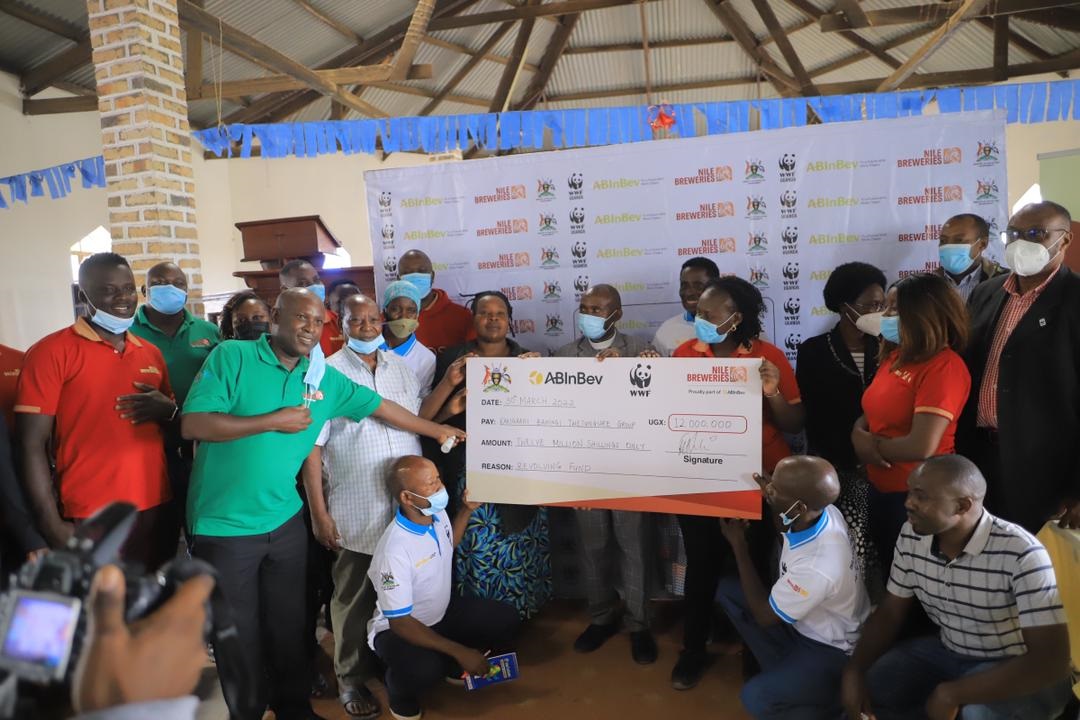
Onapito made these remarks on March 30th, 2022, in Mbarara at a ceremony to hand over the UGX2.2 billion for the project. Nile Breweries also handed over farming equipment and UGX 12 million towards the revolving fund of the Bahinji Twetungule Farmer’s Group from the Kakigaani area. Kakigaani is one of the many communities, with a total of 1,076 buffer households neighbouring the river that are being supported to undertake river and wetland management, forest restoration and sustainable land management.

Onapito said that the project aligns with NBL’s parent company, AB InBev’s water stewardship goal of ensuring that by 2025, 100% of its communities in high-stress areas will have measurably improved water availability and quality.
River Rwizi and its catchment cover an estimated area of 8,200 square kilometres spanning 12 district local governments in Western Uganda. The river provides water and related environmental services to approximately 2.5 million people, comprising 4.5% of Uganda’s population. It is the main source of water for Mbarara City, a major hub for western Uganda, hosting a population of over one million people and sustaining beverage, dairy, construction, municipal solid waste, health, and agro-industrial industries among others.
Despite the river catchment being important for supporting social, economic, and ecosystem functions for upstream, midstream and downstream economies. the catchment has been heavily degraded resulting in occasional water shortages during the dry season and flash flooding during the wet seasons. The water demand for Mbarara city is mostly unmet in the dry seasons and water received at the end-user taps is currently turbid (brownish) in most parts of the year.
The support by Nile Breweries has enabled so far, 95 households in the catchment area to access safe water through the provision of nine community rainwater harvesting systems. In addition, a zero-grazing dairy project was established which will further reduce erosion and provide alternative livelihoods for community members. In addition, a total river buffer length of 18 km, and total catchment area of 14,567 hectares were mapped for restoration while micro-catchments in the area have been supported and strengthened in best restoration and governance practices.
The project is being implemented through technical support from WWF UK and WWF Uganda country office in partnership with the Ministry of Water and Environment (MWE), Directorate of Water Resources Management (DWRM), Victoria Water Management Zone (VWMZ), National Environment Management Authority (NEMA), River Rwizi Catchment Committee, District Local Governments and local communities.
 Ruparelia Foundation to Hold Free Eye Camp in Bukedea in Honour of Rajiv Ruparelia
Sustainable partnerships
According to Dr Florence Adong, the Director of Water Resources Management (DWRW), Ministry of Water and Environment, R.Rwizi emerged as the most endangered river in Uganda from studies done to assess the degraded water sources in Uganda. She represented Hon Beatrice Anywar, the State Minister for the environment at the event in Kakigani, Rwampara.
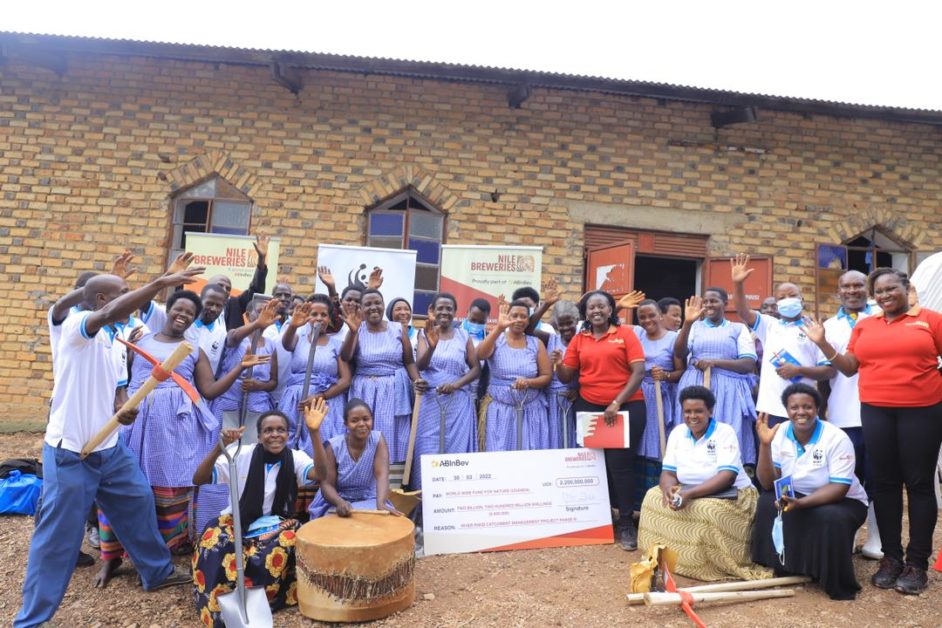
“We need a good strategy to maintain the flow, quantity and quality of our water resource. This requires a lot of cooperation, trust-building and confidence, thus our model is based on working with many stakeholders including the community to restore the river,” she said at the event.
“Water and environmental resources go hand in hand and contribute to the economic development of the country so let us all protect and prioritize them. On behalf of the ministry, I would like to thank Nile Breweries and its parent company AB Inbev for playing their part and call on others in the private sector to do the same,” she added.
“We want a world where people can co-exist with nature and water is one of the critical resources. Environment conservation is no longer charity; it is a business. When we build our resilience of water sources, we are building our economy and improving the lives of our communities,” said David Duli, Country Director WWF Uganda, the key implementor of the project.
“The Rwizi Catchment project aims at developing collective stakeholder-driven approaches and implementing site catchment-based interventions to address water risks to enable improved community livelihoods and water quality and quantity,” he added.
“AB InBev has been able to make substantial progress on ensuring that water resources are protected and that farmers and communities are better able to access sustainable sources of water without depletion,” said Onapito.
Efficient and sustainable use of water by Nile Breweries
Onapito also said that over and above supporting water sustainability projects, the company itself was investing in efficient use of water.
“When Mbarara Plant started operations in 2013 water usage was of 5hl/hl of water was used to produce 1 beer and this has since reduced to 2.6hl/hl of water to produce 1 beer. This has been as a result of technological investment, mindset change where all the employees are focused on the sustainability of the river, the output of the water risk assessment,” he said, adding: “We have continued to be legally compliant to the permits related to abstraction both groundwater and surface water – installed the level monitoring station to establish the daily levels of the river, conduct discharge measurements on monthly basis to determine the flow curve of the river, installed gabions worth UGX 460m.” “The continued focus on sustainable use of the water resource by reduction of the plant water usage by more than 50% has been important in indicating the plant’s approach and focus in as far as sustainability is concerned,” Onapito reiterated, adding that the tax contribution of the NBL Mbarara plant since 2013 is ha