Uganda’s telecom sector is increasingly defined by a two-horse race between MTN and Airtel.
Both companies are growing strongly, benefiting from rising smartphone adoption, data usage, and mobile money transactions.
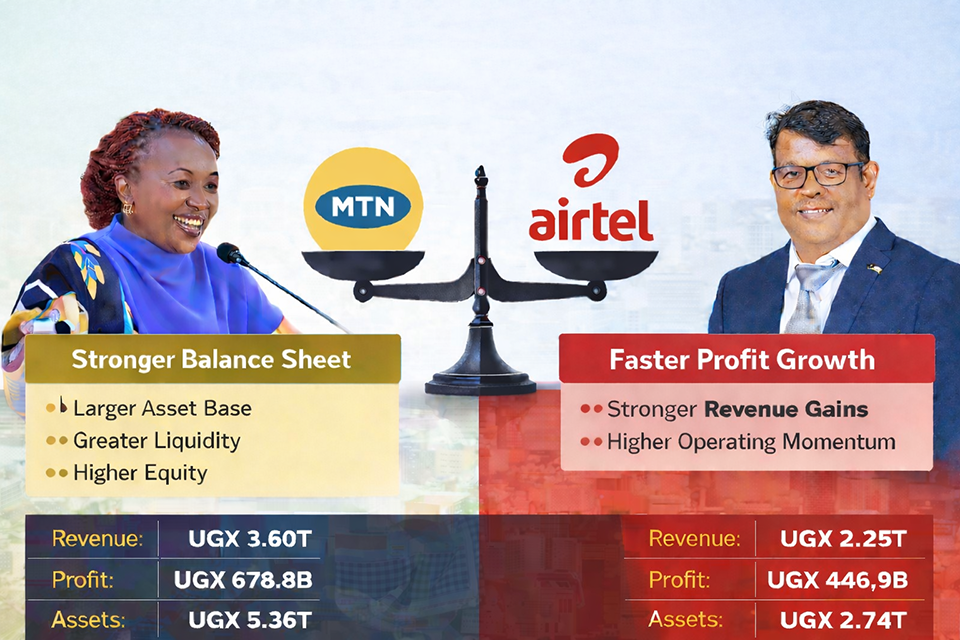
But a pound-for-pound look at their latest financials reveals a subtle but important divide: MTN currently holds the stronger financial position, while Airtel is delivering faster reported earnings growth.
The difference highlights two contrasting strengths in the market. MTN is the better-capitalised telecom with deeper liquidity and a larger asset base.
Airtel, meanwhile, is extracting stronger operating momentum from its network and subscriber growth.
But it is important to note that MTN’s asset base appears larger partly because of how it reports its business. MTN presents a consolidated financial structure that combines telecom operations with its mobile money ecosystem, bringing large fintech assets, cash balances, and transaction flows onto the same balance sheet.
This significantly boosts reported equity, liquidity, and asset size. Airtel, however, separates its telecom business from Airtel Money, which is reported under a different entity.
As a result, much of the cash, float balances, and transaction-related assets tied to mobile money do not fully appear on Airtel Uganda’s telecom balance sheet, making its financial position look smaller and more leveraged in comparison.
It will be interesting to see how the reporting will change when MTN finally spins off its mobile money business from the main telecom operations in the second half of this year.
MTN’s size and financial strength

MTN remains the larger telecom by virtually every financial metric. The telecom closed 2025 with revenue of UGX 3.60 trillion and profit after tax of UGX 678.8 billion, compared with Airtel’s UGX 2.25 trillion revenue and UGX 446.9 billion profit.
MTN’s total assets stood at UGX 5.36 trillion, nearly double Airtel’s UGX 2.74 trillion.
More importantly, MTN’s balance sheet is far stronger. It ended the year with UGX 2.27 trillion in equity and UGX 1.35 trillion in cash and cash equivalents, providing substantial liquidity and investment capacity.
Airtel, by contrast, reported UGX 185.4 billion in equity and UGX 27.2 billion in cash, leaving it more reliant on debt financing and tighter cash management.
The contrast shows up clearly in leverage and liquidity. MTN’s capital structure provides a comfortable buffer to fund network expansion, absorb shocks, and maintain dividend payments.
Airtel’s financial structure is thinner, with liabilities far outweighing equity, although management says its leverage remains manageable at around 1.5 times EBITDA.
Airtel’s earnings momentum is stronger
While MTN dominates in scale and financial depth, Airtel is showing stronger short-term earnings acceleration.
Airtel’s revenue grew 13.3% in 2025, roughly in line with MTN’s 13.6% growth. But Airtel’s operating profit rose 35%, and profit after tax jumped 41.1%, far outpacing MTN’s 5.8% reported profit growth.
Part of the difference is accounting. MTN’s profit growth was dampened by a UGX 110.9 billion tax settlement with the Uganda Revenue Authority.
Excluding that one-off charge, MTN’s underlying profit after tax would have reached UGX 789.7 billion, representing 23.1% growth, still strong, but below Airtel’s reported earnings surge.
Even so, Airtel’s performance suggests it is currently converting subscriber and traffic growth into profits more quickly.
Data is the real growth engine
Both telecoms are seeing the same structural shift in where their money comes from. Data services are now the fastest-growing revenue stream, while traditional voice is slowing.
For MTN, data revenue grew 28.8% in 2025, compared with just 1% growth in voice services.
Fintech revenue, largely mobile money,rose 17.3%, supported by a 23.3% increase in transaction value to UGX 195.5 trillion.
MTN’s customer ecosystem is also expanding. The company reported 24.2 million subscribers, including 12 million data users and 14.7 million fintech users, showing how deeply digital services are becoming embedded in its business model.
Related
 Kenya Shilling Holds Firm as Remittances Rise and Markets Show Mixed Signals – Central Bank Report
Airtel is seeing a similar shift. Its data and value-added services generated UGX 1.10 trillion, up from UGX899.7 billion the previous year, roughly 22% growth. Voice revenue grew much more slowly, increasing only from UGX 995.5 billion to UGX 1.03 trillion.
This implies that the future of telecom earnings will increasingly depend on data consumption and digital services, rather than traditional calling.
MTN is investing more aggressively
The two operators also differ in how much they are investing to support future growth.
MTN invested UGX 594.4 billion in network infrastructure and capacity upgrades during the year. Its financial statements also show UGX 412.5 billion in capital expenditure on property, plant and equipment and UGX 62.3 billion in intangible assets.
Airtel’s investment was lower but still significant, with about UGX 229.1 billion spent on property, plant and equipment and UGX 11.2 billion on intangible assets.
The spending helped Airtel add 258 new network sites in 2025, improving coverage and capacity.
MTN’s heavier spending reflects its deeper balance sheet and broader digital strategy. The company is investing not just in connectivity but also in platforms such as mobile money, device financing and home broadband.
4G and 5G investment: Building the next battle ground
The next phase of competition between MTN and Airtel Uganda is increasingly defined by investment in 4G expansion and the gradual rollout of 5G networks.
While both telecoms are expanding their infrastructure to support rising data demand, their strategies differ in scale and timing.
For now, 4G remains the backbone of telecom revenues. Most smartphone users and data traffic in Uganda rely on 4G networks, making coverage and capacity improvements critical for sustaining growth in data consumption, mobile money transactions, and digital services.
MTN has taken the more aggressive investment approach. The telecom invested about UGX 594 billion in network infrastructure and upgrades, largely aimed at strengthening its 4G network while preparing for future 5G expansion.
MTN indicates that its 4G coverage now stands at 88.6% of the population, while 5G coverage stands at 19%, with at least 126 new sites fixed in different parts of the metropolis.
Airtel’s investment has been smaller but targeted, investing about UGX 229 billion on network infrastructure, including the addition of 258 new network sites to expand coverage and improve service quality. Rather than rapid expansion, Airtel has focused on improving performance and efficiency within its existing network footprint.
The two companies also differ in their approach to 5G deployment. MTN has taken the lead in introducing the technology in Uganda, launching 5G in selected urban areas and positioning it for high-capacity services such as enterprise connectivity and fixed wireless broadband.
Airtel has been more cautious, prioritizing 4G expansion while monitoring demand for 5G devices and services.
These strategies reflect broader financial realities. MTN’s stronger balance sheet allows it to invest more aggressively in next-generation infrastructure. Airtel’s more measured spending has helped it maintain strong profitability while still expanding network capacity.
In the long term, however, the telecom that best converts network investment into higher data usage and digital service adoption will shape the future of Uganda’s telecom sector.
What this means for the future
The financial results suggest two different strategic positions heading into the next phase of telecom growth.
MTN appears better positioned for long-term dominance, thanks to its stronger balance sheet, higher liquidity and greater ability to fund infrastructure expansion. These advantages give it the capacity to shape the market through investment in networks and digital platforms.
Airtel, however, is demonstrating strong operational execution, converting subscriber growth and data demand into rapid earnings expansion. If it continues to grow revenue and reduce leverage, it could narrow MTN’s financial advantage over time.
For the broader telecom sector, the growth story now revolves around data, mobile money and digital services. Operators that can invest consistently in network quality and digital ecosystems will capture the largest share of that growth.
At the moment, MTN has the stronger financial engine powering that race. But Airtel’s accelerating profits suggest the competitive battle for Uganda’s telecom market is far from settled.