MTN Uganda and Stanbic Uganda, arguably two of Uganda’s largest listed companies, have both released their 2025 financial results.
Beyond their scale, the two are also among the country’s biggest taxpayers, underscoring their central role in the economy.
Out of curiosity, we place them side by side.
What emerges is a study in contrast between two market leaders operating at the very top of their respective sectors.
While they sit in different industries, comparing them across key financial and operational metrics offers a useful lens into how scale, efficiency, and capital are deployed in Uganda’s corporate landscape.
One is a telecom and fintech platform built on reach and volume. The other is a banking group anchored on balance sheet strength and capital efficiency. Both are dominant, but in fundamentally different ways.
Scale vs efficiency
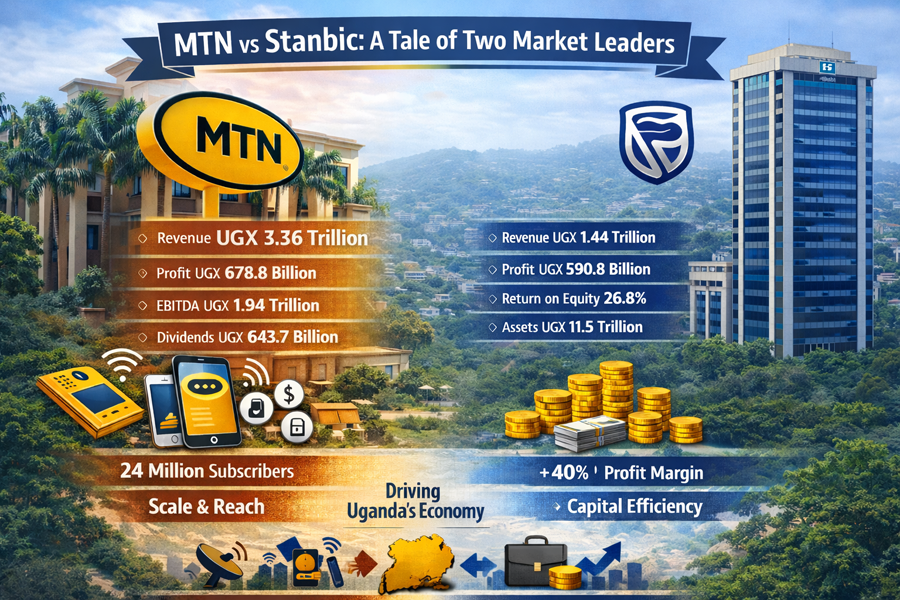
On the surface, MTN’s scale is immediately evident. The company reported revenues of UGX 3.6 trillion in 2025, more than double Stanbic’s UGX 1.44 trillion.
This reflects MTN’s mass-market model, serving over 24 million subscribers across voice, data, and mobile money services, and embedding itself deeply in everyday economic activity.
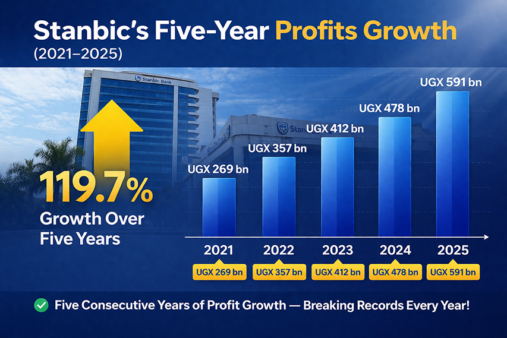
Stanbic, however, tells a different story. Despite its smaller revenue base, it delivered UGX 590.8 billion in profit after tax, not far behind MTN’s UGX 678.8 billion.
This highlights a key distinction: scale does not always translate proportionally into profit.
Profitability and efficiency
A closer look at margins reinforces this difference.
MTN recorded a profit margin of 18.8%, supported by strong EBITDA margins of 53.8%. Stanbic, on the other hand, converts a significantly higher share of its revenue into profit, with margins exceeding 40%.
This reflects the structural differences between the two models. MTN operates a capital-intensive infrastructure business that requires continuous investment in network expansion and technology.
Stanbic operates a financial intermediation model, where disciplined cost control and effective pricing of risk drive higher efficiency.
Returns and capital efficiency
Stanbic’s return on equity of 26.8% further underscores its ability to generate strong returns from shareholder capital.
While MTN generates higher absolute earnings, Stanbic demonstrates stronger efficiency in how capital is deployed. This is typical of mature, well-optimized banking institutions.
Balance sheet strength
Related
 Tax Justice, Trust & Nation-Building: A Conversation with Tax Appeals Tribunal's Crystal Kabajwara
The contrast becomes even clearer when looking at balance sheet size.
Stanbic reported total assets of UGX 11.5 trillion, more than double MTN’s UGX 5.36 trillion.
This reflects its role as a financial intermediary, mobilizing deposits and allocating capital across the economy, while MTN’s model is centered on infrastructure, connectivity, and digital platforms.
Cash generation and shareholder returns
MTN stands out for cash generation and dividends. The company generated EBITDA of UGX 1.94 trillion and paid total dividends of UGX 643.7 billion in 2025, compared to Stanbic’s UGX 360 billion.
This positions MTN as a strong income-generating stock, with consistent and substantial shareholder payouts.
Growth trends
In terms of momentum, Stanbic recorded stronger profit growth, with earnings rising by 23.6% year over year.
MTN’s reported profit growth was more modest at 5.8%, although adjusted figures excluding one-off tax impacts show stronger underlying performance.
This suggests that while both companies are growing, their trajectories are shaped by different operational and regulatory dynamics.
Two complementary engines of the economy
Rather than a competition, the comparison highlights two distinct but complementary models of corporate success.
MTN represents scale, broad, consumer-driven, and embedded in daily transactions across the economy.
Stanbic represents efficiency, capital-driven, disciplined, and focused on financial intermediation and economic expansion.
Together, they illustrate how value is created in different ways at the top end of Uganda’s corporate sector.
The bigger picture
What emerges is not a contest, but a broader insight into how Uganda’s economy functions.
MTN enables connectivity and digital transactions at scale. Stanbic mobilizes and allocates capital to drive growth.
Both are central to the country’s economic ecosystem, operating in different spaces but contributing to the same overarching story of expansion, inclusion, and value creation.