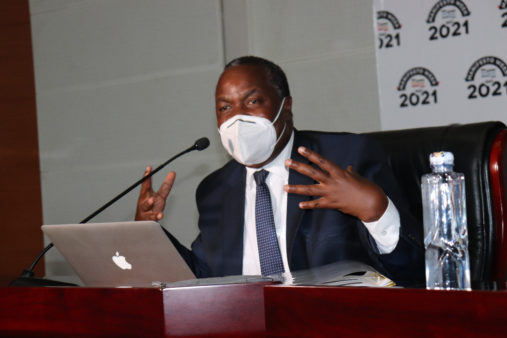
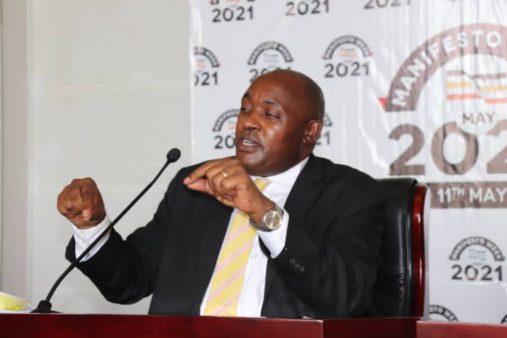
Prof. Ephraim Kamuntu the Minister of Justice and Constitutional Affairs has revealed that the judiciary has enhanced access to justice among the poor and marginalized through special court sessions in refugee camps.
In his presentation during the manifesto week on Wednesday 5th May, he stated that “so far, criminal mobile court sessions have been held in the following camps; Kyangwali – Hoima ; Rwamanja – Kamwenge, Bidi bidi – Koboko, Imvepi – Arua, Kiryandongo, Nakivale – insigiro, rhino camp – arua, omugo camp – arua.”
Expanded small claims procedure courts to all districts
The judiciary has rolled out small claims procedure (SCP) as a quick response to the resolution of commercial disputes below the subject matter of UGX10,000,000.
The judiciary does this with the view of improving access to justice to the Ugandan business community to unclog capital that is locked up in disputes and ultimately release that capital back into commerce and trade to facilitate overall economic growth for the country.
Using this procedure, at least UGX11 billion is released back into the economy annually.
Since its inception in 2011, SCP has been rolled out to 78 out of 82 of the targeted chief magistrates courts and 48 out of 398 of the gazetted magistrate grade one courts. Out of the established 135 districts, SCP has been rolled out to 107 districts.
The ministry has also increased the high court circuits from the current 13 to 20: the number of gazetted high court circuits increased from 13 to 20. Nakawa high court circuit was dissolved to create Mpigi and Mubende High Court circuits. In addition, more Circuits were carved out of the Mbarara, Jinja, Mbale, Masindi, and Gulu Circuits, which were too wide and diverse. This led to the realization of the Manifesto commitment of creating additional High Court Circuits in Mukono, Mpigi, Mubende, Iganga, Luwero, Hoima, Rukungiri, Moroto and Tororo. However, out of 20 gazetted High Circuits, only 14 are operational.

Appointment of more judicial officers and improvement on their conditions of Service:
The President appointed 18 Judges and Justices to both the High Court and the Appellate Courts. These included three (03) Justices of the Supreme Court, three (03) to the Court of Appeal/ Constitutional Court, and twelve (12) to the High Court. Eleven (11) of these came on a replacement basis, whereas seven (7) Judges were newly appointed.
Similarly, Parliament passed a resolution increasing the number of High Court Judges from 50 to 82. Since then, the High Court’s staffing levels now stands at 57, including the Principal Judge. This development is hoped to enhance adjudication of cases by providing more Resident High Court Judges, thus reducing the highly stressed workforce.
The Ministry has been under the Justice Law and Order Sector (JLOS) whose mandate is to: Administer justice, maintain law and order and promote the observance of human rights. The institutions that are allied to the Ministry for Policy guidance include:–
- Electoral Commission
- Uganda Law Reform Commission (ULRC)
- Uganda Human Rights Commission (UHRC)
- Law Development Centre (LDC)
- Uganda Registration Services Bureau (URSB)
- Office of the Director of Public Prosecutions (ODPP)
- Judicial Service Commission (JSC)
The justice ministry has also invested in technology to improve the efficiency of judicial officers:
Electronic Court Case Management Information System (ECCMIS) In September 2019, the Judiciary signed a Contract for the Design, Development, Deployment, and Maintenance of the Electronic Court Case Management Information System (ECCMIS).
The Design and Development of ECCMIS System is complete awaiting commissioning in May 2021 and is expected to be piloted in 18 Courts in FY 2021/22.
• The ECCMIS will be a fully-featured system that automates and tracks all aspects of a case life cycle from initial filing through disposition and appeal as to each individual party for any case type.
• The envisaged benefits of the ECCMIS include, amongst others, enabling e-filing of Court cases; reducing corruption by limiting person-to-person contact; reducing case backlog due to easy access to case information and details; facilitating litigants/public to access on-line information about their cases.
The Judiciary Performance Enhancement tool; a tool designed to adopt a 360-degrees evaluation approach was launched in January 2019 and is being piloted for full roll out/ coverage. The tool is expected to increase judicial officers’ performance levels, facilitate performance monitoring and evaluation, and to inform the Judiciary Reward Policy.
The evaluation tool is based on performance standards and measures pegged on accessibility, timeliness, staff quality and levels of integrity. It also employs a weighting system for each category of judicial work.
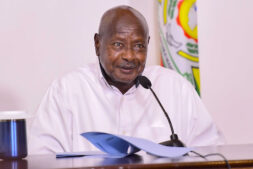 Could Museveni’s Election as EAC Chair Renew Push for Accelerated East African Integration?
Video Conferencing Facility;
The Judiciary has so far installed a total of 11 sets of Video Conferencing System. With this Video Conferencing System, Court cases can be handled remotely with Court and parties submitting on-line.
These sets have been installed in the following Courts; the Supreme Court, the Court of Appeal, the High Court at Kampala, Kitalya Mini Max Prison, and a temporary set in Kigo Women Prison. Two more Video Conferencing terminals have been created in Luzira Maximum Prison.
These have been in addition to the already installed sets at Buganda Road Chief Magistrates Court, Luzira Maximum Prison, and Luzira Female Prison.
The Video Conferencing System has been very vital in the handling of cases during the period of COVID-19 Pandemic; during which social distancing has had to be enforced. Additional sets have been installed in the High Court Circuits of Masaka, Masindi, Jinja, Arua, Gulu, and Mbarara.
With this Video Conferencing System, the Judiciary will enhance its capacity to handle cases online hence reduce case backlog.
However, a total of 14 High Court Divisions/Circuits remain uncovered with the Video Conferencing System plus all the Magistrates Courts save for Buganda Road Court.

In the year 2021, four sets of Court Recording and Transcription equipment are planned to be procured with the available funding.
With this system, the Judicial Officers will be able to free themselves from the vigorous long-hand writing in their courtrooms.
The long-hand writing has not only affected the case disposal rates leading to case backlog but has also disabled some Judicial Officers making them unable to write, and thereby occasioning them partial or permanent disability.
Build regional centres for the Court of Appeal:
Although construction of regional Court of Appeal Centers has not commenced, the Court has adopted the system of handling appeals from the different regions where they arise from.
The Court regularly holds sessions in the following circuits; Arua, Gulu, Masaka, Mbale, Fort Portal, Jinja and Mbarara.
Construction of appellate courts
The Government of Uganda is constructing the Supreme Court and Court of Appeal.
The storied twin tower building is expected to UGX 63.9 billion and is due for completion next year 2022.
This will afford the two appellate Courts a permanent home and save the government more than UGX6 billion per year which is currently being spent on rent for the two courts.