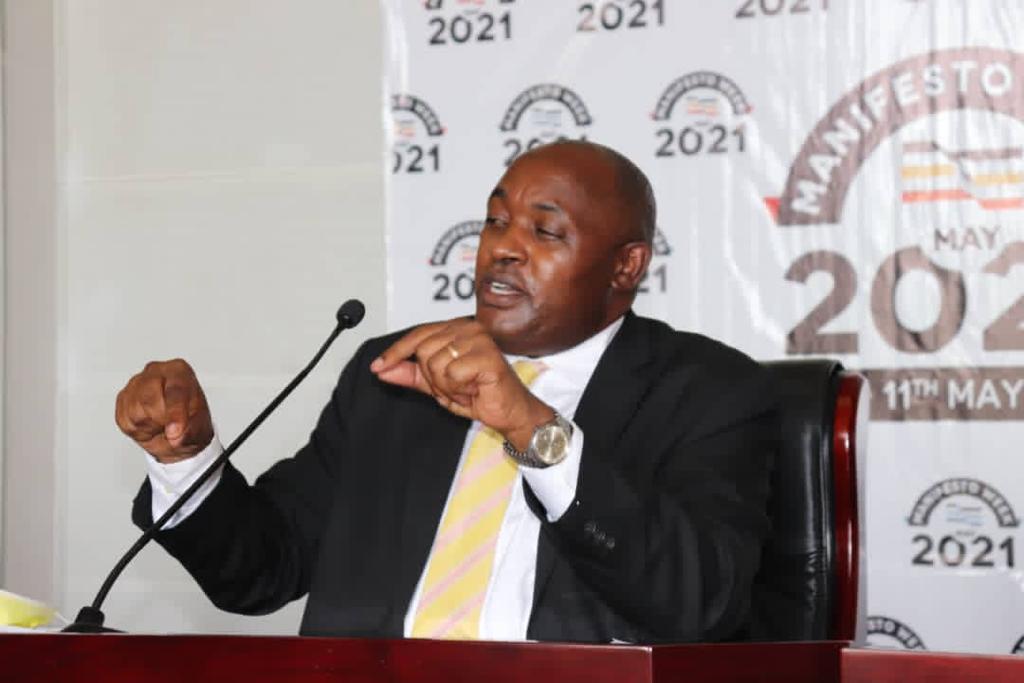
The Lands ministry on Friday presented its progress in implementing its manifesto commitments. Considering the importance of land in Uganda’s development plan, there is need to strengthen the country’s land tenure system. A cabinet presentation by Minister Chris Baryomunsi gave an account of what his ministry has achieved in the last 5 years.
A Commission of Inquiry into land matters was established, carried out investigations and a report is being prepared.
The Land Fund’s capitalization has also been increased from UGX42 billion in 2016 to UGX115billion in 2021. Part of the money of this fund has helped in resolving historical land injustices in Tooro, Buganda, Ankole and Bunyoro by buying land from absentee Landlords.
Over 236,000 acres have been procured using the Land Fund. This land will be allocated to bonafide and lawful occupants to regularize their land rights. The Ministry has acquired 33,036 acres of land from absentee landlords for redistribution to lawful and bonafide occupants. This is in addition to the stock of 236,036 acres of land that had been acquired.

The Ministry of Land, Housing and Urban Development says it has been working tirelessly to create an enabling environment for all citizens to maximise their constitutional rights to land ownership and utilization.
During the outgoing manifesto period, 2016 -2021 the lands ministry decentralized the registration of land 22 Ministry Zonal Offices (MZOs) have been established Country wide to take land services closer to the people. These MZOs are facilitating the creation of an efficient and effective land administration system. Some of these MZOs are located in the following districts; Kampala (KCCA), Mukono, Masaka, Mityana, Luwero, Mpigi, Wakiso (Wakiso-Busiro and Wakiso-Kyadondo), Jinja, Mbale, Lira, Tororo, Moroto and Soroti to name a few.
“MZOs are fully operational and functional and provide the same services as those provided at the Ministry headquarters in Kampala. The MZOs have tremendously reduced on the distance, time and cost of doing business whilst carrying out land transactions,” said Dr. Chris Baryomunsi, the State Minister for Housing, said while presenting the achievements of the Ministry of Land, Housing and Urban Development during the NRM Manifesto Week 2021.
He also revealed that all freehold, leasehold and Mailo titles have been digitalized and entered into the Land Information System (LIS). Certificates of Customary Ownership (CCOs) have also been digitalized. This is aimed at minimizing fraud and double titling which has been a major concern in recent years.
The Lands Ministry also built a Records and Archival Centre at Entebbe, for the safe custody of all land records and a National Land Information Centre are fully operational to support the development and implementation of the Land Information System (LIS). Working with Uganda Registration Services Bureau (URSB), the Ministry of Land established a one stop centre where search letters are issued in less than 2 hours.
The lands Ministry Finalized the development of the National Land Acquisition, Resettlement and Rehabilitation Policy which addresses key issues relating to land acquisition, resettlement and rehabilitation of Project Affected Persons (PAPs).

Also concluded is stakeholder consultations on the draft Land Acquisition Bill, 2019, the Bill seeks to repeal the current Land Acquisition Act, Cap 226 and make the acquisition of land for Government infrastructure projects expeditious.
“This is aimed at speeding up development and avoid delays that are caused by project affected persons that demand for unreasonable compensation,” said Dr Baryomunsi.
 Could Museveni’s Election as EAC Chair Renew Push for Accelerated East African Integration?
The ministry has also drafted the Uganda Land Commission Bill which is due for presentation to Cabinet for consideration and approval and thereafter will be submitted for debate and enactment.
In an effort to enhance security of land ownership, the occupants of communal land are being issued with Communal Certificates of ownership which are a big a relief to land owners. So far the ministry has incorporated a total of 606 Communal Land Associations (CLAs) as legal entities in order to be able to register their customary land in the districts of Kaabong, Kotido, Moroto, Napak, Amudat, Kakumiro, Masindi, Kikuube, Buliisa, Agago, Pader, Nwoya, Mubende, and Kayunga.
Under the law, only legal entities can hold and own customary land. The total number of customary landowners registered under CLAs is 3,602,321. Dr. Baryomunsi revealed that: “over 20,000 Certificates of Customary Ownership (CCOs) have been issued to customary landowners in Kasese, Nwoya, Pader, Soroti, Katakwi, Butaleja, Adjumani and Kabale districts,” said the minister.
A Dispute Resolution Desk has been established in the Ministry which handles dispute related to land matters in a bid to strengthen institutions and mechanisms for land dispute resolution and mediation.
The lands ministry also issued eviction guidelines during the COVID-19 induced lockdown to protect occupants from illegal land evictions as a means of protecting people and their properties.
Some of the challenges that have affected the ministry in implementing the manifesto commitments include; encroachment on government land, the high cost of mortgage financing as many commercial banks lend at high-interest rates, slums among others. In a quest to curb the growing number of slums, the Ugandan Government is working on a master plan for new cities to avoid the increasing number of slums within the country.
All the approved District Land Boards (DLBs) in the country have completed training. During this period, the ministry collaborated with JLOS institutions and other stakeholders in addressing issues related to access to justice, alternative dispute resolution and support to the reduction of land-related case backlog.
More than 300 land titles were processed and issued to bonafide and lawful occupants in Kibaale and an excess of 300 land titles issued to tenants in Nakaseke district. This followed the regularization of the land rights of lawful and bonafide tenants in Kibaale (Bunyoro region) and Nakasongola and Nakaseke (Buganda region).
The Ministry in collaboration with GIZ (RELAPU), has carried out sensitization and mapping of tenants on mailo land in Mityana, Mubende and Kassanda in the subcounties of Bulera (8,963), Kikandwa (1,545), Bukuya (6,034), Kiyuni (3,579), Kakindu (1,010), Maanyi (5,750), Kiganda (4,311), Kasambya (1,900) , Myanzi (4,734), Kigando (5,936), Nabingoola (5,686), Malangala (906).
Consequently, the debut batch of Certificates of Occupancy for bibanja owners on Mailo land for 200 households are ready for issuance in Myanzi subcounty in Kassanda.