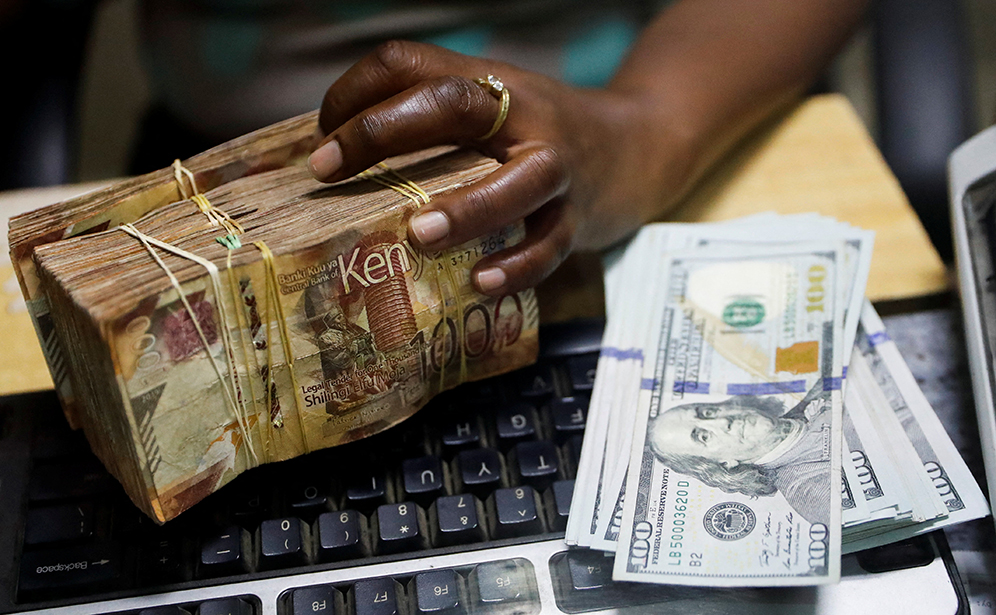
Kenya’s financial markets displayed a mix of resilience and caution during the week ending March 12, with the Kenya Shilling holding steady against major currencies.
Remittances continued to rise, and equities posted gains even as bond market activity slowed, according to the Central Bank of Kenya’s latest Weekly Bulletin released on March 13.
The report paints a picture of a relatively stable monetary environment supported by strong foreign exchange reserves and continued inflows from Kenyans abroad, even as global geopolitical tensions and volatile oil prices continue to cast uncertainty over the broader economic outlook.
The shilling remains stable
The Kenya Shilling remained largely stable against major international and regional currencies during the review period, underscoring the effectiveness of the Central Bank of Kenya’s ongoing monetary management efforts.
By March 12, the currency was trading at KSh129.3 per dollar, only marginally weaker than the KSh129.2 recorded on March 5, suggesting minimal pressure on the local currency despite ongoing global volatility.
The stability of the shilling has been partly supported by Kenya’s healthy level of foreign exchange reserves and sustained inflows of remittances, which continue to bolster the country’s balance of payments position.
Strong foreign exchange buffer
Kenya’s foreign exchange reserves remain comfortably above statutory thresholds, providing a critical buffer against external shocks.
As of March 12, the Central Bank reported foreign exchange reserves of $14.46 billion, equivalent to 6.2 months of import cover.
This level remains significantly above the statutory minimum requirement of four months, giving policymakers adequate room to intervene in currency markets if needed and maintain macroeconomic stability.
Strong reserve levels also provide reassurance to investors and international markets regarding Kenya’s capacity to manage external obligations and potential volatility in capital flows.
Remittances continue to power the economy
Diaspora remittances once again emerged as a major pillar supporting Kenya’s external accounts.
In February, Kenyans abroad sent home $412.7 million, representing an 8% increase from $382.2 million recorded in February 2025.
Over the past 12 months, remittances have reached $5.05 billion, up from $4.96 billion in the previous comparable period.
These inflows remain one of Kenya’s most stable sources of foreign exchange earnings, helping to cushion the economy against fluctuations in exports, tourism revenues, and foreign investment.
Beyond macroeconomic stability, remittances continue to support household consumption, small business investment, and real estate development across the country.
Liquidity remains strong in the money market
The domestic money market remained liquid throughout the week, reflecting ample liquidity in the banking sector and active Central Bank monetary operations.
Commercial banks maintained excess reserves averaging KSh37.8 billion above the required Cash Reserve Ratio of 3.25%.
At the same time, the Kenya Shilling Overnight Interbank Average Rate declined slightly to 8.66%, down from 8.72% the previous week.
Interbank activity also increased, signaling stronger short-term lending between banks.
The average number of transactions rose to 21, compared with 15 in the previous week, while the average value traded climbed to KSh12.2 billion from KSh8.8 billion.
These developments suggest a banking sector operating with sufficient liquidity and confidence.
Strong demand for government securities
Kenyan government securities continued to attract strong investor demand. During the Treasury bill auction on March 12, investors submitted bids totaling KSh43.7 billion, nearly double the KSh24 billion government had offered.
 After 29 Years in Court, Government Ordered to Pay UGX 512.9 Million in Kamuli Land Dispute
This represents an auction performance of 182.3%, highlighting strong investor appetite for safe, fixed-income assets.
Interest rates displayed mixed movements. Rates on 91-day and 364-day Treasury bills declined, while rates on the 182-day Treasury bill increased slightly.
Meanwhile, longer-term government debt also saw significant investor interest.
In the Treasury bond auction held on March 11, the reopened 20-year and 25-year bonds attracted bids worth KSh117.4 billion, against an advertised amount of KSh60 billion.
The resulting 195.7% performance underscores sustained demand for long-dated government securities, particularly from institutional investors such as pension funds and insurance firms.
Equity market gains momentum
Kenya’s equity market delivered a strong performance during the week.
At the Nairobi Securities Exchange (NSE): The NASI index rose by 1.63%, the NSE 25 index by 2.31% and the NSE 20 index by 2.28%.
Market capitalization also jumped 6.7%, driven largely by the initial public offering (IPO) of Kenya Pipeline shares, which boosted investor activity.
Trading volumes improved as well. Total shares traded rose by 10.19%, while equity turnover surged by 38.41%, indicating stronger investor participation.
These developments suggest growing investor optimism within the equities market despite broader global economic uncertainties.
Bond market activity slows
In contrast to equities, activity in the domestic secondary bond market softened during the week. Bond turnover declined by 11.47%, suggesting reduced trading volumes among investors already holding government securities.
However, the bulletin also highlighted movements in Kenya’s international bond yields. In global markets, yields on Kenya’s Eurobonds increased by an average of 33.37 basis points, indicating slightly higher perceived risk among international investors.
Eurobond yields for Côte d’Ivoire also rose, while those for Angola declined, reflecting varying investor sentiment across African sovereign debt markets.
Global pressures continue
Globally, inflation concerns remain a key focus for policymakers and investors. The United States’ headline inflation rate remained steady at 2.4% in February, unchanged from January, while core inflation also held at 2.5%.
Meanwhile, geopolitical tensions, particularly the ongoing conflict in the Middle East, continued to influence global financial markets.
The US Dollar Index strengthened by 0.4% during the week as investors sought safe-haven assets amid uncertainty. Energy markets also experienced significant volatility.
International oil prices surged sharply, with Murban crude oil rising to $92.13 per barrel on March 12, up from $76.25 per barrel on March 5.
Higher oil prices could exert inflationary pressure on oil-importing economies such as Kenya if sustained over a longer period.
Outlook: stability with external risks
Overall, the Central Bank’s weekly bulletin suggests Kenya’s domestic financial system remains stable and well supported by strong liquidity, healthy reserves, and steady remittance inflows.
However, the global environment remains uncertain.
Rising oil prices, geopolitical tensions, and fluctuations in global capital markets could still influence Kenya’s currency stability, inflation outlook, and external financing conditions in the coming months.
For now, Kenya’s monetary authorities appear to have adequate buffers in place to manage these risks while maintaining macroeconomic stability.