He speaks candidly about the evolution of Uganda’s legal profession—its need for mentorship, specialisation, and ethical renewal—while making a compelling case for policy-driven innovation, carbon trading, and collaboration across Africa’s legal and trade systems. As a thought leader and mentor, Kenneth embodies a new model of transformational leadership in the legal profession, one grounded in service, adaptability, and the courage to challenge convention.
Beyond the legal profession, Kenneth reveals a deeply personal side: his faith-driven philosophy, love for hiking and mindfulness, and a firm belief that true success lies in impact, not income.
This is the story of a lawyer redefining practice for the Fourth Industrial Revolution, merging intellect with empathy, and leading a new generation of jurists into the digital age. The CEO East Africa Magazine’s, Dennis Asiimwe, tracked down the man who is the face of the next generation of the legal sector’s leaders for a conversation that dug deep.
Can you tell us about your early childhood? Where were you born and raised? And what are your earliest memories growing up? What’s bred in the bone, so to speak?
I was born in Mbarara, but I was raised in Masaka, for most of my early childhood, after which I came to Kampala.
My earliest memories were warm and fuzzy – we used to have a lot of family gatherings. When we moved to our first house in Kampala…it was an unfinished house, we didn’t have water, and there were so many mosquitoes at the time…it’s a core memory for me because we would sit with a tadoba playing with shadows on the wall, telling stories. I think of those days as some of the happiest of my life. I think that was the closest that we have ever been as a family. That all changed when we eventually got electricity in the house, of course. We are still close, though (laughter). That is something that stays with me, the stories that we would have.
What kind of family environment did you grow up in? And were there strong influences from your parents or extended family regarding education or career aspirations?
I would say it has been mixed. My father was a disciplinarian and very focused on his role as a provider. My father practised law for a long time (he went through the ranks, from Magistrate and retired as a Principal Judge), and because of his influence, we were told to study professional courses. I actually wanted to study journalism – I love reading and I love writing. At some level, I also wanted to teach, so that has always been an aspiration of mine. In school, anyone who knew me knew to hunt for me in the library if they were looking for me, where I could be found reading novels.
My mother heavily influenced my career, too. She insisted on Namilyango College. She was a literature teacher and interested me in reading and in English generally. She was a dedicated career woman, and I learnt about the importance of consistency. She worked at the Bank of Uganda for 30 to 40 years and only retired recently. She showed me the importance of forging a career. She also did her masters later on in her life, and I saw how she balanced raising us and studying. She is a powerful woman. She encouraged me to have values in my work and to remain steadfast.
At one point, I also wanted to be a pilot – I was fascinated by planes and the idea of flying.
I was held back from some of these aspirations because I sucked at math. When I finished school, I was encouraged by my father to study law at university. It was easy to go in that direction because I always wanted to influence the society I lived in, especially with regards to instances of injustice, and felt as a Lawyer I might have the tools to do that.
What values did your family or community instil in you that you still carry today?
Love. The negative emotions are easy to access, but love is something you need to strive for. I grew up surrounded by love, and this was embedded in me. You have to be intentional about it and cultivate it.
Walk us through your education journey.
I moved around a lot during my primary school because my father worked as a judicial officer. My first school in Kampala was Rubaga Boys (in Masaka, I don’t remember the schools that I went to), then Jack and Jill (a school in Kabalagala), and then to Shimoni. Eventually, I ended up in Greenhill, which, you can imagine, was something of a culture shock. I got jumpy about the simplest of things – I had big glasses, had clunky shoes, and often felt awkward. And I was overweight. It was a great school for my academics, though.
With secondary, I talked over with my closest friend which schools we wanted to go to, and I remember thinking I wanted to avoid Budo, because the school just sounded like it was a bit much, like expectations were extreme. Then my mum consulted with a couple of teachers, and we chose Namilyango College.

And that’s where I ended up. It too was a culture shock of sorts. It was academically stringent, with sporadic tests, and I am the kind of person who thrives within structure and schedules. I was a prefect in Senior One, but I struggled academically, coming third from last at one point. The sporadic nature of the tests and the prefectural duties were just not letting me thrive.
At the end of the academic year for Senior One, the school offered me two options: I could repeat a class, or I could find another school to go to, to continue my education. My parents got me into Ntare School.
It was an easy decision, and I switched and loved the school. It had structure, but it also had extracurricular activity and felt like a more rounded educational experience for me. There was autonomy to a major extent in how you managed your time. This was the era of Mr. Kamuhanda…
Oh, he was formerly a Deputy Headmaster at King’s College Budo…
Yes, and we benefited from his reign as actual Headmaster. He was an excellent educator. From Ntare, I went to Makerere College School, where I lasted one term and then ended up at Ntinda View, where I finally settled. That was another cultural shock, because of the transition from traditional schools to private schools, but by this point, I was able to take stock of my situation. I didn’t move schools again until I went to Uganda Christian University.
I had the option to study IT at Makerere University, but I wanted to study law and took the opportunity to do so at UCU. It was one of the best decisions of my life – I really enjoyed my time at UCU. I was focused. After law school, I went on to do my master’s, which was in International Commercial Trade, with a bias towards intellectual property.
Tell us about your earliest experiences entering the legal profession.
My first experience would be my internship at Rukutana and Company Advocates.
A lot of lawyers in Kampala went through that firm.
They were heavily litigation-based. I then joined Kiwanuka Karugire and Company Advocates, where I was heavily mentored by Peter Kauma and Thomas Ochaya, who is now a judge.
What was it like practising law in Uganda back then? When you first entered chambers?
That would be about 15 years ago. The practice of law has evolved since then because of technology. But we still have the same major areas, being dispute resolution and commercial transactions. But back then, it was summarised by very little money and very much work. I also feel like we had more pride in our profession. We had more ideals back then. We still had a case backlog, and we still had the divide between big law firms and small law firms that exists today. We were also fewer back then, of course.
Did you have a mentor or senior lawyer who particularly influenced your early career development?
I sought out mentors to understand how they adjudicated over cases…judges like Egonda Ntende…
Are you allowed to do that? Because it would make a lot of practical sense…
To do that?
Yes. So people like the late Justice George Kayinehamba, retired Justice Bart Katureebe, Justice Ochaya, Peter Kawuma, individuals of that nature. I can’t say I had an individual or specific mentor that shaped my process, someone monitoring my career, offering measured advice. I might be better developed as a lawyer within my profession if this were the case, better finessed.
Is mentorship the fastest way to grow the next generation of competent lawyers?
 Deal Makers: Meet Deloitte Advisors Behind Absa’s Acquisition of StanChart’s Wealth and Retail Business in Uganda
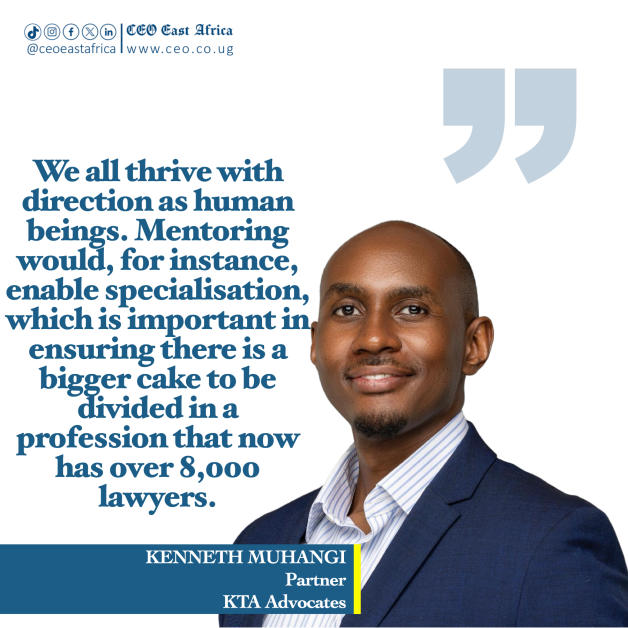
Absolutely. Without guidance, you will make more mistakes, and sometimes they are mistakes you cannot come back from. We thrive with direction as human beings. Mentoring would, for instance, enable specialisation, which is important in ensuring there is a bigger cake to be divided in a profession that now has over 8,000 lawyers (and growing). There are different things you don’t learn in school, like how to bill, how to prepare a letter of engagement, and these are things you learn through mentorship. Mentorship, good and intentional, gives a young lawyer the ability to learn, broaden their perspectives and make fewer mistakes.
Looking back, what principles guided KTA as a law firm that has endured and grown?
Pragmatism and adaptability. We are pioneers in the tech sector, we are pioneers in sustainability, and we have established revolutionary ways in harnessing intellectual property. We examine the marketplace and the global economy. We are part of a network that is in 110 countries, and we tap into that for guidance on the legal landscape. We examine areas that often remain untapped, like policy, where a legal environment is pertinent. Business requires an enabling policy environment, and this is an area we are active in. We are innovative about how we practice, and we are intentional about our brand.
Which practice area(s) are you most passionate about? Why?
Intellectual property is very close to my heart, especially from a policy perspective. Technology is also an area I am passionate about. Developed countries have high Intellectual Property registrations –they incentivise the population. The National Association of Traditional Herbalists were unable to get patents for their products here because of a law giving the National Drug Authority jurisdiction in that regard, and instead registered them in the United States. Who benefits in that regard? The United States, of course.
Sustainability has also piqued my interest. Carbon credits are an innovative way to influence climate change.
Are there particular landmark cases or transactions you look back on that were particularly defining?
I would say in terms of Intellectual Property, it was the case of Winnie Assege VS Opportunity Bank. It was the first case to determine Image Rights in Uganda. It also won us Intellectual Property Africa Law Firm of the Year at the Africa Legal Awards in 2019. Another case was when the internet service providers formed an association and were responding to license fees being spiked exorbitantly, I think it was by about 300%! We took this issue to court, and the matter was settled successfully. That’s a case I am also really proud of.
How would you describe the practice of law in Uganda when you started, versus today?
Legal Education is still pretty theoretical. Most of the things I have learnt, I learnt in practice. It is why experience trumps everything. I think it would be more practical if it were spread out over a few years. I also think it is much better if you have lecturers who are in practice.
With regard to changes in commercial and corporate practice, it was previously seen as one area bundled up together. Today, we are moving towards specialisation. People will specialise in taxation law, in oil and gas, in project work, in technology, sustainability, intellectual law, that sort of thing. And I think it has helped improve the quality of legal services provided. And that has been a noticeable change from when I started.
As for regulation and ethics, I feel ethics is somewhat downhill. Regulation is more from the perspective of who complains. Uganda Law Society has become a behemoth of dissent. Its primary role is to advance the interests of its members. It should be looking out for lawyers, ensuring they are not simply surviving but also thriving. How to grow their practices, how to skill them in terms of legal education and advancing their careers, which bar associations can we benchmark against?
It is now about politics and camps, and within that environment, advancing the interests of the members becomes impossible. It needs to act as a collective.
If you had the power to reform any aspect of the Ugandan legal system, which aspect would you target?
The judiciary. I think politics has seeped into every facet of our lives. I don’t think anyone would complain about things in the judiciary if things were managed on a timely basis, efficiently. If you knew that if you filed a matter, it would be heard and disposed of in a particular period of time. If I went to court, the judge would hear me at this particular time. If we had innovations, like the way depositions work in the U.S legal system, where you don’t have to go to court to hear testimony, and testimony can instead be heard in chambers? This would definitely help reduce the backlog which results from hearings in court.

I would also target the Uganda Law Society. It is an association of custodians of the law. We have gone away from our mandate, which is the interests of lawyers. We are now focused on personal battles and fighting the government. We are more focused on governance issues and have gone away from issues that affect the bar itself.
You have served in significant leadership roles. What lessons have you learned about leadership across different contexts (law, public service, traditional institutions)?
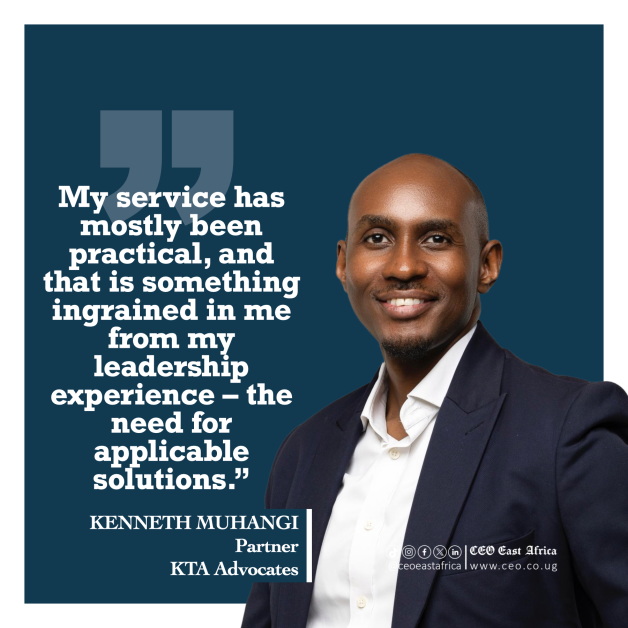
My service has been at my bar. I have served as a Young Lawyers’ Representative (when I was a younger lawyer). I have served as the Chair of the ICT Cluster. I have served on the East African Law Society as the Chair of the Media and Communications Committee. I have been a teacher and trained within the judiciary. My service has mostly been practical, and that is something ingrained in me from my leadership experience – the need for applicable solutions.
How do you personally define ‘success’ at this stage of your life?
Impact. How do I impact my community? How do I impact my friends, my family…money is fleeting. It is probably this that makes me more intentional about teaching.
How do you maintain work-life balance in such a demanding profession? Are there hobbies, passions, or causes outside law that are close to your heart?
I practice mindfulness meditation. I love hiking – it helps me access communities I have never been a part of. I have met communities that still practice smelting. I am very faith-oriented; I am a Christian, so I am more interested in teaching other people how to live a faith-based life. I also serve in the church. I am a bit of a TV-head, and love the cinema as well.
What are your thoughts on the importance of aligning Uganda’s legal frameworks with regional and international trade frameworks?
We are a landlocked country – let’s start there. How can we do anything without talking to our neighbours? I am big on associations, and I believe we need to form associations because without the collective, it is difficult to wield influence, to advance. I feel trade policy is effective only with collaboration across the region. I am a proponent of the African Continental Free Trade Area, and I am a proponent of the East African Federation.
In what practical ways can legal aid be made more accessible and affordable?
Money. We need to put money into the legal aid process. I often want to put this to the leadership at Uganda Law Society: where does the money from the 8,000-strong membership contributions go? We used to have a Legal Aid program, bro bono days within the ULS membership. We had Legal Aid programs, and these have all failed. I think this is something we need to think about, how we give back to our communities. Legal Aid is not just about litigation. We can do it by offering Civic Education, we can teach market women and innovators in Katwe about intellectual property, trademarks and registering patents for their inventions, things of that nature. I definitely want to see more legal aid, and I think it is something we need to speak about as lawyers.
Can technology play a role in this? For instance, through legal information portals, mobile clinics, and pro bono networks?
100%. The question on all our lips is Artificial Intelligence and how it impacts us. We need to examine this from a question of policy. As a law firm owner, do I ignore a young lawyer now that I can simply use AI to draft it? How will young lawyers develop then, because that sort of work is part of the mentoring process? So we need to examine the sustainability of the process while incorporating AI within the various sectors, including the legal sector. Or using chatbots to assist with the process of Legal Aid, which would actually be a practical solution, or even for the preparation of simple, basic documents. We complain about case backlog, but these are areas where technology can help us – we can video conference for testimonies or use the deposition process as used in some jurisdictions like the United States. We have seen the progress in the legal sector with ECMIS, which allows the filing of documents electronically and how much it has impacted the sector. Technology can advance legal practice, but we have to be guided in this regard.
What are some of the opportunities and challenges in regulating digital finance, e-commerce, and cross-border transactions? What do you think of the view that the legal fraternity must be proactive in shaping policies for data protection and cybersecurity?
The practicality of it – regulation can sometimes be a stumbling block to innovation, and also makes it so that only foreign players can come in and be able to invest, pay for the license and set up payment platforms. Our licensing frameworks are pricey. In the telecom space, it is not possible for everyone to afford ROKE Telecom or even the MTN or AIRTEL, and the option here would be Community Service Providers, but the legal framework puts them through too many hoops for this option to develop and emerge.
Finally, what message do you have for Uganda’s business community about the importance of sound legal practice and governance in national development?
Collaboration and association are vital for advancement. Most industries that have thrived have done so through collaboration and association. The banking sector is an excellent example, as are associations like KACITA. Uganda Law Society, before it turned into a political behemoth, was an excellent example of a potent association that wielded considerable influence through association and collaboration.