
By The CEO Magazine team
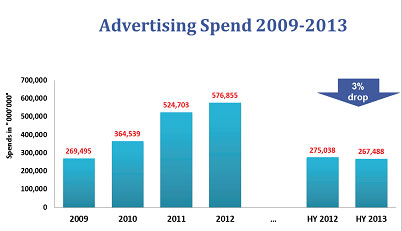
• Growth slows down from 44% in 2011 to 10% in 2012
• Half year figures show a 3% negative growth between HY 2012 and HY 2013
The advertising industry has been one of the fastest growing sectors in the economy, often growing several points above the national growth rates. But now for the first time in a long time, the industry has shown negative growth, triggering off fears that the traditional advertising as we know it is beginning to change, especially as the digital/online revolution begins to shake down traditional media.
According to figures available from research house Ipsos- shows that between 2011 and 2012 advertising grew by only 10 % from
Ushs524.7bn to ushs576.8bn, a 34 % drop in growth compared to 2011 when advertising grew by 44 % from Ushs364.5bn in 2010 to
Ushs524.7 bn.
Between 2007 and 2008, advertising grew by 47.5 % from Ushs149.4bn to Ushs220.5bn and between 2008 and 2009, advertising slowed down- precipitated by the financial crisis of 2008, growing by only 22.2 % from Ushs220.5bn to ushs269.5bn in 2009. The following year, the industry picked up, registering growth of 35.2 from Ushs269.5bn to Ushs364.5bn and between 2010 and 2011, advertising picked up another 11 %age points, growing by 44 % from Ushs264.5bn to Ushs524.7 bn.
However, for the first time in 7 years, the industry registered single digit growth precisely 9.9 % from Ushs524.7bn to Ushs576.8 bn. If the half year 2013 figures are to go by, all indicators are that there will be a slowdown, yet again, with a possibility of contraction into the negatives by year’s end. According to provisional HY2013 results from Ipsos, advertising spend declined by 3 % compared to the same period last year, dropping from Ushs275bn in the first 6 months of 2012 to Ushs267.5bn in the first 6 months of 2013- a 3% drop.
Move over traditional Advertising, here comes Digital
 Ruparelia Group Wins Key Entebbe Land Case, Clearing Path for the New Mega Speke Resort and Convention Centre, Entebbe
The tough economy aside, traditional advertising is facing a shakedown from Digital Advertising and Social Media where for as little as Ushs100, 000, one can carry out a targeted advertising campaign on any of the many online advertising platforms such as Google and Facebook.
Today, almost every company worth its name has an array of social media platforms such as twitter and Facebook that they use to communicate directly to their fans and some companies such as MTN have taken it a notch higher to migrate significant portions of customer care to social media.
Although digital media is not likely to substitute traditional advertising in the near future, it is evident to note that for once, traditional advertising has a very serious competitor in the name of social media.
Social media, according to experts is almost real time and allows everyone to self-publish, taking away much of the power and influence from media owners and placing it in the hands of everyone. The reduction in traditional media influence has also come along with a reduction in media budget allocations.
However, Robert Kabushenga, Vision Group CEO, believes that whereas social and digital media are growing in influence, this does not mean an end to traditional media. He believes the rise of social and digital media is yet another phase in the evolution of media similar to the rise of radio and TV to complement traditional print media.
“If you think digital media will replace traditional media, you need to think twice. You need to ask Amazon’s Jeff Bezos why he bought the Washington Post. He must know something that we don’t know,

Comments are closed.