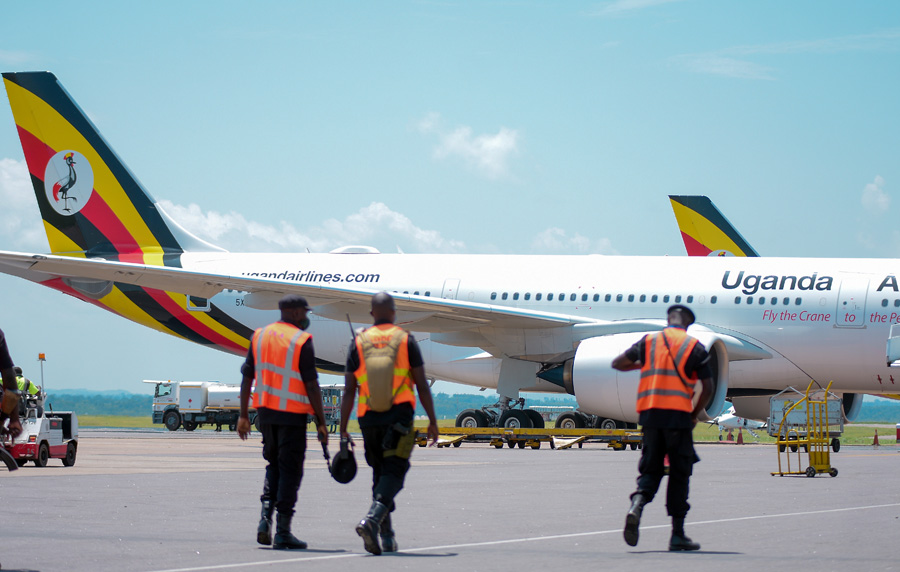
An internal brief prepared for the new consulting cum interim chief executive officer, Girma Wake, shows that Uganda Airlines is currently operating only five aircraft against a required schedule of eight.
The brief, which details the status of the airline’s fleet, indicates that three of its six owned aircraft were declared unserviceable, which has left the national carrier to function well below planned capacity.
Three Aircraft Grounded
The brief shows that of the six aircraft owned by Uganda Airlines, three are grounded and classified as requiring immediate maintenance, while one additional aircraft currently in operation is under an Aircraft, Crew, Maintenance, and Insurance (ACMI) arrangement.
The first disruption dates back to November 28, 2025, when a CRJ900 regional jet was grounded.
The aircraft, the brief notes, requires critical spare parts and a complete engine change.
It is listed as unavailable, with major maintenance marked as immediate. Its operational status is described as “out of days,” meaning it cannot legally operate until repairs are completed.
The situation worsened on January 11, 2026, when one of the airline’s two Airbus A330-800neo wide-body aircraft, which is Uganda Airlines’ primary long-haul aircraft used for intercontinental routes, including London and Mumbai, was taken out of service.
The brief notes that the aircraft cannot return to service until outstanding obligations with Rolls-Royce, the engine manufacturer, are cleared.
Even after settlement, scheduled for February 20 (Friday), the aircraft is expected to wait between 12 and 14 weeks to secure a spare engine.
Another setback occurred on Thursday (February 19), when the second Airbus A330-800neo was grounded following a borescope engine inspection. A borescope inspection involves inserting a camera probe into the engine to examine internal components for damage without dismantling it.
Engineers discovered cracks on engine blades that require repair before the aircraft can safely resume operations.
The inspection had been recommended by South African Airways Technical engineers ahead of a scheduled February 22 service, which included a London flight.
Remaining operational fleet
According to the brief, the internal fleet table shows that only three CRJ900 aircraft, registrations, remain fully available, with two of these due for major maintenance in June 2026 and May 2027, respectively.
The grounded CRJ900 and both A330 aircraft are all marked as requiring immediate attention.
For an airline with a total owned fleet of six aircraft, grounding three simultaneously represents a 50% reduction in owned capacity.
Operating only five aircraft against a required eight creates a significant operational gap and increases reliance on leased capacity.
Urgent leasing needs
 Nicholas Mukasa Appointed Bank of Namibia Deputy Governor
To stabilize operations and restore its schedule, the brief suggests that Uganda Airlines urgently needs to lease at least one mid-range narrow-body aircraft, such as an Airbus A220, A320-family aircraft, A321 long-range variant, or Boeing 737, as well as one wide-body aircraft from the Airbus A330 or Boeing 787 family.
Short-notice leasing arrangements, particularly for wide-body aircraft, typically come at premium rates and could further increase operating costs.
With both wide-body aircraft grounded, nearly the airline’s entire long-haul fleet has effectively been removed from service, except for Dubai.
On Friday, Uganda Airlines confirmed temporary disruptions to long-haul services due to unscheduled maintenance, which impacted its London and Mumbai routes.
The Dubai route has continued operating using an Airbus A320-200 under a short-term wet lease with Lithuanian carrier DAT.
A wet lease, similar to an ACMI arrangement, involves renting an aircraft together with crew, maintenance, and insurance.
However, Uganda Airlines said passengers who had been affected by schedule changes had been contacted and offered rebooking options without additional change fees.
Leadership shake-up
The fleet disruptions come amid a leadership shake-up ordered by President Museveni.
In a February 13, 2026, letter to Works Minister Katumba Wamala, the President cited leadership and management weaknesses and directed that former Ethiopian Airlines Chief Executive Officer Girma Wake be appointed to oversee reforms.
Wake has been brought in as consultant and advisor and is serving as acting chief executive officer until July 2026, when Uganda Airlines is expected to appoint a substantive chief executive.
Financial pressures
The operational challenges also come against a backdrop of financial strain.
The Auditor General’s report for the 2024/25 financial year indicates that Uganda National Airlines Company Limited, which operates the national carrier, recorded a net loss of UGX 230 billion, a slight improvement from UGX 231.5 billion.
While revenue rose by 19.2%, returns from recently launched long-haul routes, including London, have yet to mature fully.
The audit also highlighted rising trade payables, unrecovered lease deposits, irregularities in fuel procurement, and gaps in governance compliance.
We could not immediately get a comment from Shakilah Rahim Lamar, Uganda Airlines’ corporate affairs and public relations manager, on the latest internal fleet status. She had not responded to our inquiries by press time.